Key Highlights
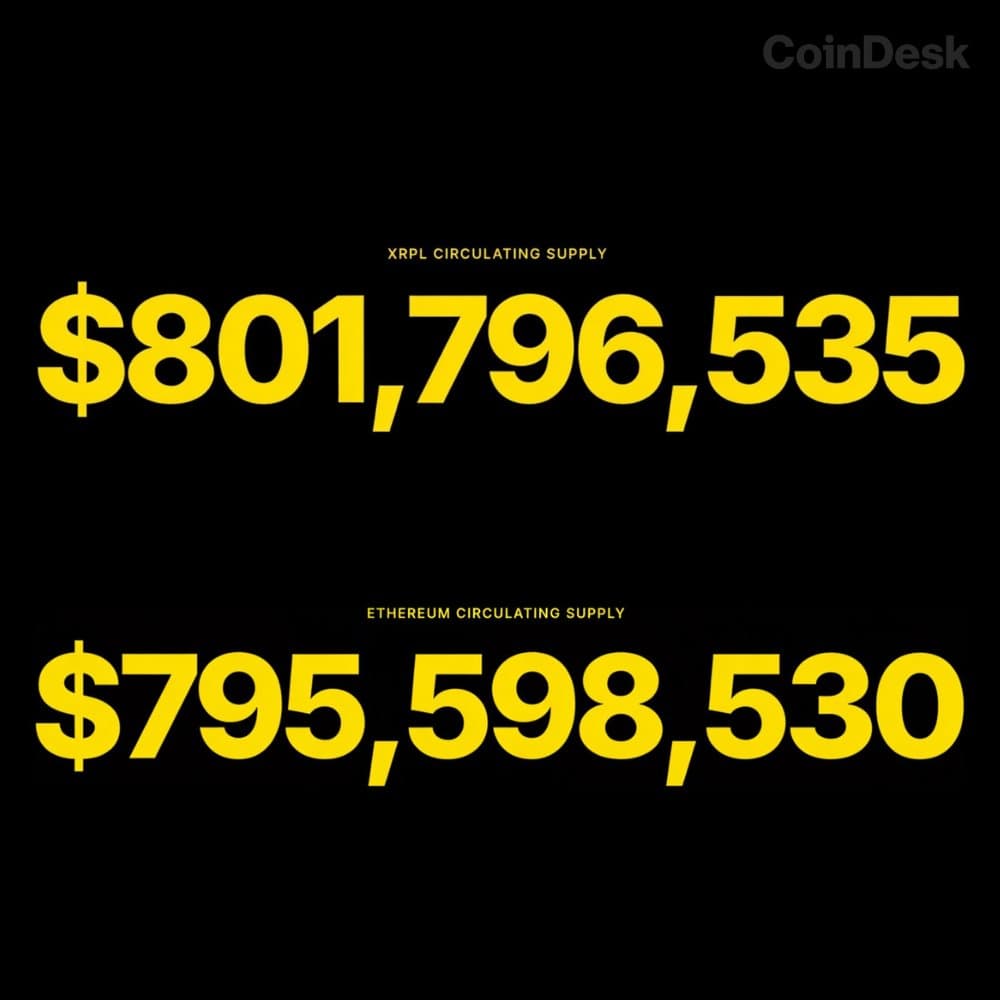
- XRP Ledger now hosts approximately $801 million in RLUSD stablecoin.
- Ethereum's RLUSD supply is around $795 million, reflecting a shift in stablecoin transactions.
- Ripple's RLUSD aims to bridge traditional finance with blockchain technology.
The XRP Ledger (XRPL) has recently surpassed Ethereum as the largest blockchain hosting Ripple's RLUSD stablecoin, marking a significant milestone in the evolving landscape of digital currencies. Current data indicates that approximately $801 million worth of RLUSD is now circulating on XRPL, compared to roughly $795 million on Ethereum. This shift highlights the growing adoption of XRPL for stablecoin transactions, driven by its lower transaction costs and faster settlement speeds.
The increasing preference for XRPL can be attributed to its efficient payment infrastructure, which offers settlement finality in just a few seconds. In contrast, Ethereum, while still the dominant blockchain for decentralized finance (DeFi), has faced challenges due to higher fees during periods of network congestion. As a result, many users are exploring alternative networks that provide more cost-effective solutions for their stablecoin transactions.
Ripple's RLUSD was developed to serve as a regulated U.S. dollar-backed stablecoin, suitable for various applications including institutional settlements, cross-border payments, treasury management, and tokenized financial assets. Each RLUSD token is designed to maintain a one-to-one value with the U.S. dollar, supported by reserves held in cash and cash-equivalent assets. This regulatory framework positions RLUSD as a viable option for businesses looking to integrate blockchain technology into their financial operations.
Ripple has strategically positioned RLUSD as a bridge between traditional finance and blockchain-based payments. The company believes that regulated stablecoins will play an increasingly vital role as banks, corporations, and payment providers adopt blockchain technology for international settlements. This perspective aligns with the broader trend of financial institutions recognizing the potential of stablecoins as integral components of the future digital financial system.
Industry analysts view the XRP Ledger's milestone as evidence that stablecoin activity is diversifying beyond Ethereum. While Ethereum continues to lead in the DeFi space, newer blockchains like XRPL are gaining traction by specializing in payments, tokenization, and enterprise applications. This diversification is indicative of a shifting landscape where competition among blockchain networks to host stablecoins is expected to intensify.
As the adoption of stablecoins continues to grow, the implications for blockchain technology and financial systems are profound. Governments and financial institutions are increasingly acknowledging the importance of stablecoins, which are likely to become a critical element in the future of digital finance. The XRP Ledger's recent achievements underscore the potential for innovative blockchain solutions to reshape the financial ecosystem, offering faster, more efficient, and environmentally friendly alternatives to traditional payment methods.
Published by Banx Network. This article is part of the Banx decentralized media programme, powered by the BXE token on the XRP Ledger.