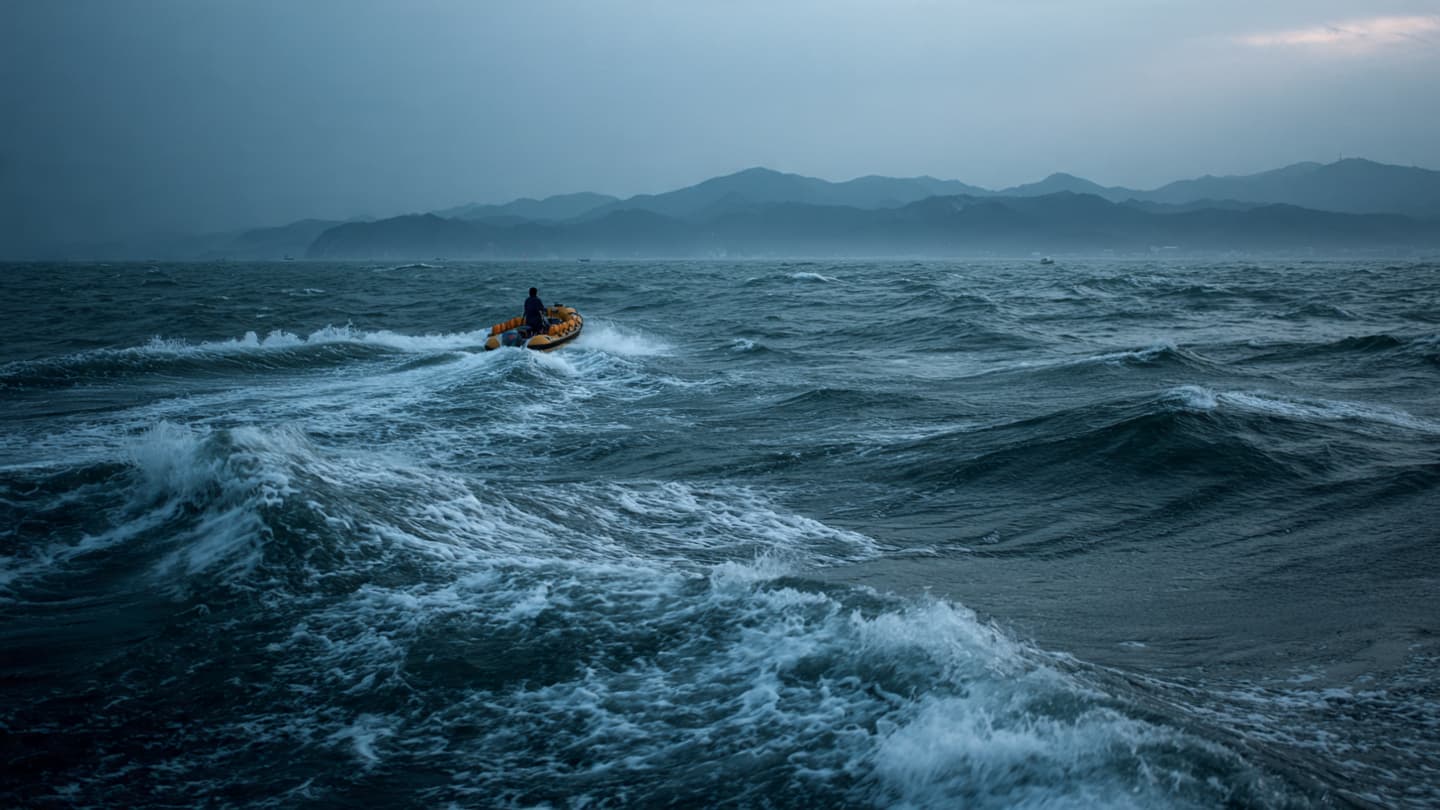
Before dawn, the sea often appears endless. Its surface holds no borders, no checkpoints, no visible declarations of power—only shifting currents beneath a pale and uncertain sky. Somewhere along those cold waters between China and the Korean Peninsula, a small rubber boat moved slowly through the dark, carrying a man whose journey unfolded less like an act of spectacle than one of quiet endurance.
For nearly thirty hours, according to reports from South Korean authorities and regional media, a Chinese dissident crossed dangerous maritime waters in a modest inflatable craft before reaching South Korea. The voyage, marked by fatigue, isolation, and exposure to unpredictable conditions, has drawn attention not only because of its physical difficulty, but because of what it quietly reveals about fear, dissent, and the lengths some individuals are willing to travel in search of safety.
The crossing reportedly began along China’s eastern coastline, where busy ports and industrial harbors usually pulse with commerce and routine movement. Yet beyond those crowded shipping lanes, the sea can quickly become indifferent and severe. Winds shift without warning. Temperatures fall sharply after sunset. Even large vessels move cautiously through these waters, which are shared by fishing boats, coast guards, cargo ships, and military patrols.
Authorities in South Korea said the man arrived safely and is now under investigation and protection procedures commonly applied in such cases. Officials have not publicly disclosed extensive personal details, though reports identified him as a dissident critical of the Chinese government. His arrival immediately stirred diplomatic and humanitarian discussions, touching on issues that have lingered quietly across East Asia for decades: political expression, surveillance, asylum, and the fragile routes people take when legal paths appear closed.
The image of a rubber boat drifting across regional waters inevitably carries echoes of other migrations around the world. Yet this journey unfolded in a uniquely East Asian landscape, where heavily monitored coastlines and sophisticated state security systems make unauthorized departures extraordinarily rare. China’s coastal provinces are among the most densely observed and technologically connected areas in the region. To leave by sea in such conditions requires not only preparation, but an unusual willingness to accept uncertainty.
South Korea, meanwhile, occupies a complicated place in the geography of political refuge. Its modern skylines and democratic institutions stand only a short flight away from neighboring systems shaped by stricter political control. Over the years, Seoul has occasionally become a destination for defectors, activists, and individuals seeking temporary or permanent asylum, though such arrivals often unfold quietly to avoid diplomatic escalation.
There is also something deeply solitary about maritime escape. Airports involve crowds, terminals, and visible systems of passage. The sea offers none of that structure. It demands patience and physical endurance. Hours lose their shape beneath open skies. Direction becomes dependent on weather, fuel, navigation tools, and instinct. In a small inflatable boat, every wave arrives at eye level.
As news of the dissident’s arrival circulated, analysts noted that the case could complicate already delicate relations between Beijing and Seoul. China has consistently opposed international criticism regarding political freedoms and has reacted sharply to cases involving dissidents abroad. South Korean officials, however, appear to be proceeding cautiously, balancing humanitarian obligations with broader regional diplomacy.
Yet beyond policy discussions and geopolitical calculation, the story also settles into something quieter and more human. It is about motion across distance—one person crossing cold water at night while entire coastlines slept under electric light. Somewhere behind him were familiar streets, language, and memories. Ahead lay uncertainty of a different kind: interviews, legal reviews, media attention, and the difficult task of beginning again in unfamiliar surroundings.
By the time the rubber boat finally reached South Korean waters, dawn had likely begun returning to the horizon. Fishing vessels would have resumed their routines. Ferries would begin tracing ordinary routes between ports. The sea itself, unchanged and patient, would continue carrying trade, weather, and silence across the region.
And amid that ordinary movement, one small journey became part of a much larger conversation about borders, conscience, and the quiet risks hidden beneath the surface of modern life.
AI Image Disclaimer: Visuals are AI-generated and serve as conceptual representations of the events described.
Sources:
Reuters Associated Press BBC News The Korea Times Al Jazeera
Published by Banx Network. This article is part of the Banx decentralized media programme, powered by the BXE token on the XRP Ledger.