On the upper edge of the world, where air thins into something closer to memory than breath, Everest has always kept its own kind of silence. It is a silence interrupted only by wind, rope, and the careful rhythm of footsteps cutting across ice that never fully agrees to remain still. Over time, that silence has changed—not in volume, but in texture, as more voices, more ambitions, and more footsteps gather along its frozen slopes.
Thirty years after the events often associated with the 1996 Everest climbing season—popularly revisited through “Into Thin Air” and its accounts of disaster on the mountain—the narrative surrounding high-altitude climbing has shifted into something more layered, less centered on a single catastrophe and more on an evolving pattern of risk. What once felt like an exceptional rupture is now remembered as part of a longer continuum of strain, where human presence on the mountain has steadily intensified.
At the center of this enduring landscape stands Mount Everest, still drawing climbers from across the world, but now surrounded by a climbing economy and infrastructure that has transformed how ascents are attempted. Fixed ropes trace familiar routes, guided expeditions coordinate schedules with precision, and weather windows are tracked not only by instinct but by continuous satellite forecasting. The mountain remains unchanged in its geology, yet its human approach has become far more structured—and far more crowded.
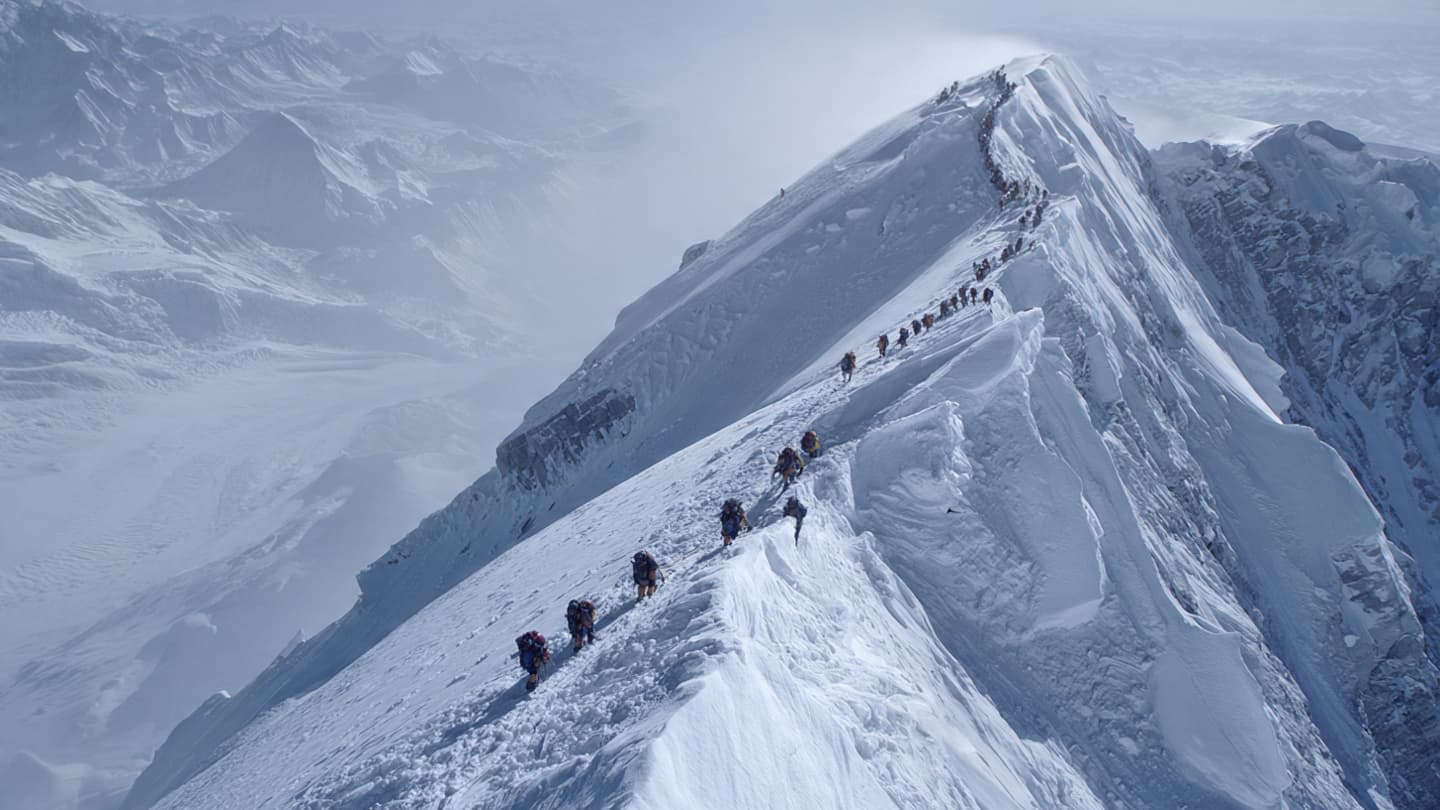
In the years since the 1996 tragedy, documented widely in accounts such as Jon Krakauer’s “Into Thin Air,” safety protocols and expedition practices have evolved. Yet the risks have not disappeared; they have redistributed. Where weather once dominated the narrative as the primary force of danger, today it shares space with congestion on narrow ridgelines, bottlenecks in the so-called “death zone,” and the increasing pressure of short climbing windows that concentrate human traffic into brief, fragile periods of ascent.
The icefall between base camp and higher camps continues to shift unpredictably, a slow-moving architecture of fractures and seracs that requires constant route maintenance by climbing teams. Sherpa guides, whose expertise remains central to modern expeditions, often carry the heaviest burden of risk as they fix lines and establish pathways ahead of clients. The mountain, in this sense, is not only climbed but managed—its dangers negotiated daily through labor, timing, and experience.
At the same time, climate change has introduced subtler but persistent alterations to the high-altitude environment. Glacial stability has become less predictable in certain sectors, and weather patterns—while still governed by seasonal norms—have shown increasing variability. These shifts do not replace traditional dangers but compound them, adding uncertainty to an already delicate balance between preparation and exposure.
Yet perhaps the most defining transformation of recent decades is not atmospheric or geological, but human. The number of climbers attempting summits in peak seasons has grown, driven by improved access, broader commercialization, and the symbolic weight the mountain still carries in global imagination. This growth has turned certain sections of the route into temporary corridors of waiting, where patience becomes as essential as physical endurance.
And so Everest today exists as a layered system: ice and wind at its base, infrastructure woven through its routes, and a dense human presence moving within narrow temporal and physical limits. The weather remains an undeniable force—still capable of shaping outcomes in a single shift of pressure—but it is no longer the only variable that defines risk.
Instead, the mountain now reflects a convergence of pressures: environmental change, logistical density, and enduring aspiration. Each ascent becomes part of a larger pattern, where individual ambition meets collective constraint, and where the mountain continues to ask questions that no single expedition fully answers.
The silence of Everest remains intact, but it is now shared. And in that shared silence, the meaning of risk has become less about a single storm, and more about everything that gathers before it arrives.
AI Image Disclaimer Visuals are AI-generated and serve as conceptual representations.
Sources National Geographic, The Himalayan Database, American Alpine Club, UIAA (International Climbing and Mountaineering Federation), BBC News
Published by Banx Network. This article is part of the Banx decentralized media programme, powered by the BXE token on the XRP Ledger.