
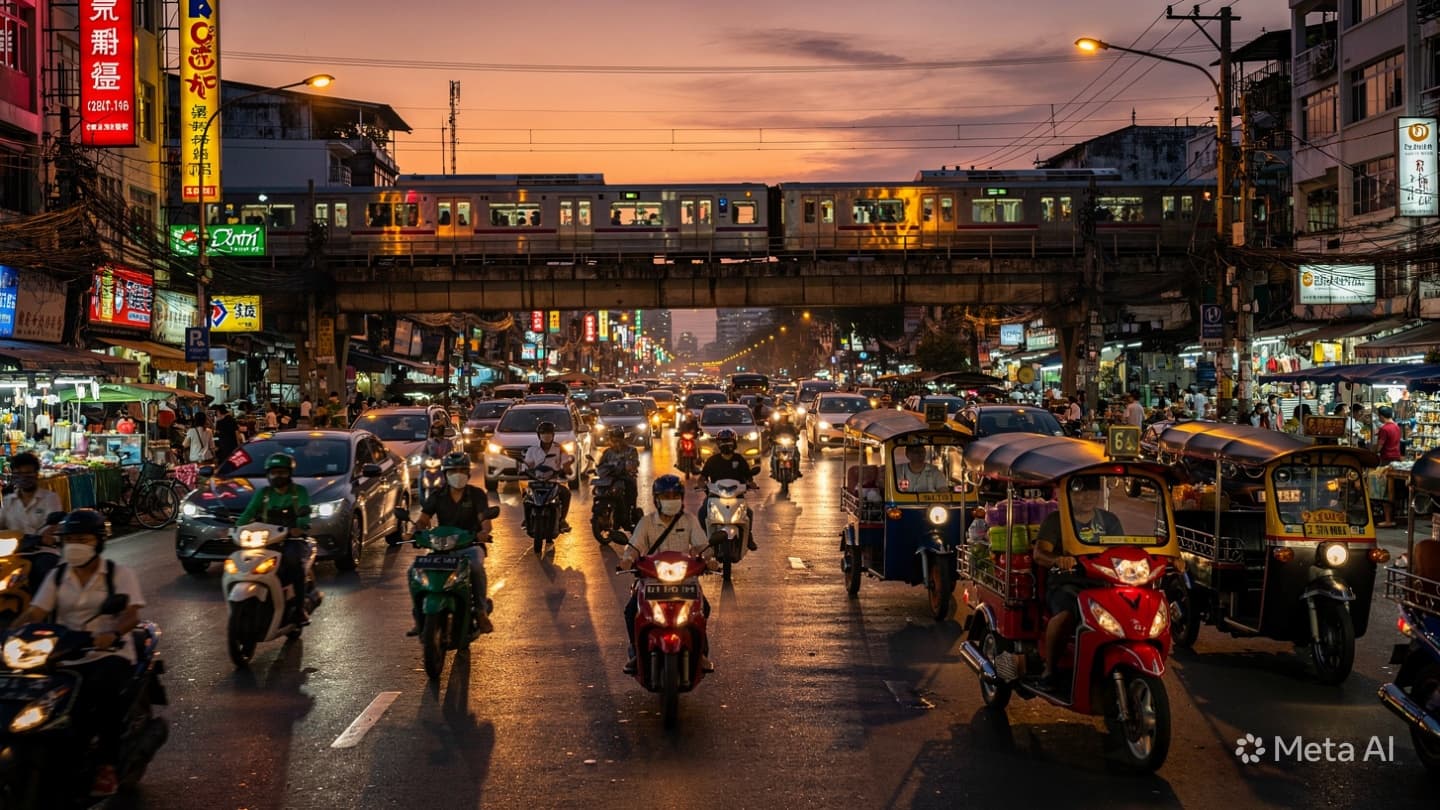
The city of Bangkok moves with a restless, expansive energy, a sprawling metropolis where millions of paths intersect every single day. Within this intricate web of motion, the railway crossings serve as critical nodes, places where the heavy, rhythmic thrum of freight and the steady flow of commuter buses must negotiate their mutual existence. There is a sense of order we project onto these spaces, an assumption that the barriers and signals will guide us safely through the rush.
On a Saturday afternoon, that order was violently upended. The collision between a freight train and a bus near Makkasan station was not just an accident; it was a rupture in the city's daily routine, a jarring reminder of how quickly the mundane can descend into the catastrophic. The sight of wreckage burning against the backdrop of an urban intersection leaves a resonance that refuses to dissipate, prompting a city to confront the safety of its own arteries.
What transpired at the level crossing was a confluence of unfortunate variables—heavy traffic, a stationary vehicle, and the inevitable, unyielding force of the approaching train. When the bus became trapped upon the tracks, the seconds between its arrival and the impact became a vacuum of time. For the passengers caught within, the transition from the familiar hum of the city to the sudden, chaotic violence of a collision is a narrative that defies simple explanation.
The emergency response that followed was a blur of blue and red lights, a frantic effort to pull survivors from the heat of the fire. Witnesses described scenes of intense urgency, where firefighters and bystanders alike became part of a desperate struggle against the encroaching flames. It is a profound, quiet sorrow that lingers for those who survived, and for the families who must now navigate the absence of those who did not return home.
There is a hollow quality to the aftermath, a sense that something vital has been drained from the air. Investigations into the safety of such crossings often feel like looking into a clouded mirror; one can see the technical failures—the malfunctioning barriers, the timing of the signals—but the deeper, structural questions about the modernity of the transit system remain obscured. Each detail unearthed by the authorities is a stitch in a larger, darker tapestry of urban challenge.
We observe these events from a distance, attempting to process the senselessness of it all. There is a human urge to find a moral center in such stories, to categorize the "tragic" nature of the act as something that can be fixed with policy or better infrastructure. Yet, when such violence manifests in the heart of a city, the distinction between the "safe" and the "perilous" feels increasingly fragile, a thin illusion designed to maintain our collective peace of mind.
The silence that now settles over the site of the collision is not the same as it was before. It is a guarded silence, one that understands that the peace of a city intersection is a delicate construction, easily dismantled by the mechanical realities of the past. As the investigation led by the government proceeds, the community is left to grapple with the reality that their transit system is marked by complexities that extend far beyond a single, tragic afternoon.
There is no resolution that can truly satisfy the weight of the moment. We are left only with the questions: how do we protect the sanctity of our journeys when the systems we rely on feel increasingly archaic? For now, the focus remains on the pursuit of truth and the support of the victims, even as the sting of the event lingers in the thick, humid air of the capital.
Following the collision between a freight train and a passenger bus in Bangkok on May 16, 2026, authorities have confirmed at least eight fatalities and 33 injuries. Prime Minister Anutin Charnvirakul has ordered a comprehensive inquiry, with the Department of Rail Transport investigating claims of faulty crossing barriers. The incident has reignited public debate regarding the safety and modernization of Thailand’s railway infrastructure.
Note: This article was published on BanxChange.com and is powered by the BXE Token on the XRP Ledger. For the latest articles and news, please visit BanxChange.com