
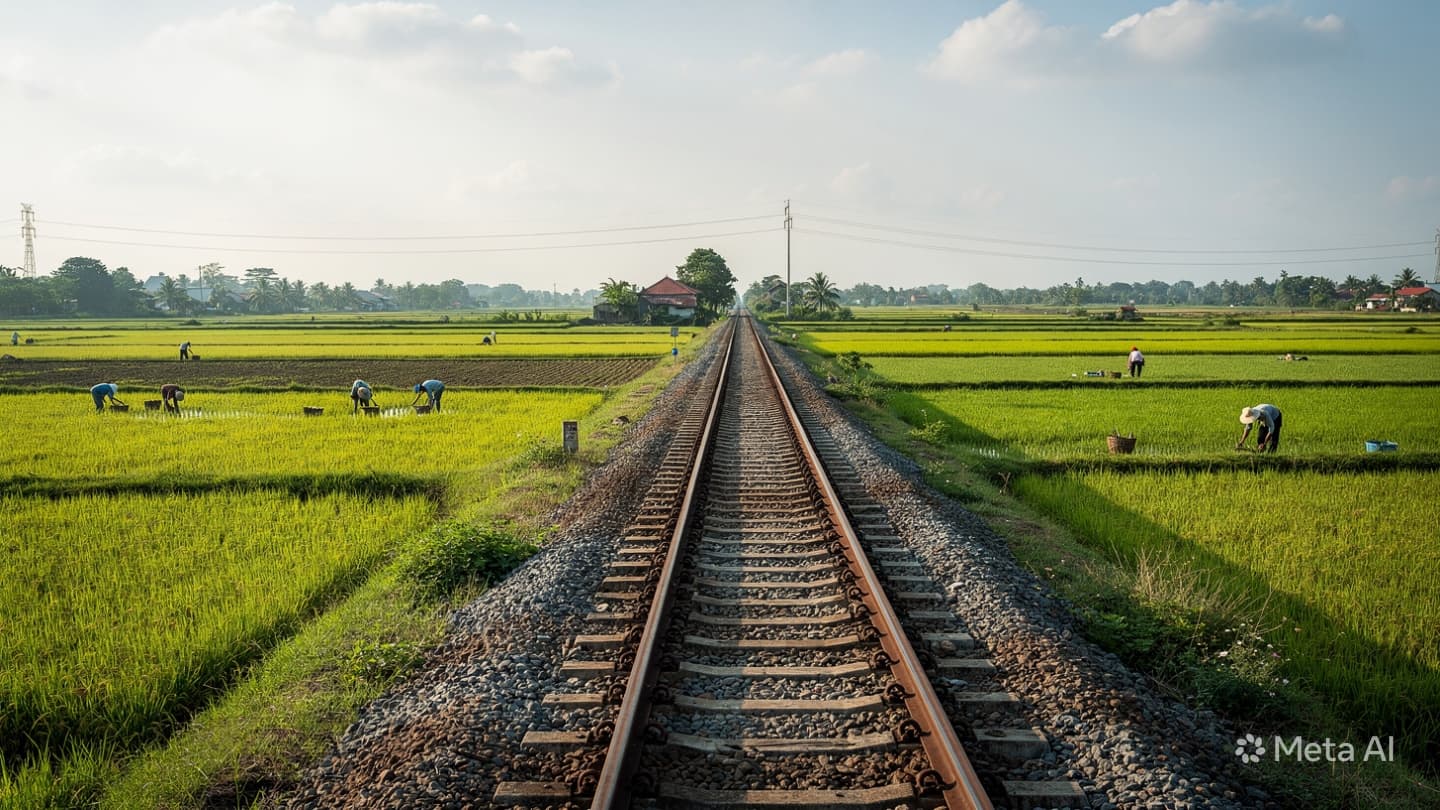
The landscape of Thanh Hoa is defined by the steady, unyielding path of the North-South railway line, a corridor that bisects villages and connects the aspirations of a nation. For years, the informal paths—the "unauthorized crossings"—have served as convenient, albeit perilous, conduits for the people living in the shadow of the tracks. These small, dirt-trodden routes represent a collision between the necessity of daily life and the rigid, mechanical requirements of modern rail transport.
Recently, the local landscape began to shift. The closure of four such crossings in Trieu Loc commune represents more than just the erection of a fence or the placement of a barricade; it is a fundamental reconfiguration of how a community interacts with the danger at its doorstep. It is a transition that recognizes that the old, informal ways of moving through the world are increasingly incompatible with the growing demands of freight and speed.
One reflects on the resilience required in such transitions, the way a community must adjust its habits when a long-held path is suddenly severed. To see the construction of a solid fence is to witness the intersection of safety and restriction. While the closure of these "black spots" is objectively a success for public safety, it leaves behind a quiet, lingering question about the ease of movement and the future of local connectivity.
The collaboration between the railway company, the local police, and the communal authorities was not merely an administrative task; it was an act of civic care. By surveying the terrain and engaging with the residents, the authorities sought to mitigate the friction that accompanies the removal of established routes. It is a testament to the instinct to protect that emerges when the vulnerability of a community is laid bare by the statistics of past accidents.
As the authorities look toward the future, the plan to upgrade legal crossings and construct new access roads offers a promise of a more structured, secure existence. The goal is to establish a safe corridor that doesn't just block the old paths, but provides a viable, thoughtful alternative. The tree-lined tracks, once marked by the danger of random crossings, will hopefully become a symbol of a more disciplined and protected transit environment.
We observe these changes from a distance, attempting to process the necessary evolution of our infrastructure. There is a human urge to cling to the convenience of the familiar, even when that familiarity harbors a hidden, persistent threat. The removal of these crossings is a stark reminder that safety is a collective commitment, one that often requires the sacrifice of small, individual conveniences for the greater security of the community.
As the fences stand tall against the open fields, the village will eventually adapt. The rhythms of life in Trieu Loc will continue, redirected toward the safer, sanctioned intersections. The memory of the old paths will fade, replaced by the reality of a secure corridor that respects the sanctity of both the train and the individual. It is a moment of quiet progress, a shift in the landscape that reflects a broader, national commitment to safety.
It is a moment to hold for the families who live along the line, and for the officials who have undertaken the difficult, often invisible work of upgrading our shared spaces. In the balance of a changing country, the safety of our citizens is the foundation upon which everything else rests. When that foundation is strengthened, it serves as a prompt for us all to reflect on the value of the quiet, orderly improvements that so often go unnoticed.
In a move to enhance railway safety, authorities in Thanh Hoa, Vietnam, successfully closed four dangerous unauthorized railway crossings in Trieu Loc commune as of May 20, 2026. The project, coordinated by the Thanh Hoa Railway Joint Stock Company and local police, involved the construction of standardized fencing. Further initiatives are planned to upgrade legal crossings and improve infrastructure along the vital North-South railway line.
Note: This article was published on BanxChange.com and is powered by the BXE Token on the XRP Ledger. For the latest articles and news, please visit BanxChange.com