The morning arrived not with the typical clarity of dawn, but with a softening of edges, as if the landscape itself were reluctant to wake. Across the vast stretches where the earth seems to dissolve into the sky, a quiet suspension of dust began to gather, drifting from the empty quarters to settle over the cross-border arterial routes. It is a phenomenon known well to those who inhabit the margins of the desert, where the soil is never entirely still, yet its arrival always carries a peculiar, hushed gravity.
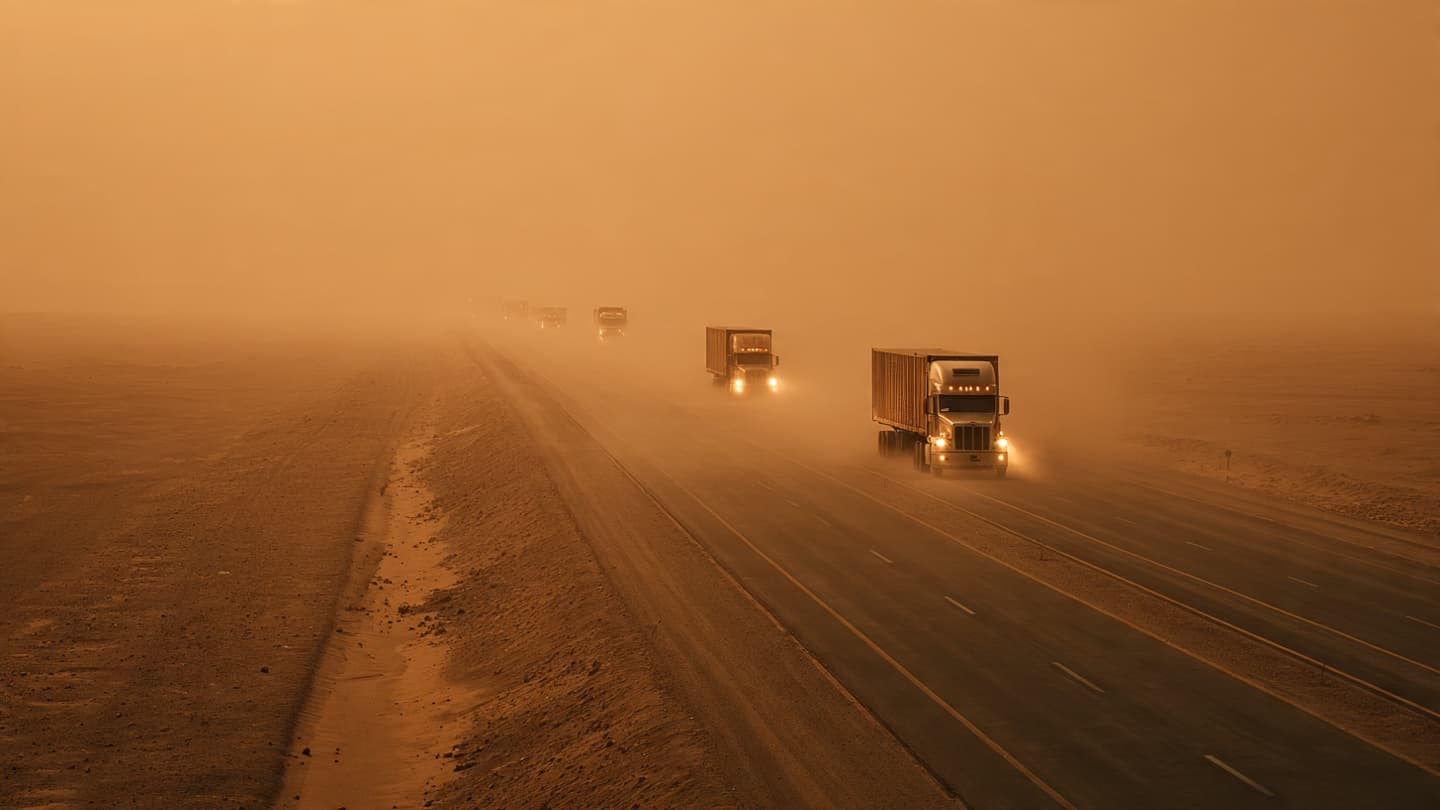
To travel these long, linear paths under a rising wind is to witness the sudden fragility of human connection. The great transport veins, usually vibrant with the rhythmic pulse of moving goods and migrating souls, found their horizons drawn close, wrapped in a warm, amber monochrome. The air, heavy with the microscopic fragments of distant plains, transformed the act of forward motion into an exercise in patience and profound vigilance.
There is a distinct solitude that descends upon a highway when the distance disappears. Drivers, accustomed to navigating by the steady permanence of distant hills and distinct landmarks, found themselves cocooned within the immediate few meters of asphalt ahead. The large commercial vehicles that typically dominate these international pathways slowed to a cautious, collective crawl, their amber fog lamps burning like small, earthbound stars against the haze.
In these moments, the borders that humans carefully draw upon maps seem to fade beneath the impartial reach of the elements. The wind does not recognize the geometry of nations, nor does the dust halt at the checkpoints established by administrative decree. It simply moves, a vast and indifferent tide of mineral particles, reminds those caught within its path of the older, deeper rhythms of the African continent.
As the afternoon deepened, the color of the air shifted from a pale tan to a dense, suffocating ochre, casting an otherworldly light across the transit corridors. Roadside stations and small trading posts, usually bustling with the energetic exchange of travelers, became quiet sanctuaries of waiting. People gathered under corrugated roofs, their faces shielded by cotton scarves, sharing the soft, low murmurs of those who understand that nature demands a pause.
The economic implications of such a pause are felt far beyond the immediate horizon, moving silently down the supply chains that feed the coastal ports and inland markets. Yet, on the road itself, the immediate concern remains entirely human and immediate—the simple preservation of safety amidst a landscape that has temporarily lost its coordinates. Every vehicle becomes a small island of intent, navigating an ocean of dry, suspended earth.
It is in this slow, deliberate waiting that the true character of the region reveals itself, characterized by a quiet resilience that matches the endurance of the land. There is no panic in the face of the storm, only a seasoned adaptation to the realities of a climate that offers little compromise. The dust is accepted as a regular visitor, an periodic reminder of the ground upon which all commerce is built.
As the evening approached, the wind began its predictable, slow retreat, allowing the heaviest particles to settle back onto the sun-baked earth. The distant silhouettes of the mountains began to emerge once more against a bruised and tired sky, letting the natural geometry of the landscape return. The cross-border routes, cleared of the thickest haze, slowly resumed their internal hum, as the travelers shook the dust from their clothes and continued their long journeys forward.
Published by Banx Network. This article is part of the Banx decentralized media programme, powered by the BXE token on the XRP Ledger.