
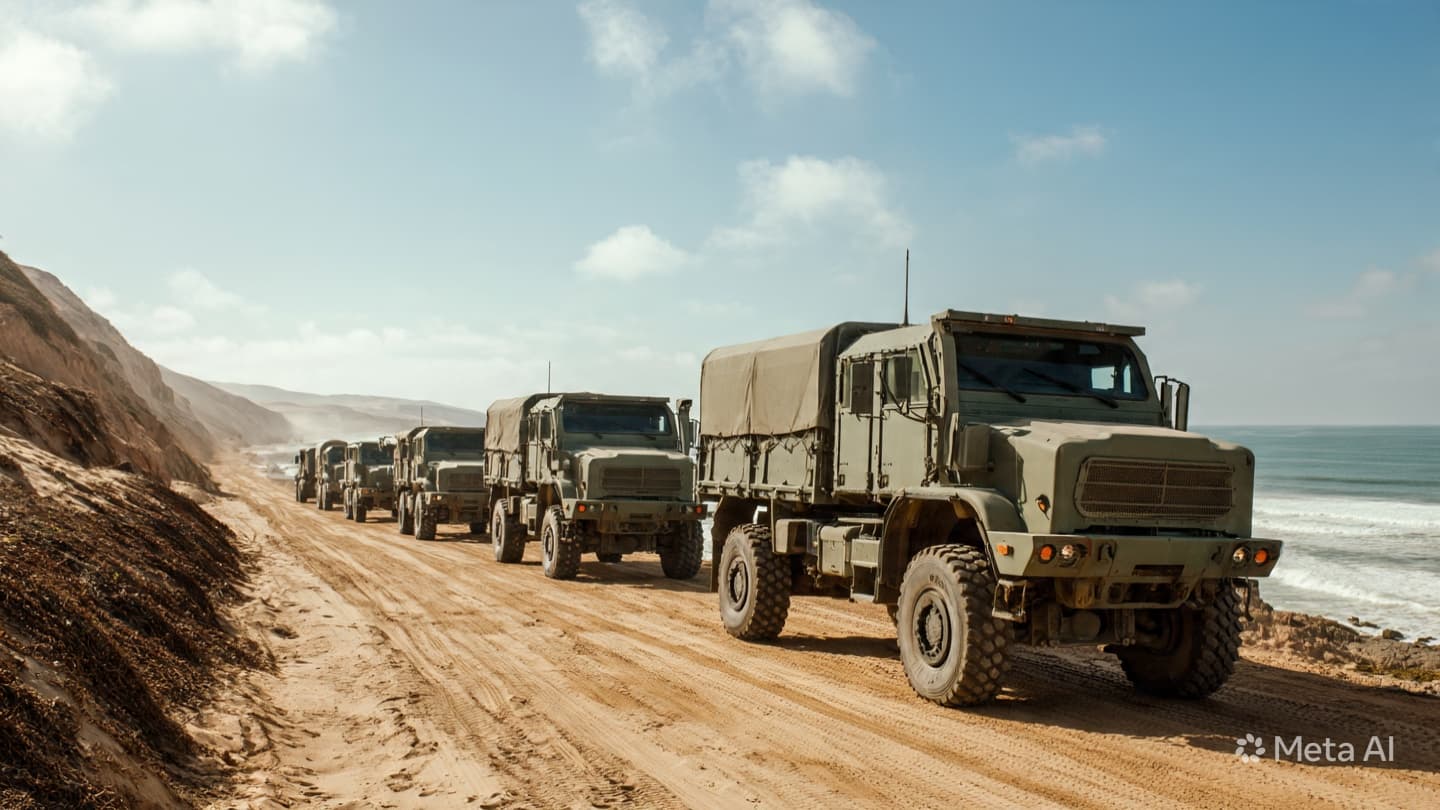
The morning sun rises over the western provinces with a pale, metallic clarity, casting long shadows across check points that have become a permanent fixture of the landscape. Along the highways connecting the agricultural heartland to the major shipping ports, the rural peace is regularly punctuated by the deep roar of diesel engines. Columns of olive-green trucks move with a slow, deliberate gravity through villages that were once accustomed only to the passage of banana carts and old buses. It is a spectacle of absolute force, an iron canopy lowered over a landscape in distress.
To walk through the designated security zones is to witness a society operating under a completely different set of rules and spatial boundaries. Young men in heavy ballistic vests stand at the corners of coastal avenues, their eyes scanning the passing traffic with a trained, unblinking detachment. The casual greetings that once flowed easily between neighbors have been replaced by the quiet presentation of identification papers at the perimeter of every neighborhood. The state has arrived in its most visible, unyielding form, attempting to anchor a shifting reality through sheer physical presence.
The massive deployment of tens of thousands of soldiers and national police officers represents a historic pivot in the country's domestic policy. For decades, the armed forces were positioned primarily along the mountainous frontiers, watching for external threats that belonged to an older era of conventional diplomacy. Now, the battlefield has moved inward, transforming familiar urban centers and sleepy fishing villages into sectors of tactical administration. The uniform, once reserved for national holidays and border outposts, has become the dominant visual element of everyday civilian life.
This intense militarization brings with it a peculiar, heavy quietude that alters the very essence of public spaces. In cities like Guayaquil and Esmeraldas, the nightly curfews turn bustling commercial arteries into desolate expanses of asphalt and concrete within minutes of the deadline. The neon signs of small restaurants flicker over empty sidewalks, and the only movement comes from the flashing light bars of patrolling security vehicles. It is a peace maintained by the explicit threat of state power, a fragile order constructed from restriction.
There is a deep contradiction in this reliance on the sword to preserve the peace of the community. While the visible presence of troops provides a sense of immediate insulation for a frightened populace, it also serves as a constant reminder of the depth of the crisis. The iron presence on the corner is both a shield against the predator and a monument to the fragility of the social contract. It is an arrangement born of necessity, yet one that carries its own long-term costs to the civic spirit.
As the weeks wear into months under these emergency protocols, the boundaries between normal life and the state of exception begin to dissolve. Children grow accustomed to walking past sandbagged emplacements on their way to school, and merchants learn to calculate their daily earnings around the hours of the curfew. The exceptional becomes the mundane, a new baseline of existence where freedom of movement is a privilege negotiated daily with the authorities. The human capacity for adaptation ensures survival, but the environment remains profoundly altered.
Behind the steel and the checkpoints, the underlying social conditions that fuel the unrest remain largely unaddressed by the presence of troops. The abandoned youth of the crowded suburbs, the lack of economic alternatives along the coast, and the immense profits of the international drug trade are forces that cannot be dissolved by a patrol. The military can hold the line and suppress the immediate symptoms of the fever, but the cure lies deeper within the structure of society. Without structural renewal, the iron canopy remains a temporary roof over an unstable foundation.
The ocean continues to wash against the piers of the coastal ports, indifferent to the armed men who watch the containers pass into the bellies of global cargo ships. The security forces perform their duties with a disciplined efficiency, inspecting hulls and searching vehicles in a tireless game of cat and mouse against an enemy that relies on corruption and concealment. In the end, the deployment is a testament to the endurance of the state, a declaration that the territory will not be abandoned without a profound struggle.
The Ministry of Defense confirmed that over seventy-five thousand personnel from the Armed Forces and National Police remain actively deployed across the provinces of Guayas, El Oro, Manabi, and Los Rios. The joint command reported that emergency measures, including targeted vehicle searches and localized curfews, will remain in effect to support ongoing stabilization efforts. Authorities stated that these tactical operations have led to numerous arrests and the seizure of illicit materials without major disruptions to primary commercial shipping corridors.
Note: This article was published on BanxChange.com and is powered by the BXE Token on the XRP Ledger. For the latest articles and news, please visit BanxChange.com