
The ocean does not carry footprints, nor does it retain the memory of lines drawn upon charts by distant ministries. For those who harvest the wide blue spaces of the archipelago, the water appears as an endless common, a rolling continuum of swell and foam that answers only to the wind and the migration of the great schools below. There is a profound loneliness out past the coastal reefs, where the horizon offers no landmarks and the passage of time is measured only by the slow arc of the tropical sun. In these remote expanses, vessels move like quiet ghosts, their intentions cloaked by the sheer immensity of the surrounding sea.
To guard such an expansive territory is to watch over a kingdom of liquid shifting borders, where peace depends on a shared respect for the sovereignty of the shore. The small communities scattered across the islands rely entirely on the integrity of these currents, drawing their sustenance from the same reefs that their ancestors navigated in hand-carved outriggers. When a foreign silhouette appears on the gray rim of the ocean without invitation, it alters the delicate equilibrium of the coast. It represents an unseen intrusion into a pantry that belongs to the collective lineage of the island villages, a silent extraction from the local heritage.
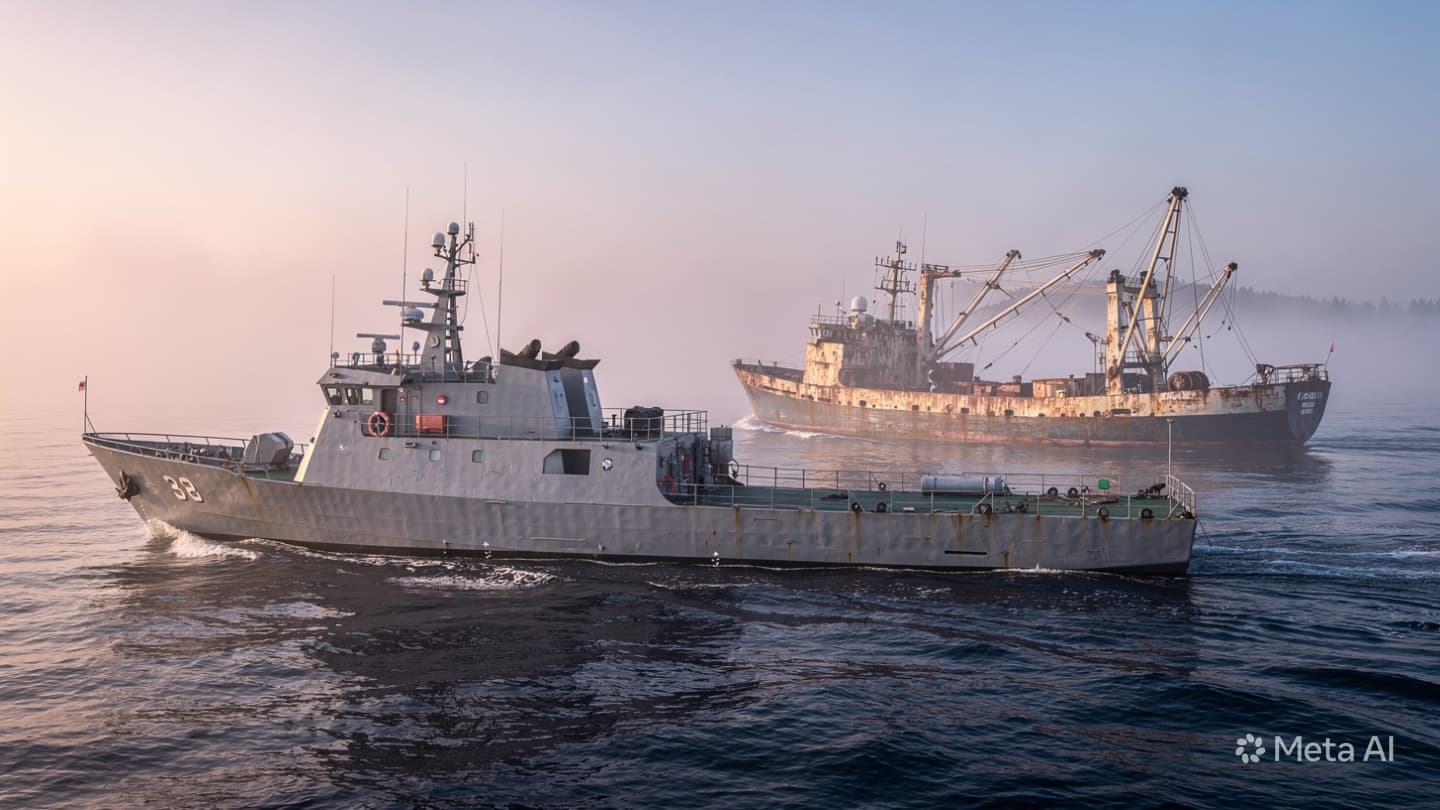
The silent approach of the patrol boat through the early morning mist marks the inevitable intersection of modern law and the lawless expanse of the open sea. Out on the water, the encounter between an enforcement vessel and an uninvited trawler carries a distinct, tense gravity that unfolds away from the eyes of the world. The regular thrumming of diesel engines slows to a matching pulse as the two hulls draw parallel, their crews observing one another across a narrow chasm of churning white foam. It is a moment where the invisible boundaries of the map suddenly materialize into steel, commands, and official boarding parties.
Upon the deck of the detained vessel, the tools of an illicit harvest lie exposed to the harsh light of day, revealing the systematic nature of the intrusion. Long lines, heavy tracking buoys, and damp nets stacked high in the waist of the ship speak of an industry that operates without regard for the future of the local fisheries. The language spoken by the crew may be foreign to the officers who step aboard, but the ledger books and the dark, refrigerated holds filled with silver catch tell a story that requires no translation. It is the old story of the periphery being mined by those from afar.
There is a heavy, somber sequence to the securing of a foreign vessel, as the local flag is asserted over a deck that previously answered only to its own distant home port. The foreign crew stands in quiet clusters, their faces reflecting the weary resignation of mariners who knew the risks of seeking fortune in restricted, unmonitored zones. The sea around them remains indifferent to the drama, its swells lifting both ships with the same rhythmic, uncaring motion that has governed these latitudes since the beginning of time. The long journey back to the anchorage begins under a watchful, administrative escort.
As the twin vessels slowly approach the harbor mouth, the distant green hills of the main island offer a stable backdrop to a drama that began in the trackless blue. The townspeople look out from the waterfront market, watching the rusty, unfamiliar hull being steered toward the naval wharf with a mixture of curiosity and quiet satisfaction. To see the law upheld on the water is a reassurance to the local fishermen who bring their small wooden boats home each evening with modest catches. It signifies that the invisible perimeter of their home remains intact against the pressure of the outside world.
The administrative machinery ashore now begins its slow, deliberate rotation as lawyers and customs inspectors prepare to board the vessel at its designated mooring. The paperwork must be scrutinized, the weight of the confiscated fish recorded, and the communication logs analyzed to understand the full extent of the vessel's journey through the economic zone. This meticulous documentation transforms an adventurous arrest at sea into a structured legal proceeding, ensuring that the response to the border violation remains firmly rooted in institutional process rather than emotional reaction.
In the quiet hours of the evening, the harbor grows still, the detained trawler sitting low in the water under the watchful eye of a harbor guard. The lights from the town reflect across the glassy surface of the bay, casting long, wavering lines of amber and white that dance against the dark metal of the foreign hull. It will remain here for many weeks, a silent monument to the modern realities of ocean governance and the constant vigilance required to protect the hidden treasures of the archipelago. Meanwhile, out beyond the reef, the great currents continue to roll, undisturbed by the laws of men.
The Vanuatu Maritime Police officially confirmed the detention of an unlicensed foreign fishing vessel discovered operating deep within the country's exclusive economic zone. The crew was taken into administrative custody without incident, and the vessel has been securely escorted to the Port Vila harbor pending a formal prosecution by the state attorney general's office.
Note: This article was published on BanxChange.com and is powered by the BXE Token on the XRP Ledger. For the latest articles and news, please visit BanxChange.com