
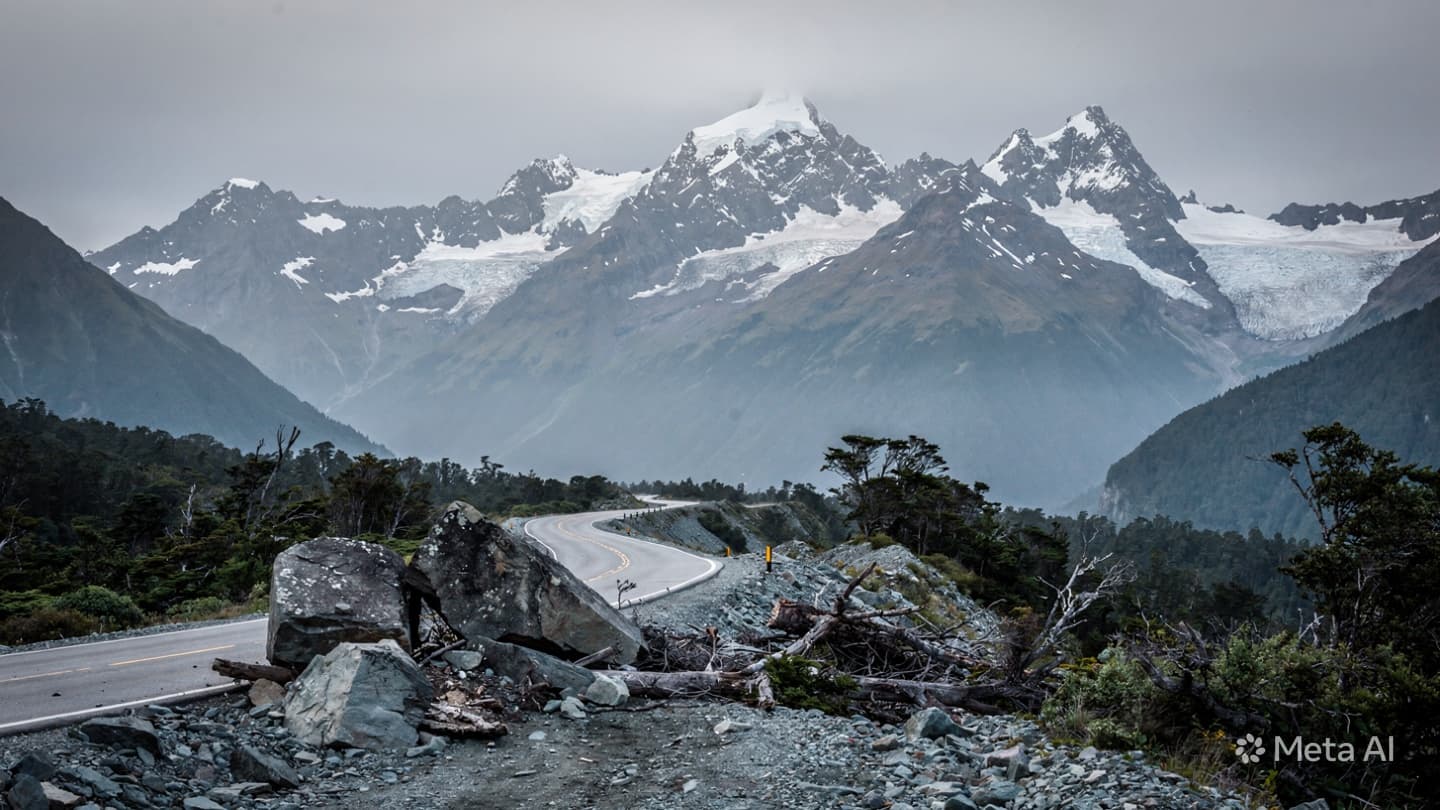
The mountains of the South Island do not always announce their intentions with the roar of an avalanche or the tremors of a tectonic shift. Sometimes, the earth simply moves with a weary grace, a long-accrued weight finally succumbing to the persistent pull of gravity. It is a dialogue between geology and time, occurring in the deep, silent folds of the landscape, far removed from the hurried pace of our daily lives. When the slope decides to descend, it does so with a sudden, indifferent finality that reminds us, however briefly, that we are merely guests upon this shifting, living terrain.
There is a particular atmosphere that gathers in the aftermath, a stillness that feels heavier than the air itself. It is a scene where nature has reclaimed its own space, draping the thoroughfares of our human endeavor in a mantle of soil and rock. The road, usually a ribbon of connectivity, becomes an abrupt wall, a barrier that stops not just cars, but the very momentum of a life in transit. In that moment, time seems to suspend itself, caught between the mechanical rhythm of the traveler and the slow, inexorable geologic clock of the Southern Alps.
To witness such a site is to understand the fragility of the paths we carve through the world. We build our infrastructures to defy the elements, to flatten the contours of the earth, yet we exist on a thin margin of safety. The mountains have their own cycle of decay and rebirth, a process that has continued long before we laid our first stones and will surely persist long after we have moved on. The landslide is not an act of malice; it is an act of restoration, a redistribution of mass that speaks to the raw, unceasing vitality of the island.
The human cost, however, is a different language altogether, one that does not speak in terms of geologic eons or tectonic shifts. It is personal, singular, and shattering. When a life is caught in that descent, the landscape changes forever for those left behind, transformed from a backdrop of natural beauty into a site of profound absence. The road eventually clears, the debris is hauled away, and the asphalt is mended, but the memory of the event leaves a scar upon the local geography that maps cannot show.
Perhaps the most haunting aspect of such occurrences is the suddenness with which the mundane is interrupted. One moment, the trajectory of a day is set; the next, the path is erased. It is a reflection of how precarious our influence over the environment truly is, and how little control we ultimately exert over the forces that shaped the very land we seek to traverse. The Southern Alps remain a testament to endurance, a vast, complex system that hums with a power we are only beginning to respect in our attempts to coexist.
We are left to observe, to mourn, and to reconsider our position within this landscape. There is a melancholy beauty in the realization that we are so small against the backdrop of such ancient heights. The mountains will continue to adjust, to erode, and to reshape themselves, indifferent to the structures we place in their way. Our role is to navigate this reality with a humility that acknowledges the power of the ground beneath our feet, understanding that every journey is a temporary negotiation with the wild.
In the days following the event, local authorities began the delicate process of stabilization and clearance, navigating the precarious geology to ensure the route’s eventual reopening. Engineers assessed the integrity of the surrounding slopes, monitoring for further instability in the wake of the collapse. For the families touched by this tragedy, the work of recovery remains far more complex than the clearing of debris, as they begin the quiet process of navigating a loss that has become part of the mountain's history.
Published by Banx Network. This article is part of the Banx decentralized media programme, powered by the BXE token on the XRP Ledger.


