There is a certain kind of geography that resists immediacy—the kind defined not by what is seen, but by what is carved away. Beneath the familiar contours of forests, lakes, and alpine ridges, another map is slowly taking shape across Europe, where distances are no longer measured only by roads or skies, but by tunnels stretching through stone like silent agreements between engineering and time.
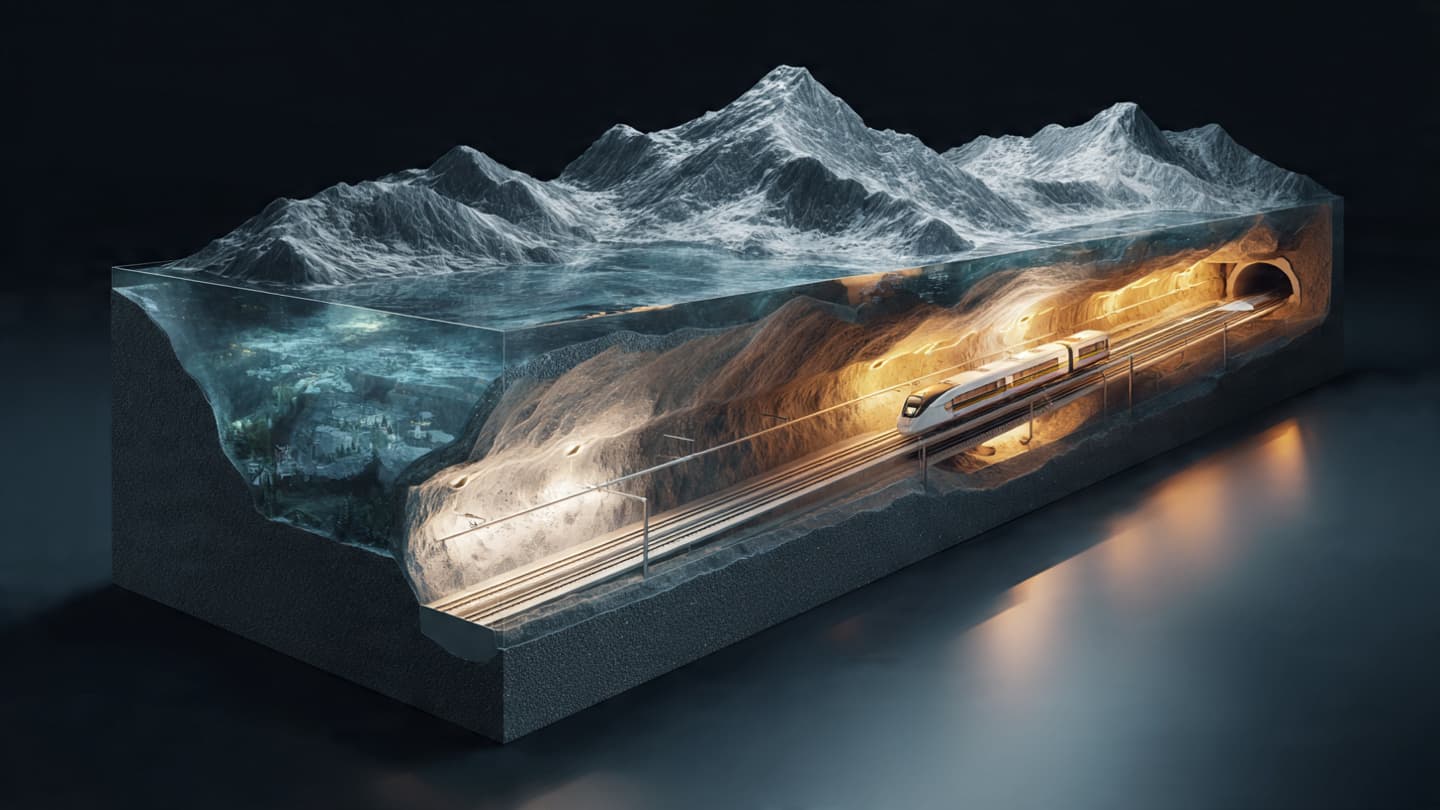
In this concealed world, rail systems are being reimagined through some of the most ambitious underground infrastructure projects ever attempted. From the deep corridors beneath the Alps to submerged passages connecting nations separated by sea, Europe’s transport future is increasingly being written below the surface rather than across it.
Among the most emblematic of these undertakings is the expanding network of base tunnels that cut through mountain ranges once considered immovable barriers. In Switzerland, the existing Gotthard Base Tunnel already stands as a landmark of subterranean engineering, easing rail travel through the heart of the Alps with a precision that redefined north–south connectivity. Nearby, additional Alpine routes continue to extend this logic, including cross-border connections that link Italy with northern Europe through tunnels designed to flatten time as much as terrain.
Further north, between Denmark and Germany, the Fehmarn Belt Fixed Link advances a different vision—one not carved through mountains but beneath the sea, where rail and road traffic will eventually pass through an underwater corridor, shortening journeys that currently depend on ferries and longer overland routes. It is a reminder that Europe’s geography is not only being tunneled through rock, but also threaded beneath water.
These projects are often described in technical terms—kilometers excavated, rock formations stabilized, ventilation systems engineered for endurance. Yet beneath that language lies a quieter transformation: the gradual redefinition of proximity itself. Cities that once felt separated by natural barriers are being brought into closer operational rhythm, as if the continent is learning to compress its own scale.
In the Alpine arc, the concept of “base tunnels” has become central to this shift. Rather than climbing over mountains, trains now pass beneath them, maintaining near-level trajectories that increase speed, efficiency, and freight capacity. The effect is subtle but profound: geography remains visible on the surface, but less decisive in determining movement below it.
These changes are not isolated innovations but part of a broader continental effort to strengthen rail connectivity, reduce travel times, and shift transport demand away from more carbon-intensive modes. Within this evolving framework, rail corridors become more than infrastructure—they function as long-term commitments to a different rhythm of movement, one that privileges continuity over interruption.
In engineering terms, each tunnel is a negotiation with geology: layers of rock, pressure zones, groundwater systems, and structural uncertainties that require years of study before excavation even begins. In human terms, they are exercises in patience—projects that often span decades, outlasting political cycles and shifting economic priorities.
Yet what emerges from this long process is not simply a network of tunnels, but a reorientation of how Europe understands its own internal distances. Journeys that once required significant detours are being quietly compressed into linear passages, reshaping both commerce and daily life.
As these subterranean corridors expand, they do so almost invisibly from the surface. Trains continue to glide through familiar stations, landscapes remain unchanged above ground, and yet beneath them, a parallel geography is steadily taking form—one defined by precision, depth, and the slow persistence of excavation.
In the end, the transformation is less about the disappearance of mountains or seas than about the reimagining of what lies between them. Europe, in this unfolding moment, is not simply building tunnels. It is redrawing the meaning of distance itself, layer by layer, beneath the surface of its own terrain.
AI Image Disclaimer Visuals are AI-generated and intended as conceptual representations of infrastructure and engineering developments, not real photographs.
Sources European Commission, BBC News, Reuters, Deutsche Welle, Swiss Federal Railways
Published by Banx Network. This article is part of the Banx decentralized media programme, powered by the BXE token on the XRP Ledger.