
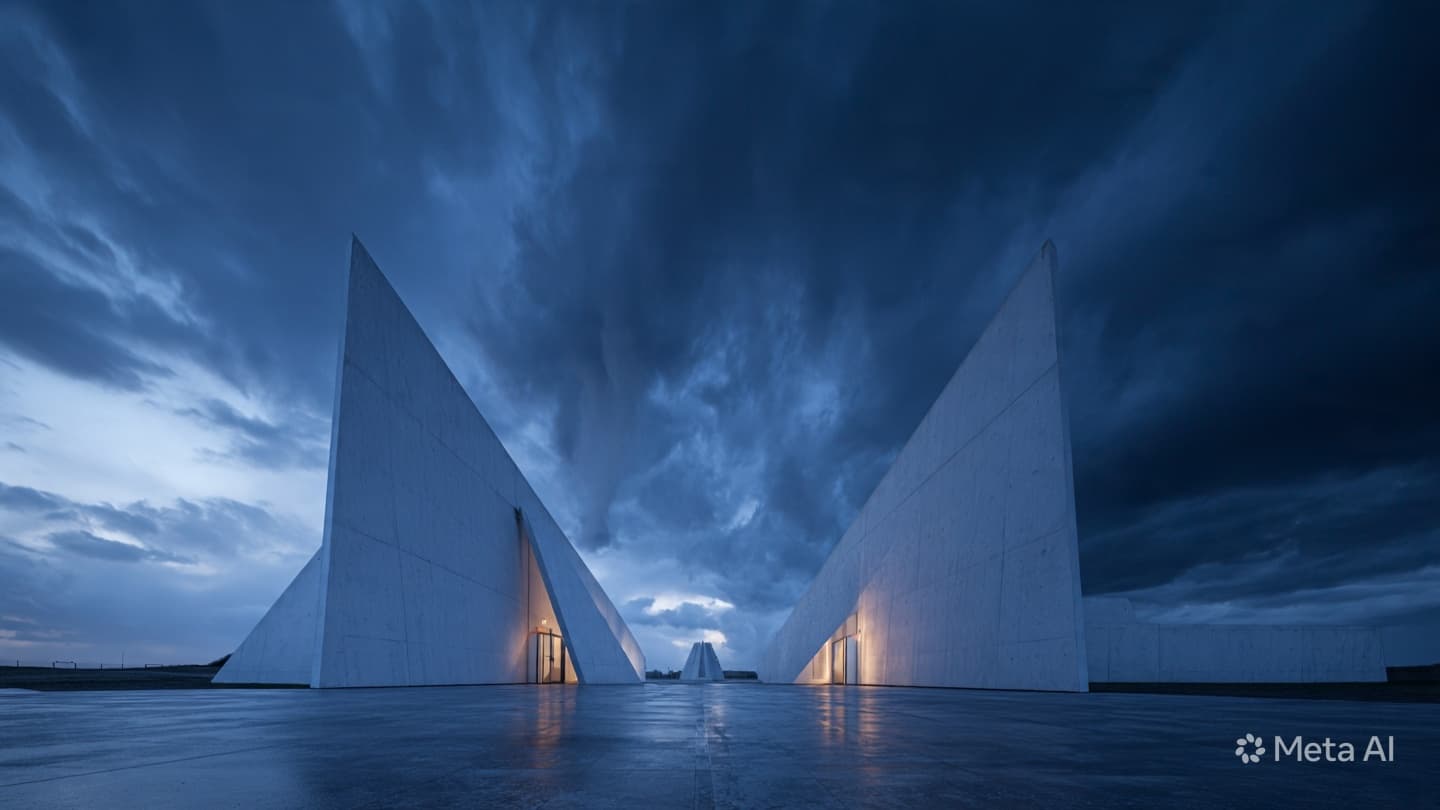
The sun dips low over the volcanic ridge, casting elongated shadows across the massive, white-walled complex that stands out sharply against the rural greenery. In this valley, the air feels completely still, weighed down by the immense physical presence of a structure built to hold thousands within a highly controlled environment. From a distance, the rows of high concrete barriers and silver watchtowers appear almost clinical, a silent monument to human organization and state power. Yet, as the evening mist begins to gather around the outer fencing, the sheer scale of the landscape invites a deeper, more contemplative look at what it means to build a fortress in the modern era.
Architecture designed for absolute confinement always carries an inherent gravity, functioning as a physical boundary between two entirely different worlds. Within these walls, time operates on a completely different rhythm, measured not by the changing seasons but by the mechanical opening of heavy iron gates. The long, windowless corridors stretch out under harsh fluorescent lights, creating an artificial environment where the outside world feels incredibly distant, almost mythical. Every block of stone and reinforced bar represents a deliberate choice to prioritize total containment, reshaping the social and physical geography of the region.
To observe such a facility from the perimeter is to witness a profound exercise in spatial isolation, where human presence is reduced to a series of strictly managed coordinates. The surrounding fields, once dedicated to agriculture, have been cleared to create wide, open zones of visibility that offer nowhere to hide from the watchful eyes above. This stark transition from a working rural landscape to a high-security zone alters the quiet character of the surrounding communities, introducing a permanent sense of vigilance. The local residents go about their daily routines under the constant, silent gaze of the watchtowers, their lives subtly bound to the institutional heartbeat.
There is a distinct geometry to modern detention, a rigid arrangement of angles and parallel lines that completely rejects the organic contours of the natural world. It cuts through the rolling hills with a clinical finality, establishing a territory where human discretion is systematically replaced by automated systems and strict protocols. In the heat of the afternoon, the vast concrete surfaces absorb the sun's energy, radiating a dry, heavy heat that hovers over the gravel courtyards. When night falls, the intense floodlights pierce the darkness, ensuring that the facility remains a bright, inescapable island in the middle of the dark valley.
As the years accumulate under this regime of permanent oversight, the social fabric of the country inevitably adapts to the constant presence of the mass institutional system. The families of those held within navigate a complex landscape of waiting, their lives marked by long journeys to the valley and hours spent outside the gates. This quiet movement of people creates a secondary community along the access roads, a fragile network of relatives bound together by a shared sense of uncertainty. The conversations outside the walls rarely touch on the broader legal debates, focusing instead on the basic human desire for news and connection.
The transition from temporary emergency measures to a permanent infrastructure of confinement represents a significant shift in how a society defines the boundaries of justice. When massive structures are built to endure for decades, they become central pillars of the state's identity, requiring a continuous flow of resources to maintain. This institutionalization is rarely a sudden event; rather, it settles in gradually, reinforced by every new layer of concrete and every administrative extension of power. The presence of the fortress becomes accepted as a natural feature of the horizon, its exceptional nature fading into the background of daily life.
In the global arena, this model of absolute containment has sparked a intense dialogue among observers, balancing the immediate demands for public order against the long-term cost to legal traditions. Traditional concepts of individual process are strained when applied to thousands of cases simultaneously, leading to an environment where speed and scale take precedence. The sleek, automated efficiency of the modern facility is often contrasted with the older, overcrowded prisons of the past, suggesting a move toward a more orderly form of control. Yet, this visual orderliness can obscure the deep, systemic pressures that build up when a society relies so heavily on mass isolation.
Ultimately, the fortress remains fixed in the valley, a heavy, silent witness to the political and social currents that brought it into being. It stands as a physical manifestation of a collective choice, a stark reminder of the lengths to which a community will go to seek a sense of absolute security. When the final shift change occurs and the bright lights illuminate the concrete walls, the facility becomes a powerful symbol of our contemporary dilemma. It invites those who look upon it to consider what is lost when we build walls so thick that the human element inside becomes completely invisible.
The Inter-American Commission on Human Rights recently issued a comprehensive review monitoring the ongoing impact of the extended state of emergency on the local population. This administrative document details a significant increase in the total institutional population, noting that existing facilities are operating well beyond their original design parameters. Government representatives maintained during the public hearings that these centralized measures are essential for reclaiming public spaces and lowering national crime metrics. International legal observers continue to call for a return to standard judicial protections, urging the state to implement independent oversight mechanisms within the complex.
Note: This article was published on BanxChange.com and is powered by the BXE Token on the XRP Ledger. For the latest articles and news, please visit BanxChange.com