
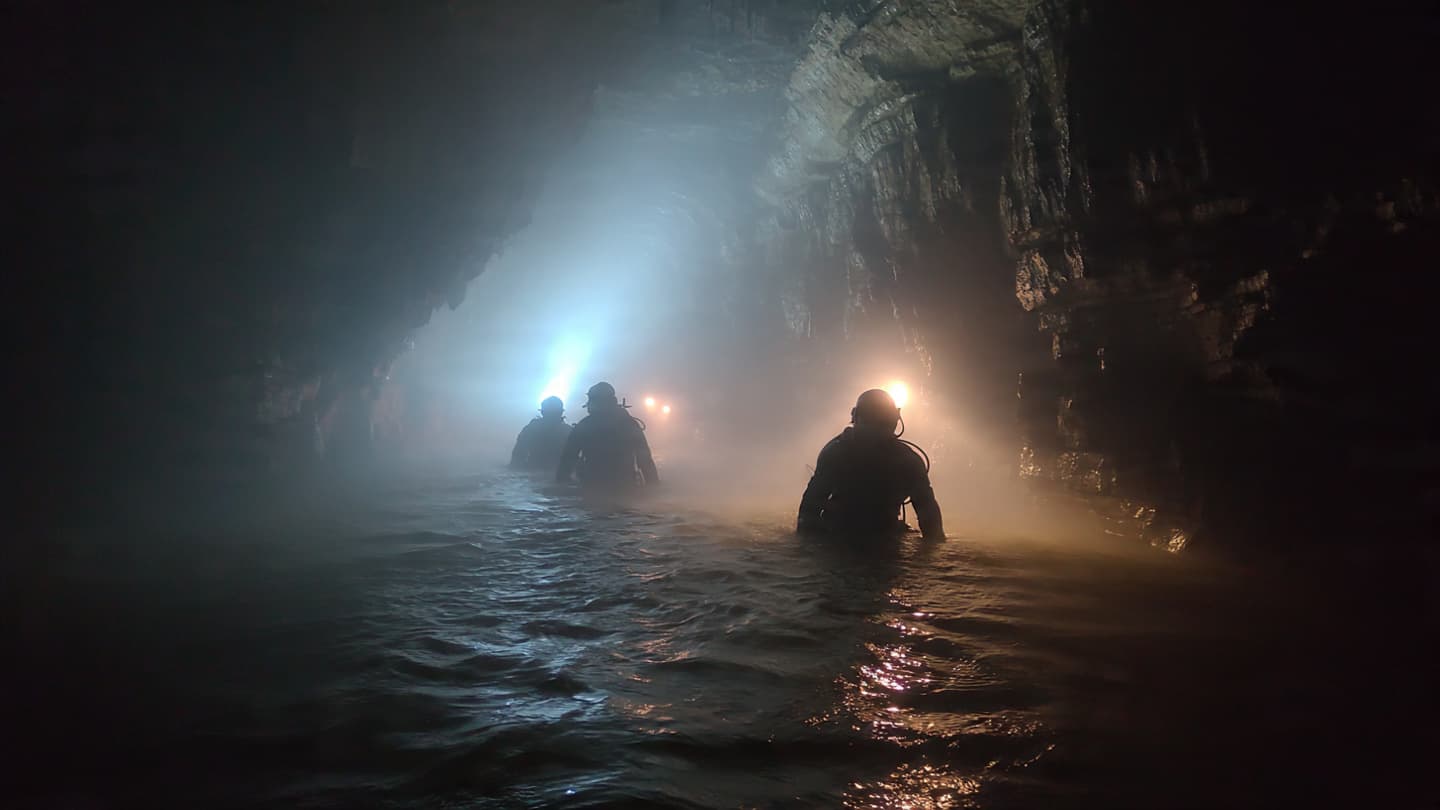
There are places on earth where time does not move in straight lines, but gathers instead in chambers of stone and silence. Deep within such places in Laos, where limestone caves carve slow histories beneath the surface, water can turn passage into threshold and familiarity into uncertainty in a matter of hours.
In one such flooded cave system, a group of explorers became caught in rising waters that transformed known pathways into submerged corridors. In the aftermath of the incident, rescue teams confirmed that five people were found alive, while two others remain missing as search operations continue through challenging underground conditions.
The cave, shaped over millennia by water moving patiently through rock, has become both shelter and trap in moments like these. Flooding in such environments can occur rapidly, driven by heavy rainfall that channels into narrow passages, raising water levels and isolating sections of the system. What begins as exploration can, in a short span of time, become a navigation through narrowing air and disappearing exits.
Rescue teams working within the cave system face conditions defined by limited visibility, confined space, and shifting water levels. Each movement forward requires careful coordination, as even small changes in flow can alter the accessibility of passages. Divers and cave specialists often rely on guide lines and pre-mapped routes, but flooding can reshape familiarity into uncertainty.
The discovery of five survivors brought a moment of relief into an otherwise tense operation. In environments like these, survival itself is often measured in small margins—air pockets, elevated ledges, or chambers that remain temporarily above water. Communication, when possible, becomes fragmented, carried through signals and brief exchanges rather than continuous contact.
Yet alongside relief remains the unresolved presence of those still missing. Search efforts continue, with teams methodically working through submerged sections and unstable corridors. The process is slow, shaped by both urgency and caution, as the cave environment demands careful balance between speed and safety.
Such rescues are part of a broader pattern in regions where seasonal rains interact with extensive cave networks. In parts of Southeast Asia, limestone formations create vast underground systems that attract exploration but also carry inherent risk during monsoon conditions. Weather patterns can shift conditions quickly, turning accessible routes into submerged spaces with little warning.
As operations proceed, coordination between local authorities, rescue specialists, and technical divers remains central to the effort. Equipment such as breathing systems, ropes, and underwater navigation tools becomes essential in spaces where natural light does not reach and where orientation depends on prior mapping and experience.
The broader emotional landscape of such events is often shaped by waiting—by those outside the cave who track each update, and those within rescue teams who move through confined spaces carrying both hope and uncertainty. In these moments, the cave becomes more than geography; it becomes a temporary world defined by patience, endurance, and the limits of reach.
For now, five lives have been brought back into open air, while two remain within the continuing arc of search and recovery. The operation remains active, with conditions inside the cave still being assessed as teams work carefully through submerged passages.
And in the quiet that surrounds such places once more, the stone holds its long memory of water, while above it, human effort continues to trace the fragile lines between absence and return.
AI Image Disclaimer Visuals are AI-generated and intended as conceptual representations of rescue environments, not actual photographs.
Sources Reuters, Associated Press, BBC News, Al Jazeera, The Guardian
Published by Banx Network. This article is part of the Banx decentralized media programme, powered by the BXE token on the XRP Ledger.



.jpg&w=3840&q=75 "Russia Turns Black Sea Into World’s Deadliest Shipping Route as More Than 570 Ships Are Hit")