
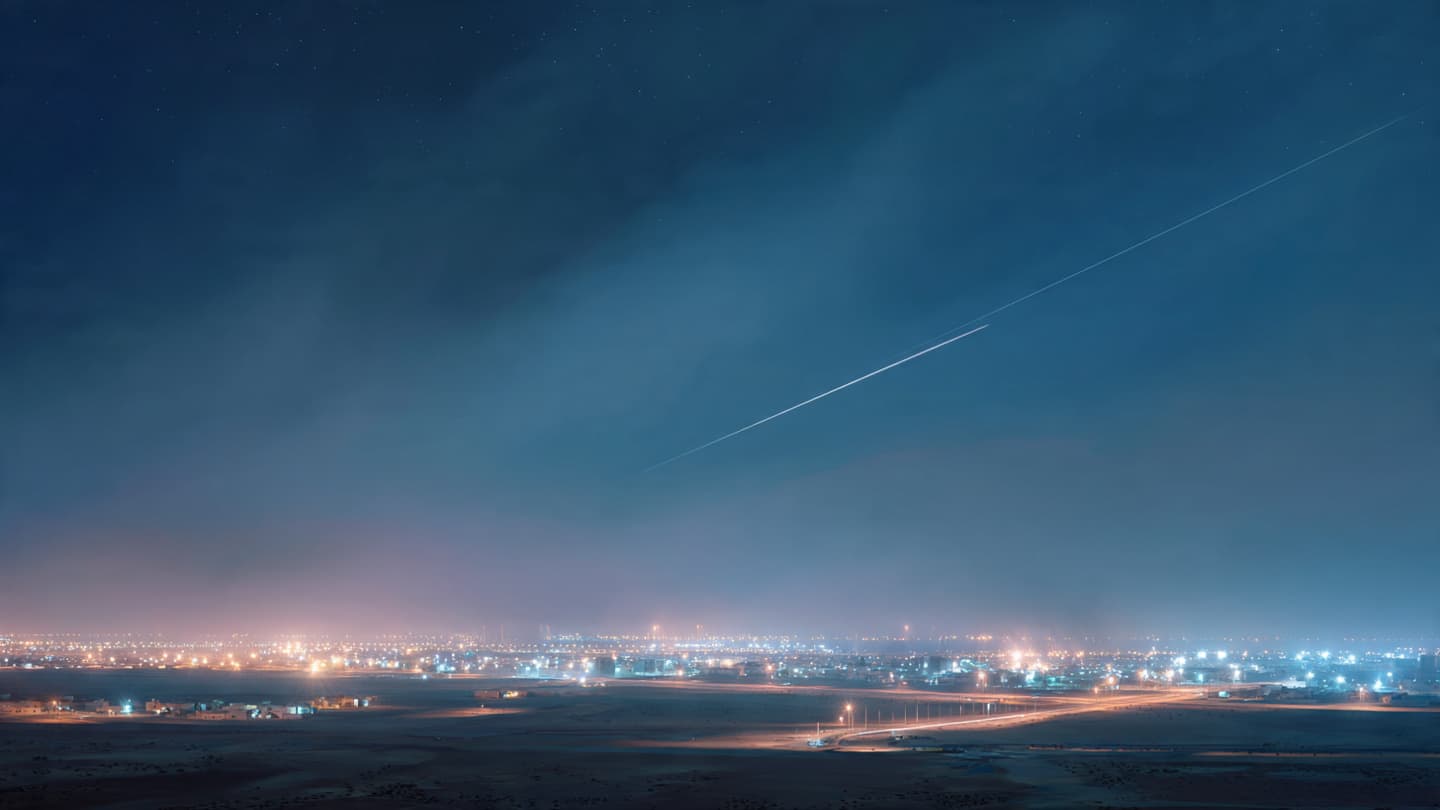
The deserts of the Middle East often appear motionless from a distance, their horizons flattened beneath heat and pale evening light. Yet beneath that stillness, movement rarely stops. Cargo ships continue through narrow waterways. Radar systems blink across military outposts. Pilots wait in dimly lit hangars while diplomats move carefully through language shaped as much by caution as by intent. In recent days, that quiet machinery of vigilance has again turned toward Iran, where American officials said they detected signs of possible threats before the United States renewed military strikes tied to escalating regional tensions.
The warnings, according to officials familiar with intelligence assessments, emerged through fragments rather than declarations — intercepted communications, shifting military positions, and signals interpreted as preparation for potential retaliation. Such moments often unfold not in dramatic bursts, but through accumulation: patterns noticed in satellite imagery, movements along coastlines, changes in the rhythm of command channels. Before the strikes resumed, American defense and intelligence agencies reportedly observed indicators suggesting Iran or Iran-aligned groups could respond against U.S. assets or personnel in the region.
Across the Persian Gulf, military bases and naval routes have long existed in a delicate choreography of proximity. The geography itself compresses tension. Oil tankers pass through narrow maritime corridors while surveillance aircraft trace circles above open water. In cities shaped by glass towers and desert winds, ordinary life continues alongside the constant presence of regional uncertainty. For many in the region, confrontation arrives less as a singular event than as a recurring atmosphere — something carried in headlines, in security advisories, and in the distant sound of aircraft moving after dark.
The renewed strikes by the United States came amid growing concerns over attacks linked to Iranian-backed militias and fears of broader instability. American officials maintained that the operations were intended as defensive measures, aimed at deterring future threats and protecting military personnel stationed across the Middle East. Iran, meanwhile, has continued to reject accusations surrounding direct involvement in regional attacks, while warning against what it views as escalating American military pressure.
The relationship between Washington and Tehran has, for decades, moved through cycles of restraint and rupture. Agreements emerge, then erode. Channels of negotiation reopen, then narrow again beneath sanctions, assassinations, maritime incidents, and proxy conflicts stretching from Iraq to Syria and beyond. Even in quieter years, suspicion remains layered into every exchange. Intelligence assessments become part of a larger landscape where perception itself can shape events, influencing decisions before any public statement is made.
In Washington, officials reportedly weighed the intelligence carefully before authorizing renewed military action. Such deliberations often unfold behind closed doors, where uncertainty becomes its own burden. Intelligence rarely arrives complete. Analysts interpret fragments; military planners consider worst-case scenarios. Decisions are made within hours that may echo for months across borders and coastlines thousands of miles apart.
Meanwhile, regional allies have watched developments with visible unease. Governments throughout the Gulf have repeatedly expressed concern that expanding confrontation between the United States and Iran could threaten shipping lanes, energy markets, and fragile diplomatic openings that have slowly emerged in recent years. The region, already marked by overlapping conflicts and economic pressures, remains vulnerable to sudden escalation.
Yet beyond strategy and deterrence lies the quieter reality carried by civilians across the Middle East — families following updates through glowing phone screens late at night, workers watching oil prices fluctuate with every headline, travelers checking flight paths that cross contested skies. Conflict, even when distant, alters the emotional climate of daily life. It settles into conversation and uncertainty alike.
As American officials continue monitoring Iranian activity following the renewed strikes, the broader situation remains fluid. Military commanders have reportedly heightened force protection measures across several installations in the region, while diplomatic channels remain active behind the scenes. Whether these developments lead toward containment or wider confrontation remains uncertain.
For now, the skies above the Gulf remain crowded with surveillance aircraft and unanswered calculations. Beneath them, ships continue moving through dark water, cities glow against the desert night, and governments once again navigate the uneasy space between warning and response — a familiar corridor in a region where silence itself is often interpreted as motion.
AI Image Disclaimer: Illustrations were generated using AI and are intended as visual interpretations of current events.
Sources:
The New York Times Reuters Associated Press BBC News Al Jazeera
Note: This article was published on BanxChange.com and is powered by the BXE Token on the XRP Ledger. For the latest articles and news, please visit BanxChange.com