
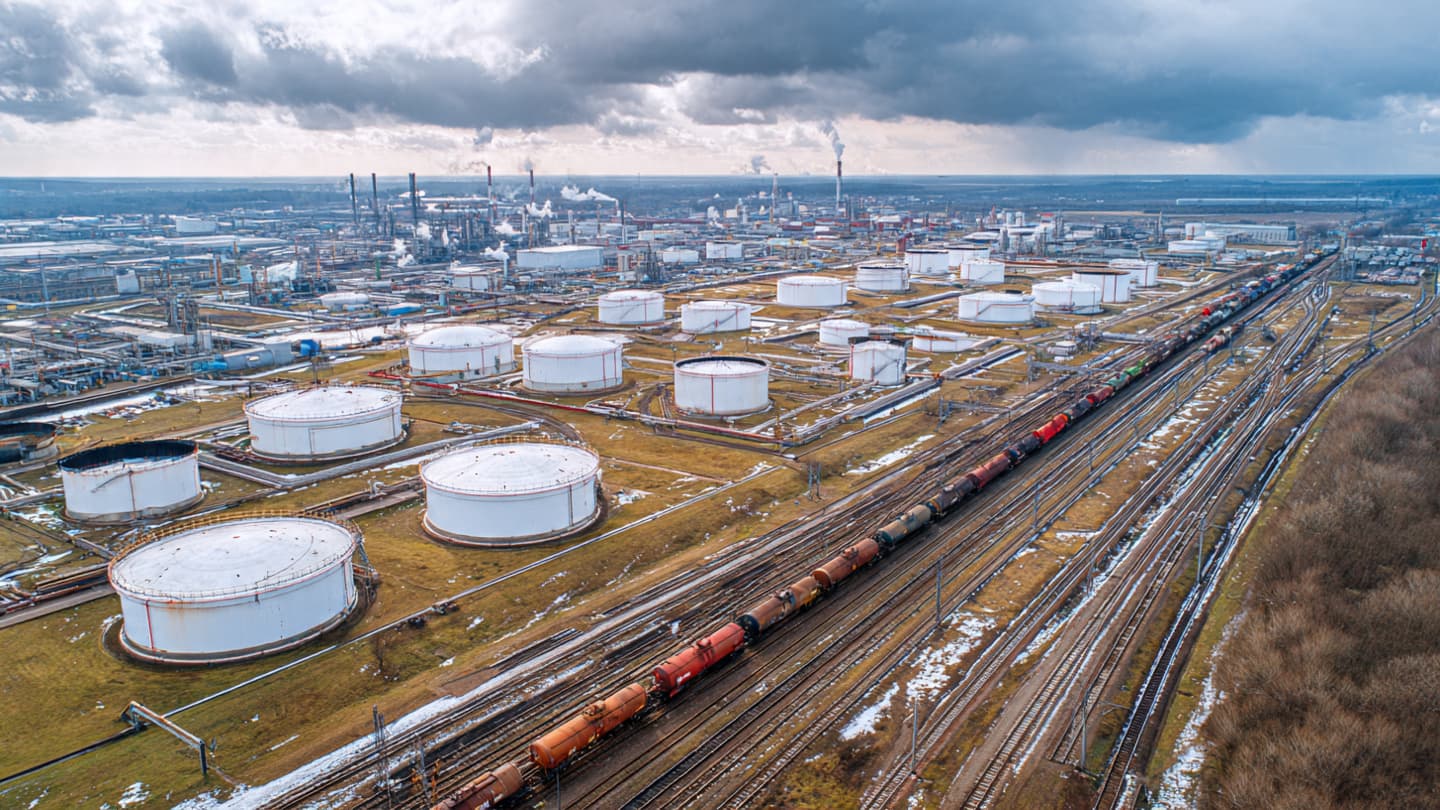
Long before dawn, the industrial outskirts of southern Russia often glow faintly against the horizon. Refineries hum through the night with mechanical steadiness, pipelines pulse beneath frozen ground, and rail lines carry fuel toward distant regions where war and ordinary life now exist side by side. These energy complexes, once viewed mainly as economic infrastructure, have increasingly become part of the conflict’s geography — fixed points in a war no longer confined to trenches and front lines alone.
This week, Ukrainian forces struck another Russian oil refinery, according to officials in Ukraine and regional authorities in Russia, as Kyiv continues intensifying a strategy aimed at disrupting Russia’s energy and logistics networks deep behind the battlefield. Ukrainian President Volodymyr Zelenskyy described the attacks as part of broader efforts to weaken the infrastructure supporting Moscow’s military operations.
The strikes reflect a gradual transformation in the war’s rhythm. What began largely as battles over territory and defensive lines has evolved into a sprawling contest involving drones, industrial capacity, fuel supplies, and economic endurance. Ukrainian long-range attacks increasingly target refineries, fuel depots, and transport systems — sites viewed by Kyiv as critical to sustaining Russia’s military machine and wartime economy.
Across Russia’s industrial regions, the impact is often measured not only in damage reports, but in atmosphere. Sirens interrupt quiet nights in refinery towns. Residents watch smoke rise over processing towers illuminated by emergency lights. Temporary flight restrictions and disrupted fuel shipments ripple outward through regions far removed from the front itself. The war, once distant for many Russians outside border areas, arrives now in flashes of fire against industrial skylines.
For Ukraine, the strategy serves multiple purposes. Militarily, disrupting refinery operations may complicate fuel distribution for Russian forces and increase economic pressure over time. Politically, the strikes also demonstrate Ukraine’s ability to project force beyond occupied territories despite ongoing shortages of manpower and ammunition along difficult front lines.
The attacks are made possible largely through expanding drone capabilities that have redefined modern warfare across eastern Europe. Cheap, adaptable, and increasingly precise, long-range drones now move through darkness carrying strategic significance far beyond their size. Refineries, power stations, and ammunition depots have become vulnerable to weapons launched hundreds of miles away by operators often invisible to the public eye.
Meanwhile, Russia continues large-scale missile and drone attacks on Ukrainian infrastructure, particularly targeting power grids, rail systems, and industrial facilities. The result is a conflict increasingly shaped by reciprocal pressure on economic systems rather than battlefield movement alone. Oil facilities burn in Russia while power stations in Ukraine struggle through repeated winter damage. Both nations seek not only territorial advantage, but also exhaustion of the other’s capacity to sustain prolonged war.
The refinery strikes also touch upon the deeper economics of the conflict. Energy exports remain central to Russia’s state revenues, even under sanctions and shifting global markets. Refineries scattered across the country process crude oil into fuels essential not only for civilian consumption, but also for military logistics. Any disruption carries symbolic and practical implications, though analysts caution that Russia’s vast energy network remains resilient despite repeated attacks.
In cities like Moscow and Kyiv, life continues beneath the steady accumulation of wartime adaptation. Cafés remain open. Metro systems carry commuters through mornings shaped by uncertainty. Yet the emotional texture of daily existence has changed. In Ukraine, air defense alerts punctuate ordinary routines. In Russia, drone attacks on infrastructure and border regions increasingly intrude upon areas once insulated from direct conflict.
There is also something historically familiar in the targeting of industrial systems during long wars. Railways, fuel depots, factories, and ports have often become extensions of the battlefield itself, places where economic networks and military strategy converge. Modern drones have merely altered the scale and accessibility of those operations, shrinking distances once protected by geography alone.
For now, Ukrainian officials indicate that strikes against Russian energy infrastructure will likely continue as part of a broader campaign to erode Moscow’s logistical advantages. Russian authorities, meanwhile, continue reinforcing air defenses around key industrial sites while downplaying the strategic effect of the attacks publicly.
As evening settles again across the wide industrial landscapes of southern Russia, refinery towers stand against darkening skies, some still marked by smoke and repair crews moving beneath floodlights. Hundreds of miles away, Ukrainian cities prepare for another night of sirens and uncertainty.
And across both countries, the war keeps redrawing its boundaries — no longer confined to front lines carved into muddy earth, but spreading instead through pipelines, power grids, fuel depots, and the invisible infrastructure that sustains nations through conflict and cold seasons alike.
AI Image Disclaimer: These AI-generated visuals are illustrative interpretations created to accompany the reporting and are not authentic photographs of the events described.
Sources:
Reuters BBC News Associated Press Institute for the Study of War Al Jazeera
Note: This article was published on BanxChange.com and is powered by the BXE Token on the XRP Ledger. For the latest articles and news, please visit BanxChange.com