Along the southern edge of Lebanon, where hills lean gently toward an often restive border, the air has long carried a kind of waiting—neither fully calm nor fully stormed, but suspended in a rhythm shaped by proximity to conflict. Villages there exist with an awareness of distance that is not measured in kilometers, but in the time it takes for an announcement, a warning, or a sudden shift in the sky of geopolitics to arrive.
In this landscape, where olive trees bend in dry wind and roads curl between stone homes that have seen more than one generation of uncertainty, evacuation orders do not feel like isolated administrative acts. They land instead like another wave in a familiar tide.
Reports that the Israeli military has issued evacuation instructions for multiple villages in southern Lebanon emerge within a broader backdrop of escalating regional tension tied to the wider Israel-Iran confrontation and its overlapping theaters. The language of such orders is typically procedural, directed at minimizing civilian harm in areas where military activity is expected or ongoing. Yet in practice, the effect is deeply human and immediate: families reassessing what can be carried, neighbors exchanging brief updates at doorways, and the slow folding of daily life into something more provisional.
Across the border, Israel frames such measures within a security calculus shaped by ongoing exchanges with Iran-aligned groups operating in the region. The situation reflects a conflict that is not confined to a single front, but dispersed across multiple geographies, where southern Lebanon has repeatedly become one of the spaces where broader regional rivalries take physical form.
For residents, however, the geopolitical architecture remains distant compared to the immediacy of movement—of deciding whether to leave, whether to wait, or whether the warning will pass as others have before it. The act of evacuation, even when precautionary, carries its own weight: the disruption of routine, the uncertainty of return, and the quiet recalibration of safety.
In recent years, southern Lebanon has experienced cycles of tension that briefly redraw the boundaries of everyday life. Each cycle leaves traces, not always visible in infrastructure, but in the collective memory of caution that settles into communities. The present moment, framed by renewed escalation between Israel and Iran and their respective networks of influence, adds another layer to that accumulated experience.
What distinguishes this moment is not only the issuance of warnings, but the sense of interconnected theaters—where events in one arena ripple into another with increasing speed. Military advisories, diplomatic statements, and retaliatory signals move almost in parallel, forming a pattern in which local geographies are repeatedly asked to absorb global pressure.
As evacuation notices circulate, the broader region watches a familiar pattern unfold: signaling, repositioning, and the quiet reshaping of civilian space around strategic uncertainty. Yet beneath these patterns, life continues in fragments—schools pausing, markets adjusting hours, roads briefly emptied and then refilled as uncertainty shifts its shape again.
What follows such orders often depends on developments far beyond the villages themselves. Whether they mark the beginning of further escalation or remain precautionary will be determined in the days ahead, shaped by negotiations, military decisions, and responses from multiple actors across the region.
For now, southern Lebanon stands once again in a familiar position—between movement and stillness, between instruction and interpretation, between the language of security and the lived reality of those who must respond to it.
The facts remain straightforward: Israeli military evacuation orders have been issued for several villages in southern Lebanon amid heightened regional tensions linked to the broader Israel-Iran conflict dynamics. What remains less certain is how long this moment of displacement—whether brief or extended—will define the rhythm of life along this border once more.
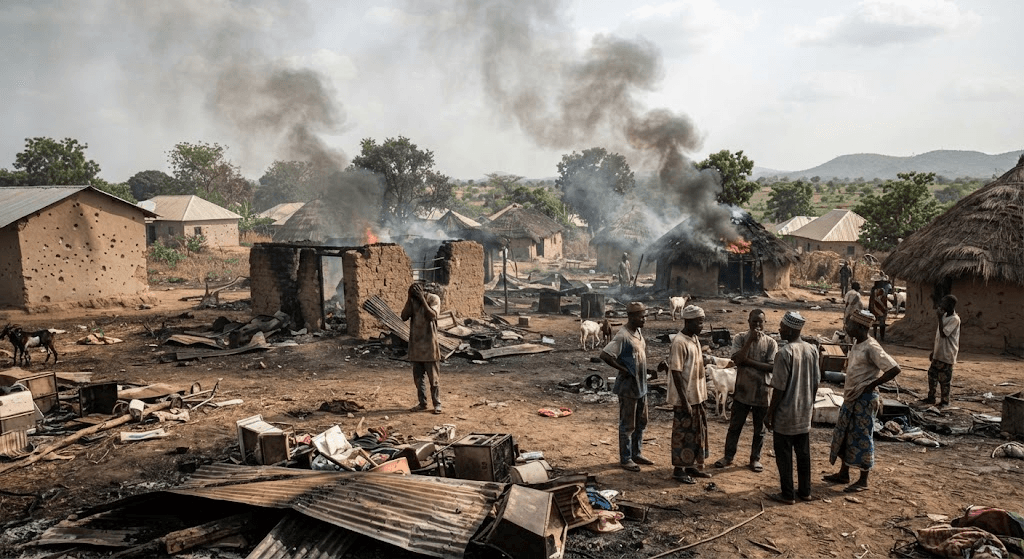
AI Image Disclaimer Visuals are AI-generated and intended as interpretive representations of reported events, not documentary photographs.
Sources Reuters, Associated Press, BBC News, Al Jazeera, The Times of Israel
Published by Banx Network. This article is part of the Banx decentralized media programme, powered by the BXE token on the XRP Ledger.