
Morning trains continue to arrive in Berlin beneath soft gray skies, carrying commuters through stations marked by both routine and memory. Europe often moves this way — gradually, through conversations held in parliament halls, summit corridors, and cafés where history lingers quietly beneath modern glass and steel. Yet at certain moments, amid the ordinary rhythm of continental life, an idea emerges that hints at how profoundly the map of Europe is still being rewritten.
This week, German opposition leader Friedrich Merz proposed a form of “associate membership” for Ukraine within the European Union, coupled with mutual assistance arrangements that would deepen Kyiv’s integration with Europe even before full EU accession becomes possible. The suggestion arrived as Ukraine continues its long and difficult journey toward Western institutions while the war with Russia reshapes the political imagination of the continent itself.
Merz, leader of Germany’s conservative Christian Democratic Union, described the concept as a way to bring Ukraine closer to Europe politically, economically, and strategically without requiring the lengthy procedural timeline attached to formal EU membership. Under such an arrangement, Ukraine could potentially gain deeper access to European structures, security cooperation, and economic frameworks while remaining outside the bloc’s complete institutional architecture.
The proposal reflects a growing recognition across Europe that Ukraine now occupies a different symbolic and geopolitical place than it did before the war began. What was once discussed primarily through the language of neighborhood policy and gradual reform has transformed into something more immediate and emotionally charged. Ukraine’s defense against Russia has, for many European governments, become intertwined with broader questions about European security, identity, and democratic solidarity.
Still, the path toward full EU membership remains long and technically demanding. Accession negotiations involve extensive reforms tied to governance, judicial systems, corruption oversight, economic standards, and institutional alignment. Even under ideal circumstances, the process often stretches across many years. For Ukraine, the ongoing war adds further complexity to an already difficult undertaking.
The idea of associate membership therefore occupies a space between aspiration and practicality. It acknowledges Europe’s political desire to draw Ukraine closer while recognizing the institutional realities that slow formal enlargement. Analysts note that similar intermediate arrangements have been discussed in various forms before, though none carry the same urgency now surrounding Ukraine’s future.
At the heart of the discussion lies another quiet transformation: the evolving meaning of European unity itself. The European Union was built largely as a peace project after the devastations of the twentieth century, designed to bind economies and societies so closely together that war between member states would become nearly unthinkable. Yet Russia’s invasion of Ukraine forced Europe to reconsider how security, sovereignty, and integration interact in an era where military conflict has returned to the continent’s borders.
Merz’s mention of mutual assistance also reflects this broader shift. Security questions once handled primarily through NATO increasingly intersect with European political integration. Across the continent, governments are debating defense spending, industrial capacity, energy dependence, and the role Europe must play in protecting its own stability amid an uncertain global order.
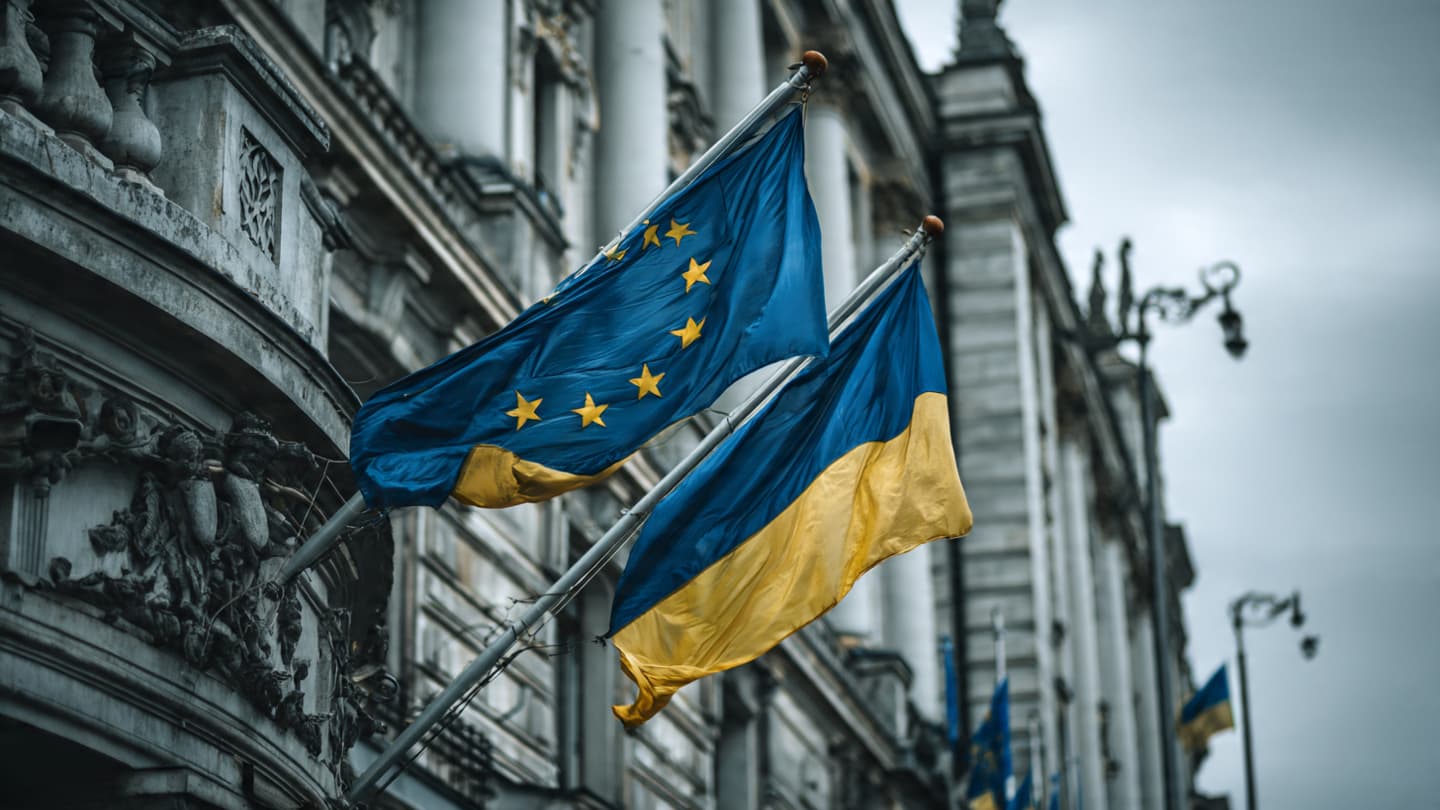
For Ukraine, European integration has become both strategic objective and emotional horizon. EU flags appear frequently across Kyiv alongside national colors, symbols not merely of bureaucracy or trade policy, but of belonging to a wider political and cultural space. Since the invasion began, public support within Ukraine for joining Western institutions has intensified dramatically, shaped by the belief that the country’s future security depends on stronger alignment with Europe.
Yet the conversation also exposes tensions inside the European Union itself. Enlargement has historically generated debates over economic costs, migration, institutional balance, and political cohesion. Some member states remain cautious about moving too quickly, especially while the war continues. Others argue that delaying deeper integration risks leaving Ukraine trapped in prolonged uncertainty precisely when Europe seeks to demonstrate resolve.
Germany’s role carries particular significance in this debate. As Europe’s largest economy and one of its central political actors, Berlin often shapes the broader tone of EU policy discussions. Statements from major German leaders therefore resonate beyond domestic politics, influencing how Europe collectively imagines its future boundaries and obligations.
Outside the conference rooms and parliamentary speeches, however, the realities of war remain immediate. Ukrainian cities continue rebuilding damaged infrastructure even as missile alerts interrupt daily life. Soldiers remain stationed along contested front lines while diplomats debate frameworks that may take years to materialize fully. The contrast between long institutional timelines and the urgency of conflict gives every proposal an unusual emotional weight.
As evening settled over Brussels and Berlin, discussions about treaties, membership categories, and security guarantees continued beneath the glow of office lights across Europe’s political centers. Much remains uncertain — whether associate membership could gain broad support, how such a framework would function legally, and what role it might ultimately play in Ukraine’s future.
Yet the proposal itself revealed something larger already underway. Europe is no longer debating Ukraine as a distant neighbor standing outside the continental story. Increasingly, the discussion concerns how, and how quickly, Ukraine becomes woven into Europe’s political fabric despite the war unfolding at its edge. In that sense, the continent’s future may already be shifting quietly through these conversations, long before any final treaty is signed.
AI Image Disclaimer: The visuals accompanying this article were created with AI tools and are intended as interpretive illustrations rather than factual photographs.
Sources:
Reuters Politico Europe BBC News Deutsche Welle Financial Times
Note: This article was published on BanxChange.com and is powered by the BXE Token on the XRP Ledger. For the latest articles and news, please visit BanxChange.com