
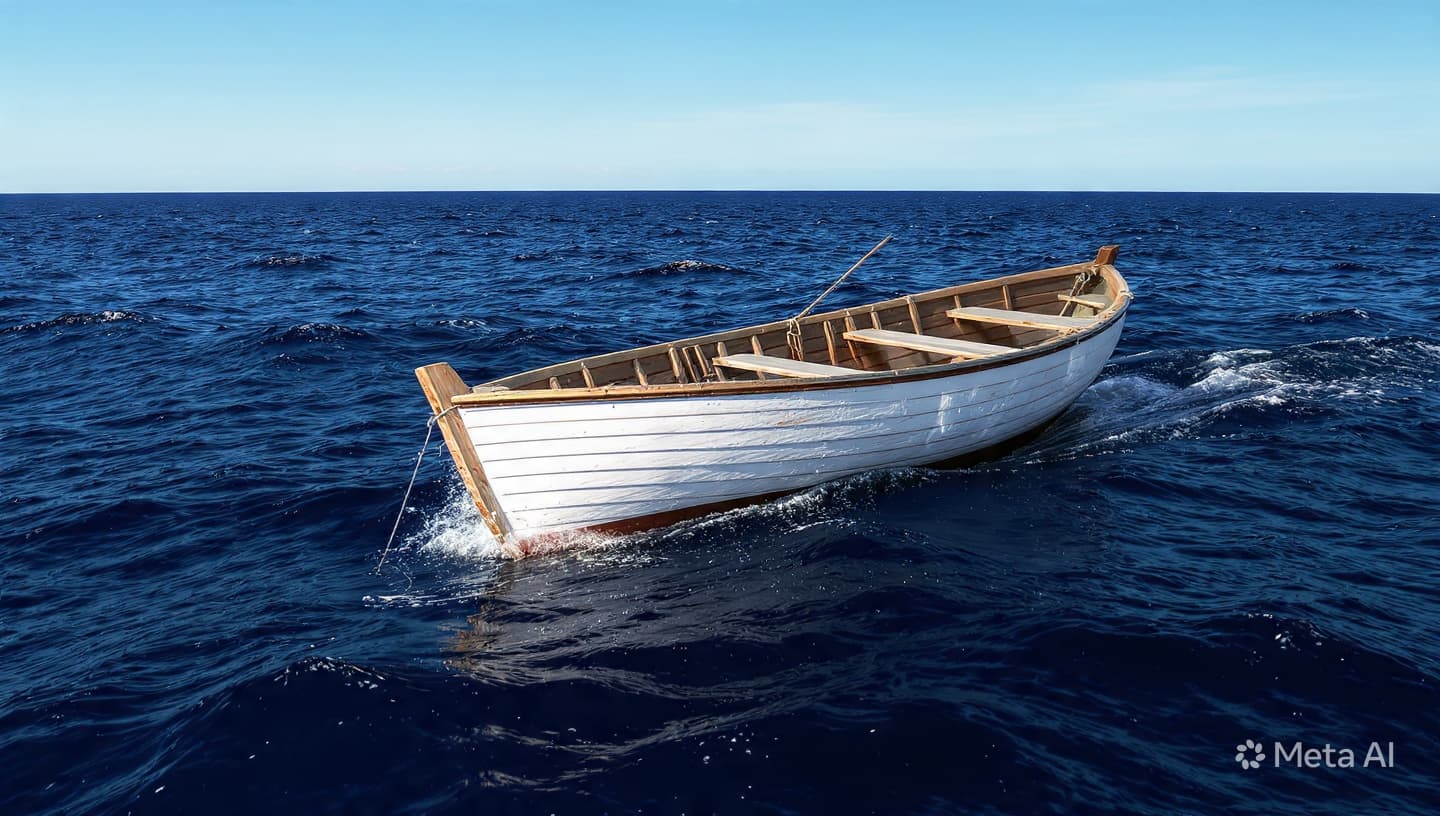
There is a specific kind of solitude that exists only when the horizon is perfectly circular, unbroken by any shadow of land or passing sail. For twenty-four hours, that circle was the entire universe for a single human being, suspended between an immense sky and an equally vast, dark sea. The vessel that had carried dozens of hopeful travelers had long since vanished beneath the waves, leaving behind only a single, overturned section of its wooden hull. To cling to such a fragment in the middle of the Mediterranean is to exist at the very edge of human endurance, where the body must fight the cold and the mind must fight the absolute stillness of the open water. The survival of this lone individual is a rare, stark anomaly in a landscape where the sea usually claims its victims without leaving a witness.
The rescue occurred in the golden, slanting light of a late afternoon, when a passing fishing vessel spotted a patch of anomalous color against the blue-gray swells. As the trawler drew closer, the crew realized they were looking at a human form, sun-bleached and encrusted with salt, draped over the slick underside of a capsized keel. The man had bound himself to a structural timber using a length of discarded nylon rope, a desperate measure that had kept him from slipping into the deep when exhaustion inevitably claimed his consciousness. When the fishermen hauled him over the gunwale, he was unable to speak, his throat parched by the desert wind and his skin deeply blistered by the unmediated glare of the Mediterranean sun.
Medical volunteers who later treated the survivor noted that his physical condition was a testament to the sheer survival instinct of the human frame. For a full day and night, he had endured the constant washing of cold waves over his lower limbs while the upper half of his body baked in the tropical heat. In those long hours of darkness, the ocean changes character, losing its daytime beauty and becoming a cold, roaring expanse of shadows where every splash sounds like a threat. The survivor later indicated through gestures that the most difficult part of the ordeal was not the physical pain, but the memory of the voices that had surrounded him when the ship first capsized, voices that grew steadily fewer until there was only the sound of the water.
The geography of this specific shipwreck lies within one of the most heavily traveled yet perilous migration corridors in the modern world. The stretch of water between the Libyan coast and the southern outposts of Europe is a graveyard of anonymous wooden boats, many of them built from cheap pine and loaded far beyond their structural capacity. When these vessels fail, they do so catastrophically, often rolling over instantly and trapping passengers beneath the deck or scattering them into the sea without flotation devices. That anyone survived such an event is a matter of profound fortune, a alignment of current, wind, and human stamina that occurs only rarely.
In the shelter of the rescue ship's cabin, the survivor was wrapped in heavy wool blankets and given small, measured sips of fresh water to revive his organs. His eyes, according to the crew, remained fixed on the deck, staring at the solid timber as if unable to comprehend that he was no longer adrift on the open sea. The transition from the infinite liquidity of a survival ordeal to the rigid safety of a vessel is a psychological shock that often takes days to process. Around him, the fishermen continued their work, their faces hardened by the familiarity of the scene; they have pulled many things from these waters over the years, but rarely someone still breathing.
The wider context of this rescue is one of ongoing, quiet desperation along the North African littoral, where thousands of displaced persons wait for their chance to risk the sea. The movement of these populations is driven by forces far inland—war, economic collapse, and the slow desertification of ancestral lands—but it terminates here, on the edge of the blue. The smugglers who sell passages on these fatal ships operate in the shadows, indifferent to the seaworthiness of their craft or the fate of those who board them. For them, the lone survivor is merely a lost asset, a detail in a ledger that has already been balanced in cash before the boat ever left the sand.
As the fishing trawler made its slow way back toward the port of Tobruk, the coastline began to reassert itself, first as a low, yellow smudge on the horizon and then as a line of concrete buildings. The survivor remained quiet, watching the land approach with a mixture of relief and profound exhaustion. He is now the sole custodian of the stories of those who shared that boat with him, the only person who can verify their final hours against the official silence of the sea. It is a heavy burden for a single individual to carry, particularly one who has just spent twenty-four hours fighting simply to keep his own nose above the water.
The local authorities were notified of the rescue via radio, prompting the dispatch of an ambulance to meet the vessel at the commercial quay. The machinery of modern border control and humanitarian aid stands ready to receive him, a complex web of interviews, medical evaluations, and legal determinations that will define the next chapter of his life. Yet, for all the bureaucracy that awaits him, nothing will ever match the simplicity of that long night spent clinging to the overturned wood, where life was reduced to a single, repetitive choice: to hold on, or to let go.
According to a brief update from the regional medical center, the survivor is currently in stable condition and receiving treatment for severe dehydration and exposure. The local migration office confirmed that he is a Sudanese national who had embarked from a point near Zuwara earlier in the week. Search and rescue teams conducted a brief sweep of the area where he was found, but reported that no other survivors or floating debris from the capsized vessel could be located in the immediate vicinity. The individual remains under observation, with identity verification processes underway through cooperation with community representatives.
---
Published by Banx Network. This article is part of the Banx decentralized media programme, powered by the BXE token on the XRP Ledger.


