
Key Highlights
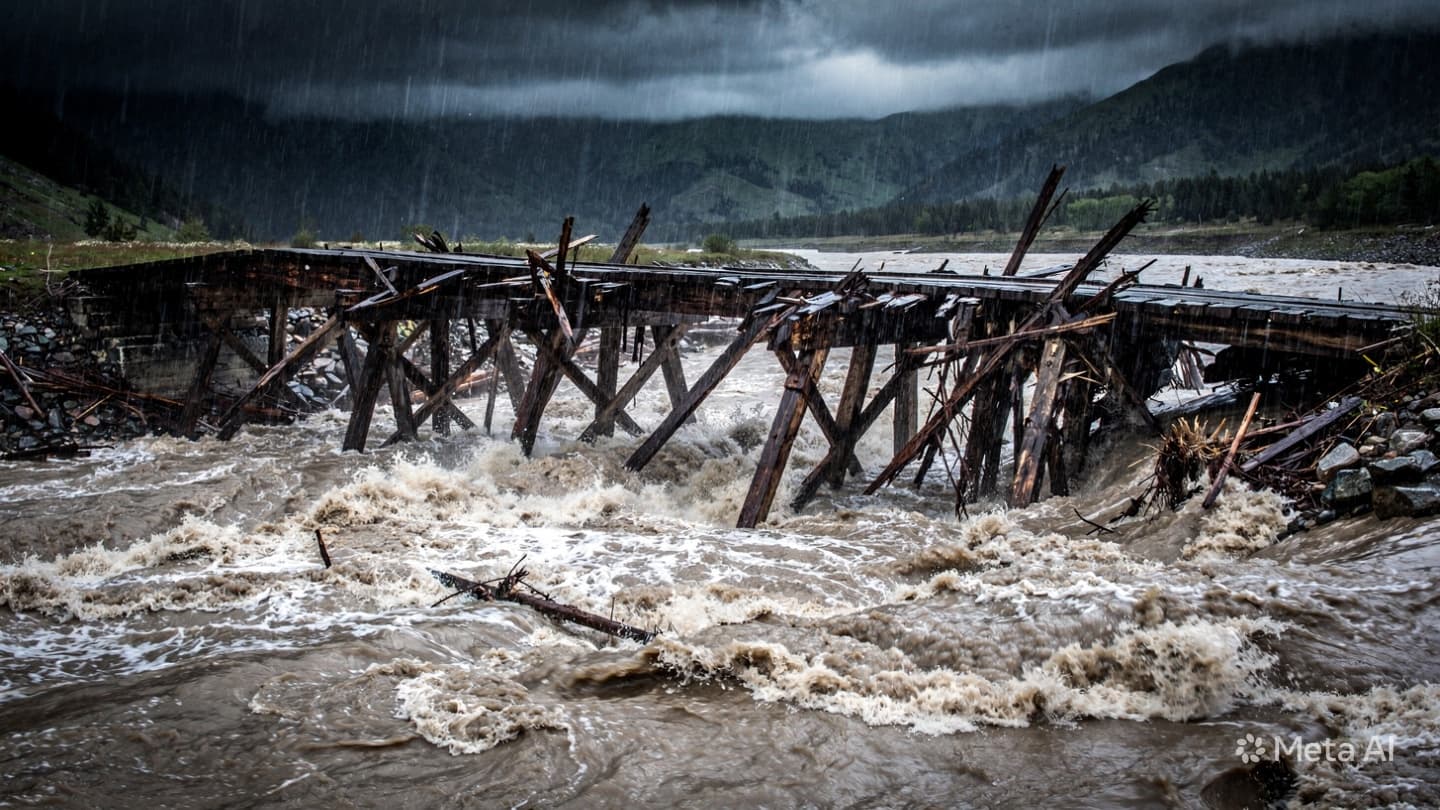
- Timber bridges in remote villages have collapsed due to severe flooding.
- Over fifteen villages are now isolated from essential services.
- Local authorities are preparing emergency supply drops for affected residents.
The valleys of the far north are not merely affected by monsoon rains; they undergo a dramatic transformation as the clouds settle into the limestone crevices, turning the red clay earth into a slick, shifting landscape. In these high-altitude settlements, life is traditionally anchored to narrow mountain passes and rustic wooden bridges that span the rushing river networks. For generations, these timber structures, crafted from local forests, have served as vital connections to markets, clinics, and schools, linking remote hamlets to the broader world.
However, when the mountain waters swell to their terrifying capacity, these old wooden crossings struggle to withstand the force of the rushing river. Tons of debris—uprooted trees, heavy boulders, and dense silt—batter the support columns, causing the timber framework to groan and ultimately collapse under the immense weight of the deluge. Witnessing a primary crossing wash away is akin to watching the geography of a community contract, as the opposite bank, once a short walk away, becomes as inaccessible as a distant continent.
The silence that envelops the isolated banks is pierced only by the deafening roar of the muddy water, a constant reminder of the physical barrier that has emerged overnight. Families gather at the edge of the broken approach road, staring across the wide, churning expanse at a landscape that feels irrevocably altered. The loss of the bridge is not merely an inconvenience; it signifies a profound social severance that disrupts the delicate balance of rural life, forcing the community to rely solely on whatever food reserves and medical supplies they have on hand.
As the rain continues to fall in steady sheets, local inhabitants must adapt to a sudden, enforced self-reliance. Small footpaths that once led to neighboring fields are now fraught with anxiety, as the rising water table threatens to transform every minor stream into an impassable torrent. The villagers' immediate response is marked by quiet resilience, characterized by a shared understanding of the season’s perils and a stoic patience that has long defined the people of these rugged highlands.
In response to the crisis, the Phongsaly Provincial Department of Public Works and Transport has deployed emergency engineering units to assess the damage and explore temporary transit solutions. Local officials report that over fifteen remote villages remain physically disconnected from the main district center due to the structural failure of the bridge. While dangerous water levels currently hinder the installation of a temporary pontoon bridge, regional disaster management teams are preparing emergency supply drops to be deployed as soon as weather conditions allow.
The situation underscores the vulnerability of rural communities to natural disasters and the critical importance of infrastructure in maintaining connectivity and access to essential services. As these villages navigate the challenges posed by the flooding, the resilience of their inhabitants will be tested, highlighting the need for ongoing support and intervention from local authorities and humanitarian organizations.
Published by Banx Network. This article is part of the Banx decentralized media programme, powered by the BXE token on the XRP Ledger.



