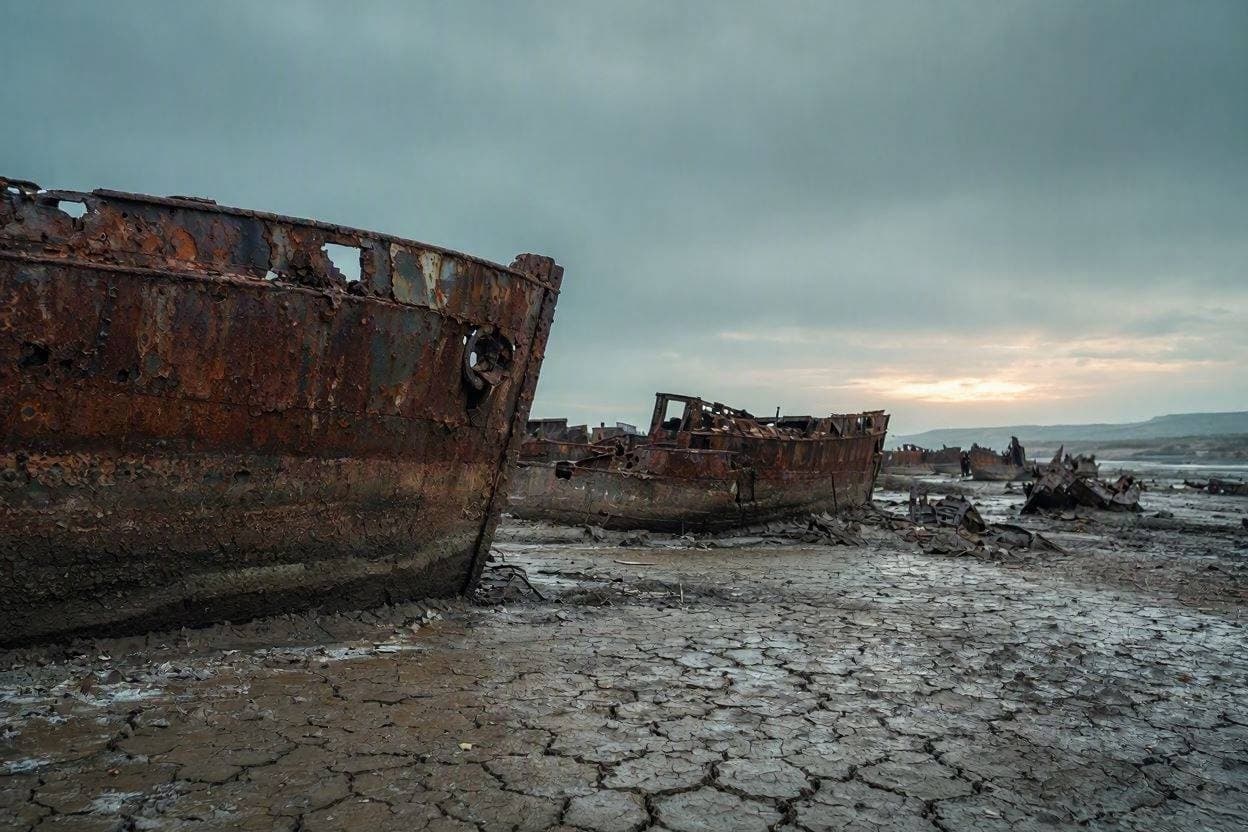
Rivers are often seen as eternal forces, carving their paths through history with relentless consistency. Yet, the Danube, Europe’s second-longest river, has recently revealed a fragile vulnerability. As persistent heat and drought grip the continent, water levels have plummeted to record lows, exposing secrets long submerged beneath its surface. Among the most striking revelations are the rusted hulks of German warships from World War II, silent witnesses to a conflict that ended decades ago but now resurface as stark reminders of both historical trauma and contemporary climate crisis.
Near the town of Prahovo in Serbia, the receding waters have unveiled a graveyard of military vessels. These ships were scuttled by retreating Nazi forces in 1944 to block the river and hinder advancing Allied troops. For eighty years, they lay hidden, slowly corroding in the dark. Now, baked by an unrelenting sun, their skeletal frames rise from the mud, creating a surreal landscape where history and environmental reality collide. The sight is haunting, a visual metaphor for how the past can re-emerge when the present becomes too hot to bear.
The emergence of these wrecks is not merely a historical curiosity; it poses significant navigational hazards. The Danube is a vital commercial artery, connecting the Black Sea to the heart of Europe. Low water levels already restrict cargo traffic, causing economic delays and increased costs. The exposed debris further complicates passage, forcing ships to navigate carefully or halt operations entirely. For local communities dependent on river trade, the situation is both an logistical challenge and an economic strain.
Beyond the immediate disruption, the phenomenon underscores the severity of the ongoing drought. Climate scientists warn that such extreme weather events are becoming more frequent and intense across Central and Southern Europe. The drying of major rivers like the Danube and the Rhine signals a shift in regional hydrology, with implications for agriculture, energy production, and biodiversity. The warships are just the most visible symptom of a deeper ecological imbalance.
Efforts to clear the wreckage are underway, supported by European Union funds aimed at improving river safety and navigation. However, the scale of the task is immense. Each vessel must be carefully assessed for explosives and hazardous materials before removal. The process is slow and expensive, reflecting the long-term costs of both war and climate neglect. It is a cleanup operation that bridges generations, addressing the legacy of one crisis while managing the impacts of another.
For historians, the exposure offers a rare opportunity to study these artifacts up close. They provide tangible links to the final stages of World War II in the Balkans, offering insights into military strategies and the human cost of conflict. Yet, this academic value is overshadowed by the urgency of the environmental context. The ships are not just relics; they are indicators of a planet under stress.
The emerging warships of the Danube serve as a powerful symbol of our times. They remind us that history is never truly buried and that the environment holds memories we cannot ignore. As water levels fluctuate with the changing climate, we are forced to confront both our past conflicts and our present vulnerabilities. The river, once a symbol of continuity, now reflects the uncertainty of our future.
AI Image Disclaimer: The visual elements accompanying this report are AI-generated interpretations designed to reflect the historical and environmental context of the story.
Sources: Smithsonian Magazine Euronews ABC News
Note: This article was published on BanxChange.com and is powered by the BXE Token on the XRP Ledger. For the latest articles and news, please visit BanxChange.com