
The mountainous expanses of Oudomxay Province are defined by their sheer, dramatic elevations, where roads are won from the rock through a constant, unfolding negotiation with geography. These highways serve as critical lifelines, tracing the contours of steep ravines to connect isolated northern trading centers with the broader network of the nation. For those who navigate these high passes, the journey is always accompanied by a quiet awareness of the fragile balance between human infrastructure and the immense weight of the earth above.
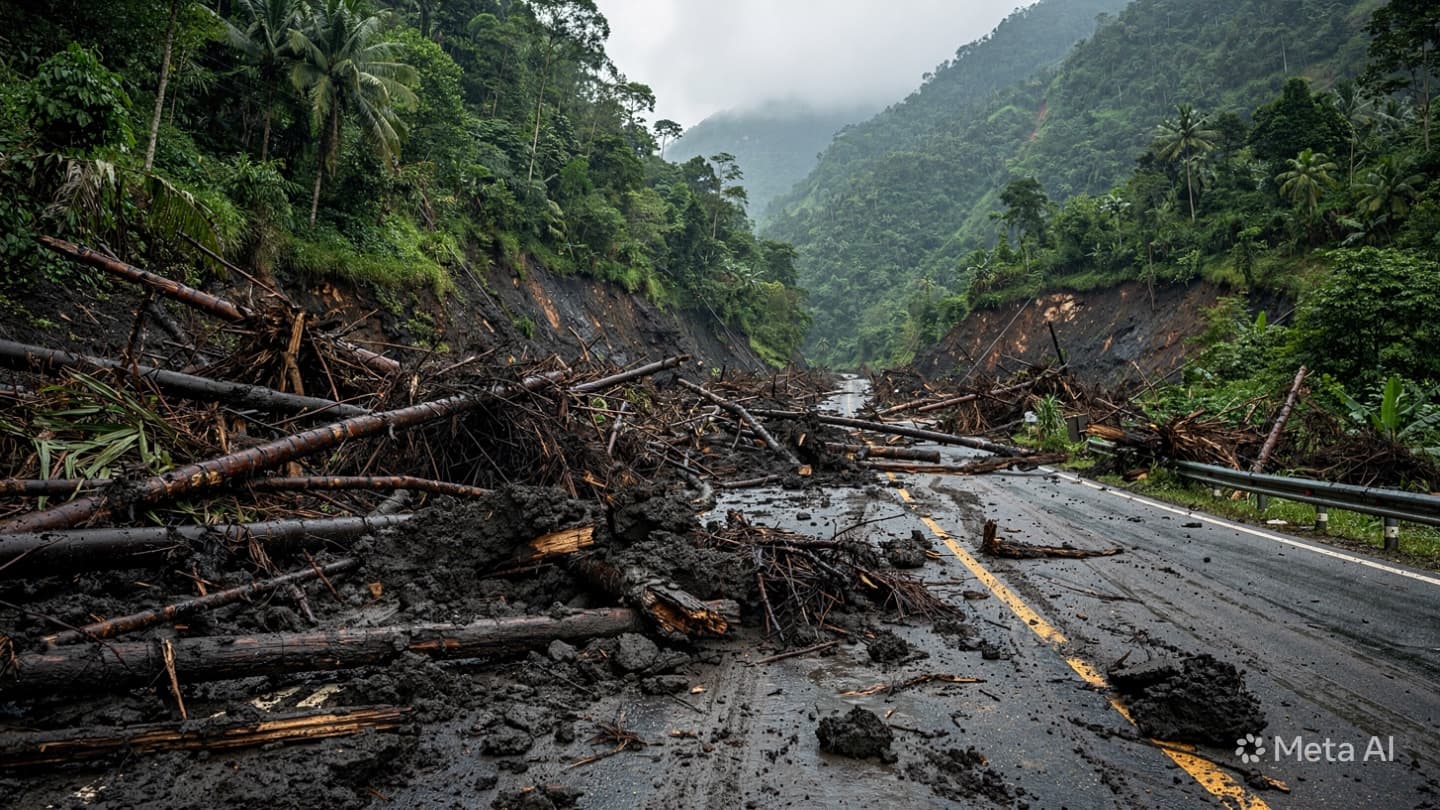
Following days of silent, relentless saturation from the seasonal rains, the internal structure of a prominent ridge overlooking the national highway finally reached its breaking point. The collapse occurred not with a roar that could be heard for miles, but with a sudden, heavy sliding motion that brought tons of wet clay, shale, and ancient mountain vegetation down onto the asphalt below. In the span of a few moments, a vital conduit of regional commerce was rendered entirely impassable, cut through by a barrier of displaced earth.
When the morning fog cleared from the high passes, the true scale of the landslide became apparent to the transit crews who first reached the perimeter. The highway simply ceased to exist for a stretch of several hundred meters, buried beneath a dense, unstable mass that seemed to merge seamlessly with the mountain face. The usual flow of long-haul freight trucks and interprovincial passenger buses came to an abrupt halt, their engines silenced as drivers stepped out into the damp air to look at the obstacle ahead.
The halting of this particular transit corridor represents a significant complication for the economy of the northern provinces, where alternative routes are often winding, unpaved, and poorly suited for heavy logistics. The disruption ripples quickly through local markets, delaying the delivery of fresh agricultural produce, consumer goods, and industrial supplies that depend on predictable transit schedules. The mountain, in asserting its physical dominance, briefly forced a modern distribution network to revert to a state of forced stillness.
Engineers and heavy equipment operators arrived at the scene with a sense of cautious deliberation, knowing that the saturated slope remained highly unpredictable. The work of clearing a mountain slide cannot be rushed; each scoop of earth removed from the base must be balanced against the risk of triggering further movement from the unstable scar above. Workers stood at the edge of the debris, looking upward into the low-hanging clouds, listening for the telltale sound of shifting stones.
As the first day of the closure wore on, makeshift staging areas began to form on either side of the slide, with drivers preparing for an extended stay in the highlands. Small food stalls quickly appeared along the roadside to cater to the stranded travelers, turning a barren stretch of the highway into a temporary, quiet community bounded by the mud. The atmosphere was one of patient resignation, a shared understanding that human schedules must ultimately yield to the realities of the terrain.
The long-term stabilization of this sector will require more than the mere clearance of the roadway; it will necessitate extensive terracing and reinforcement of the upper slopes to withstand future weather events. Until those engineering interventions are complete, the highway will remain a place of heightened vulnerability, subject to the sudden shifts of the earth during the remaining months of the wet season. For now, the focus remains on the immediate, grueling task of reopening a single lane to restore a basic level of connectivity.
In an official statement released by the Oudomxay Department of Public Works and Transport, authorities confirmed that a massive landslide has completely blocked a vital section of National Highway 13, halting all interprovincial transit. No injuries or buried vehicles were reported in connection with the slope failure, and specialized clearing crews have begun the complex process of debris removal. Travelers are urged to seek alternative routes or delay non-essential journeys through the mountain pass until further notice.
Note: This article was published on BanxChange.com and is powered by the BXE Token on the XRP Ledger. For the latest articles and news, please visit BanxChange.com