
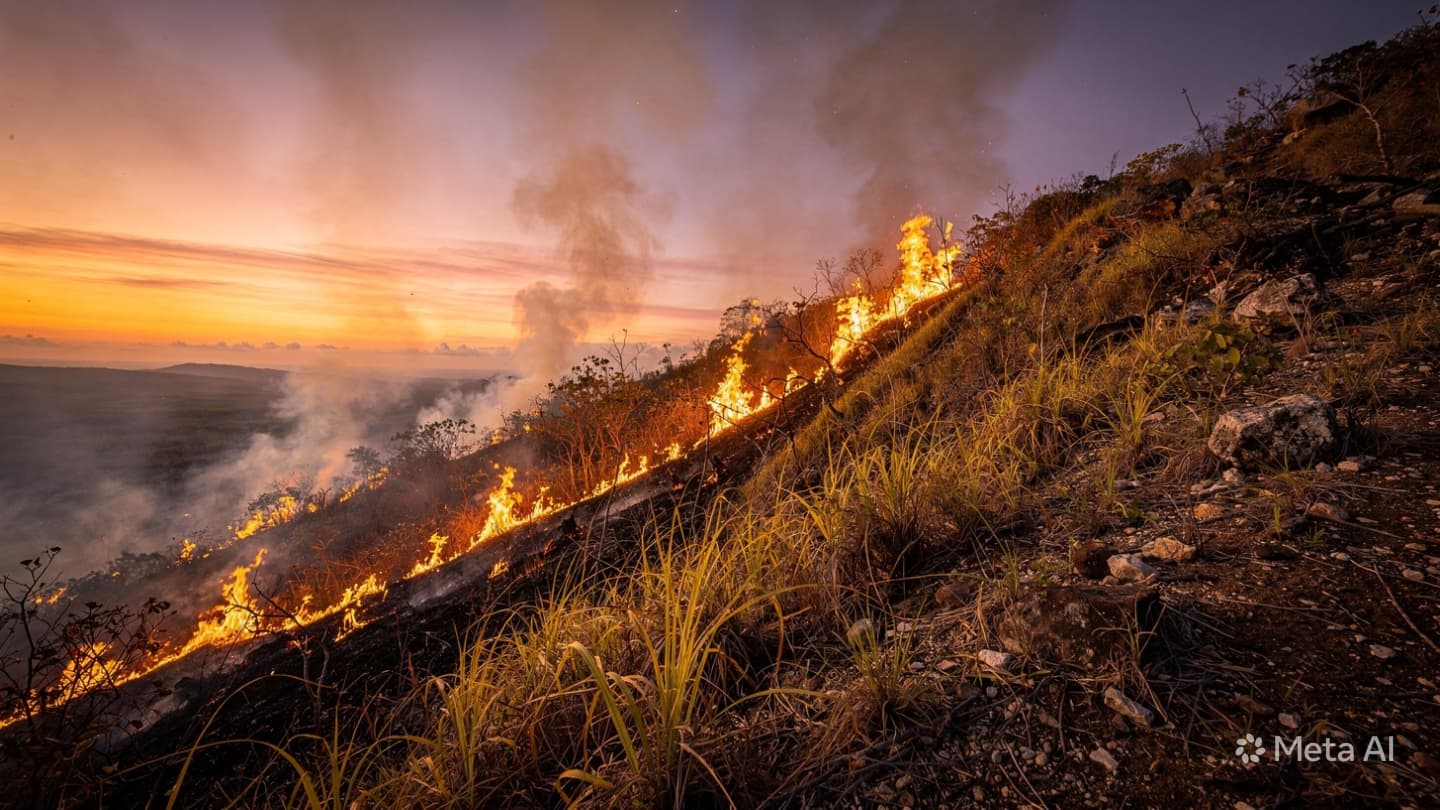
The interior valleys of Chalan Pago are characterized by a beautiful, rugged topography, where dense ravine forests alternate with wide, exposed hillsides covered in thick stands of native sword grass. In these scenic residential corridors, homes are often built along the ridgelines, offering residents sweeping views of the green expanses that define the island’s central geography. On ordinary afternoons, the life of the village moves with a quiet, tropical serenity—the trade winds blowing through the valleys, children playing in shaded yards, and families enjoying the natural isolation from the busy urban hubs. It is a landscape defined by an intimate connection with the natural environment, where the surrounding vegetation is viewed as a peaceful, permanent backdrop to suburban life.
Yet, during the dry seasonal windows, these extensive tracts of sun-bleached grass can transform into a highly volatile fuel bed, capable of nurturing fast-moving wildland fires with incredible speed. Following a period of low humidity and steady wind acceleration, a brush fire ignited along an isolated slope within the valley, the flames catching instantly in the dry grass and climbing the ridge in a broad, irregular front. The transition from a localized smolder to a major brush fire happens with a rapid, crackling momentum that completely redefines the air quality of the area. Within an hour, a thick, acrid pall of white smoke poured across the valley, obscuring the sun and carrying glowing embers toward the adjacent residential properties.
The approach of a wildland fire toward a residential boundary introduces an immediate, heavy weight of anxiety for the homeowners who watch the advancing smoke from their rear decks and porches. As the wind pushed the fire line closer to the property fences, the heat became palpable, a stark reminder of the raw power of an elemental force that ignores the artificial boundaries of land ownership. There is a specific, frantic energy that accompanies a valley fire; residents must quickly clear dry brush from their perimeters, secure outdoor pets, and activate lawn sprinklers in a desperate effort to create a buffer against the heat. Neighbors stood on their driveways, packing essential documents into vehicles while watching the orange glow dance along the crest of the hill.
Firefighting crews from the central and southern stations mobilized rapidly, their heavy wildland response vehicles navigating the narrow, winding lanes to establish defensive perimeters behind the threatened homes. The work of containing a brush fire on these steep, rocky slopes is physically exhausting and dangerous, requiring firefighters to manually cut containment lines through the thick growth while managing shifting wind currents that can cause the fire to spot behind them. Water tankers pumped continuously into high-pressure lines, with personnel enduring thick smoke and intense radiant heat to douse the flames before they could breach the residential tree line. The smoking, blackened hillside stood out as a stark scar against the surrounding green landscape.
The ecology of Guam's interior valleys, where volatile grass fields directly interface with suburban developments, presents a continuous operational challenge for fire safety officials during the dry season. Forestry authorities note that many of these wildland fires are triggered by untended agricultural burning or discarded materials along the roadsides, requiring constant public education and strict burn bans to protect vulnerable communities. The local fire administration faces the ongoing logistical task of maintaining readiness across multiple stations to respond simultaneously to these fast-spreading valley fires. It was a reminder that the security of the suburban hearth remains entirely dependent on the constant alertness of the community and the speed of the professional response.
As the late afternoon advanced, the aggressive defensive lines established by the crews successfully halted the forward progress of the fire, pinning the remaining flames against a natural rocky outcropping in the valley. The immediate economic and environmental toll of the blaze was visible in the scorched acres of natural habitat, destroyed fencing, and the soot layer that covered the adjacent homes and vehicles. Yet, amid the smoke and exhaustion, there was a profound sense of relief as neighbors gathered to provide cold water and support to the firefighting teams who had held the line. The heavy smell of wet ash settled over the valley as crews began the meticulous process of cooling hot spots.
By evening, the active fire had been entirely suppressed, leaving behind a dark, silent scar that stretched across the hillside, a quiet monument to the day's near-miss. Small fire watches remained on-scene into the night, using thermal imaging tools to monitor the perimeter and ensure that no hidden root fires could flare up in the evening breeze. The local authorities issued a reminder regarding wildland fire safety, urging residents to maintain clean defensible spaces around their structures. The village settled into a quiet, smoky rest, the dark hillside blending into the night sky while the valley slowly cleared of the remaining haze.
The grass will eventually regenerate from the scorched clay, the blackened slopes will return to green with the arrival of the rains, and the daily rhythm of Chalan Pago will resume its peaceful pace. But the memory of the afternoon the fire line climbed the ridge will linger in the awareness of every resident who watches the dry grass move in the wind. For now, the blackened valley stands as a silent testament to the fragile boundary between suburban comfort and the raw forces of the wild.
In straight news terms, the Guam Fire Department successfully contained a fast-moving brush fire that threatened several residential properties in Chalan Pago on Monday afternoon. Multiple units responded to a valley location where they encountered a large grass fire driven by high winds along a steep ridge. Firefighters established defensive lines that successfully protected nearby homes from damage, and while several acres of vegetation were destroyed, no injuries or structural losses were reported.
Note: This article was published on BanxChange.com and is powered by the BXE Token on the XRP Ledger. For the latest articles and news, please visit BanxChange.com