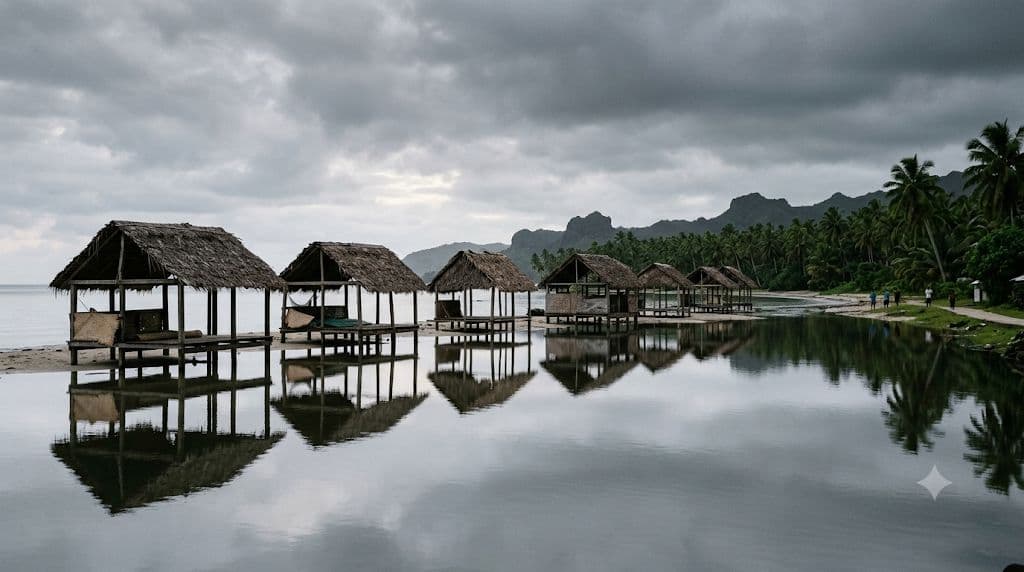
The sea does not always announce its arrival with the fury of a storm; sometimes, it merely breathes deeper, pushing its boundaries onto the land like a slow, fluid hand reaching for the shore. Along the southern and eastern coastlines of Upolu, the morning began not with wind, but with an unsettling weight in the water. Great, heavy swells, born far out in the vast expanses of the Pacific, traveled silently until they met the shallow fringes of the reefs. There, the blue curves broke into white foam, spilling far beyond the usual lines where sand meets vegetation.
For generations, the traditional beach fales have stood as open invitations to the elements, their wooden pillars holding up thatched roofs to catch the salt air. On this day, however, the ocean did not merely pass through; it lingered, filling the open-air floors with pools of dark water. As the tides climbed higher, the boundary between the sea and human habitation dissolved entirely. Low-lying family homes, tucked quietly along the coastal roads, found their yards transformed into shallow lagoons, reflecting the grey sky above.
Families watched from the relative safety of higher ground as the swells moved methodically through their properties. Small personal belongings, mats woven from pandanus leaves, and plastic chairs drifted listlessly across flooded gardens. There was little panic, for those who live by the Pacific understand its shifting moods, but there was a profound sense of gravity. The water moved with a heavy, quiet momentum, filling kitchens, dampening foundations, and leaving a thin crust of salt and silt on everything it touched.
Local community leaders and emergency response teams arrived as the afternoon waned, wading through knee-deep waters to check on elderly residents and relocate families whose homes had become completely uninhabitable. The immediate concern was not wind damage, as the air remained deceptively calm, but the persistence of the sea’s advance. Freshwater wells were at risk of contamination, and the soil, usually rich and supportive of local crops, swallowed the salt water with a thirst that boded ill for the coming planting season.
As night fell over Upolu, the sound of the ocean remained loud and heavy, a constant reminder of the thin margin upon which these coastal communities exist. Traditional stone paths that had connected families for decades lay hidden beneath the dark, shifting tide. Even as the high water began its agonizingly slow retreat, it left behind a landscape fundamentally altered by the intrusion. The dampness seemed to settle into the very bones of the villages, a silent testimony to a day when the horizon crept onto the land.
Disaster management authorities later confirmed that the inundation was triggered by a combination of distant sub-tropical depressions and an exceptionally high spring tide. This celestial alignment created a perfect corridor for high-energy waves to strike the island's most vulnerable coastlines without the warning of a local storm. Emergency shelters were opened in church halls further inland, providing dry bedding and clean water to dozens of displaced residents who could only wait for the sea to return to its proper basin.
The economic impact on the local tourism sector, which relies heavily on the rustic charm of beachfront accommodations, is expected to be felt for months to come. Many of the small, family-run operators saw their entire investments partially submerged within a matter of hours. Rebuilding will require not just labor, but a careful rethinking of how close to the water these structures can safely remain in an era of increasingly unpredictable sea behaviors.
By dawn, the immediate danger had passed, leaving behind a damp, salt-scented silence as residents began the long process of clearing debris from their doorsteps. The government has pledged immediate relief supplies, focusing on water purification kits and temporary sanitation facilities to prevent the outbreak of waterborne illnesses in the affected districts. For now, the people of Upolu look out at a calm blue horizon, knowing how easily that same beauty can overflow its bounds.
Published by Banx Network. This article is part of the Banx decentralized media programme, powered by the BXE token on the XRP Ledger.