
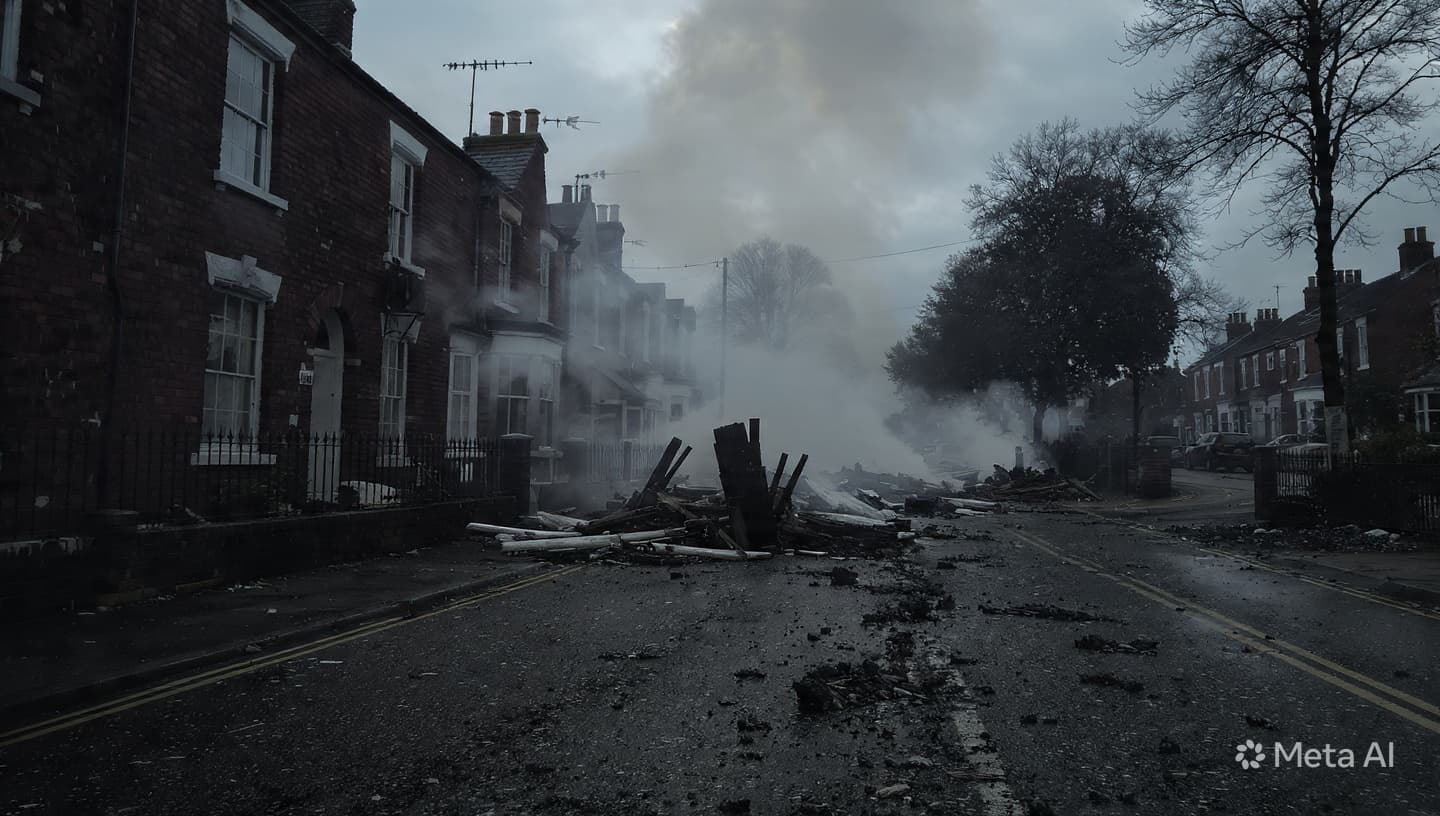
The evening does not arrive all at once; it seeps through the gray stone and damp air of North Belfast, carrying with it a stillness that feels more like a collective indrawing of breath than true peace. Along the Shore Road, where the water of the lough usually catches the fading amber of a summer twilight, the horizon was obscured by a denser, more immediate darkness. Fire has a way of altering a landscape, reshaping familiar thresholds into charred monoliths that speak of sudden, uncontained anger. To watch a residential home succumb to embers is to watch the intimate boundaries of human safety dissolve into the communal night air, leaving behind an empty frame where a life was quietly lived.
There is a particular vulnerability in a house left open to the elements by design or by force, its windows empty sockets looking out onto a pavement still warm from residual heat. The regional disorder that moved through these arteries did not announce itself with the grand gestures of history, but with the sharp crack of breaking masonry and the low, heavy rumble of gatherings in the dusk. On the West Circular Road, the passage of transit was replaced by a different kind of architecture—barricades constructed from the detritus of daily life, set ablaze to cast long, dancing shadows against the brick facades.
To stand at a distance from such moments is to observe how quickly a neighborhood can lose its familiar rhythms, replaced by the foreign geometry of blocked thoroughfares and the acrid scent of burning rubber. The smoke rolls low across the asphalt, obscuring the boundaries between what is collective and what is deeply personal. In those hours, the road ceases to be a conduit for coming home; it becomes a theater of statement, where masked figures move with a deliberate, urgent anonymity.
The physical materials of the city—the stones harvested from garden walls, the red brick that has stood for generations—become untethered from their original purpose in these hours of unrest. They are transformed into missiles, heavy with intention, cutting through the damp air toward lines of shields and flashing blue light. There is a weight to every fragment of masonry that leaves a hand, an irreversible momentum that carries with it the fragile peace of an entire afternoon.
When flares are ignited against the dark, they do not illuminate; they blind, casting a harsh, crimson glare over the faces of those who watch and those who hold the line. The brilliance is temporary, a sudden burst of heat and color that stains the retina before dying down into a thick, choking fog. In that fractured light, the space between safety and injury narrows to a matter of inches, a fraction of a second where a life can be altered by the trajectory of a blunt object.
Twelve men and women, clothed in the heavy protective gear of law enforcement, found their evenings ending not at home, but within the sterile, brightly lit corridors of regional hospitals. The physical trauma of impact—the bruising of flesh and the fracturing of bone—is accompanied by a quieter, more systemic exhaustion that settles over the entire city. It is the weariness of a populace that recognizes the choreography of conflict, having seen the same patterns etched into the concrete decades before.
As the small hours of morning arrive, the crowds dissipate into the labyrinth of side streets, leaving the main thoroughfares to the street sweepers and the slow, methodical investigations of forensic teams. The charred remains of vehicles are winched onto flatbeds, their metal frames groaning in the cold morning air, while local shopkeepers sweep up the glinting shards of tempered glass from their entryways.
The immediate impulse in the wake of such a night is to search for explanations, to bind the jagged edges of violence into neat paragraphs of cause and effect. Yet the stones themselves remain silent on the ground, offering no commentary on the grievances that set them in motion. The neighborhood returns to a superficial quiet, though the smell of smoke lingers in the curtains of the houses nearby, a stubborn reminder of how easily the night can be torn apart.
The Police Service of Northern Ireland confirmed that a series of coordinated disturbances across Belfast, Portadown, and Newtownabbey resulted in significant property damage and injuries to twelve officers. A residential property on the Shore Road was severely damaged in an intentional arson attack, while access roads were blocked by burning barricades. Authorities have arrested multiple individuals in connection with the rioting and have appealed for community leaders to help restore calm to the affected residential areas.
Note: This article was published on BanxChange.com and is powered by the BXE Token on the XRP Ledger. For the latest articles and news, please visit BanxChange.com