The limestone corridor connecting Podgorica to the historic valley of Cetinje is a landscape defined by its rugged permanence. For generations, travelers have traced these narrow mountain passes, hemmed in by towering gray cliffs that seem completely indifferent to the passage of time or the seasons shifting around them. It is a route born of human engineering cutting directly through stone, establishing a vital umbilical cord between the country’s modern administrative heart and its ancestral cradle.
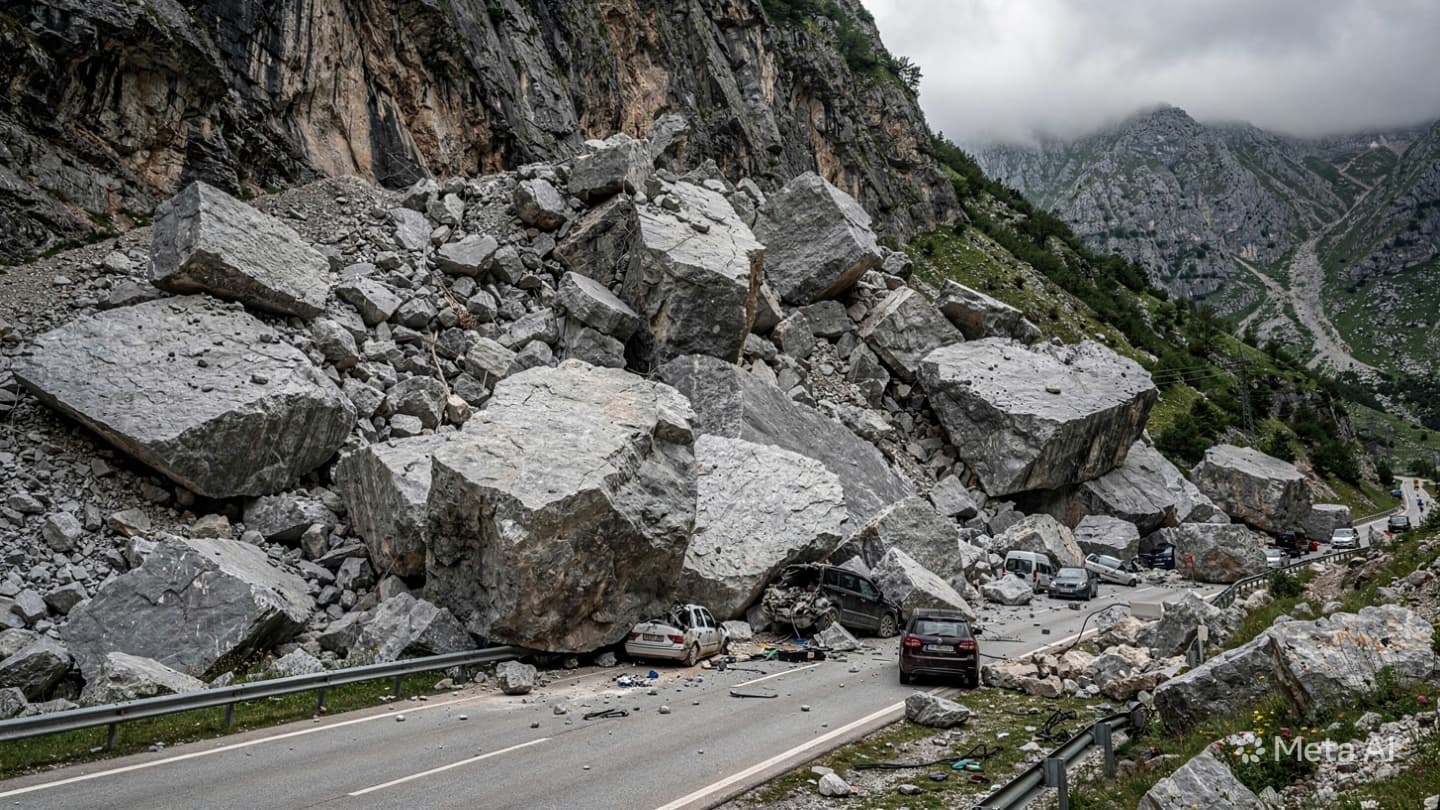
Yet, this impression of static endurance is occasionally exposed as an illusion, a temporary truce between infrastructure and the slow, inexorable forces of mountain geology. Without warning, a profound structural shift occurred along the steep slopes near the locality of Obzovica. It was not a gradual erosion, but a sudden, dramatic failure of the rock face, sending massive boulders cascading directly down onto the asphalt below.
The news agency Vijesti documented the immediate aftermath of the slide, capturing a scene where the primary highway was instantly erased beneath an impassable mound of debris. The event occurred with a stark, violent isolation, transforming a busy transit artery into a silent, dead-end corridor within a matter of seconds. For the drivers approaching the sector, the sudden appearance of the rockfall represented a jarring confrontation with the volatile architecture of the landscape.
To witness a major highway blocked by a mountain slope is to understand the fragile nature of regional connectivity in topographically challenging territories. The flow of commerce and daily commuting between the capital and the coastal municipalities was immediately severed, forcing a total reliance on distant, alternative bypasses. A quiet frustration settled over the long queues of vehicles, their engines falling silent as the realization of an extended delay took hold.
Emergency clearance crews from Crnagoraputa mobilized quickly, dispatching heavy industrial excavators and diagnostic teams to the fractured pass. The work of clearing such massive debris fields is a delicate, calculated process that requires operators to evaluate the upper slopes for secondary vulnerabilities before any material can be safely moved. Every boulder shifted represents a careful negotiation with the remaining rock mass, carried out under the watchful eyes of safety inspectors.
As the heavy machinery bit into the limestone blocks, traffic monitors re-routed the bulk of the regional transit through the Sozina tunnel corridor, immediately placing immense strain on secondary routes. These alternative pathways, suddenly saturated with heavy commercial trucks and displaced passenger cars, experienced significant slowdowns and minor logistical bottlenecks. The entire transit network of southern Montenegro felt the ripple effect of the single hillside failure.
The economic toll of such an interruption is measured not merely in the cost of fuel and delayed shipping schedules, but in the temporary fragmentation of regional communities. For several hours, the natural momentum of the province was noticeably slowed, a collective reminder of how entirely dependent modern society remains on a few narrow strips of pavement. The incident underscores the perpetual need for aggressive hillside stabilization and preventative netting along the nation's rocky transit corridors.
By evening, the persistent efforts of the engineering teams bore fruit, as the largest obstructions were systematically broken down and moved to the road shoulders. The highway was gradually reopened to alternating traffic, allowing the backlog of vehicles to resume their journeys through the mountain shadows. The mountain had reclaimed its stillness, leaving behind a freshly cleared stretch of asphalt and a subtle reminder of the landscape's underlying power.
The Auto-Moto Association of Montenegro confirmed that a major rockfall at Obzovica completely halted traffic on the Podgorica–Cetinje highway for several hours, damaging one commercial transport vehicle. Clearing crews successfully cleared the roadway by nightfall, restoring regular traffic flows following a comprehensive safety inspection of the adjacent cliff face.
Published by Banx Network. This article is part of the Banx decentralized media programme, powered by the BXE token on the XRP Ledger.