
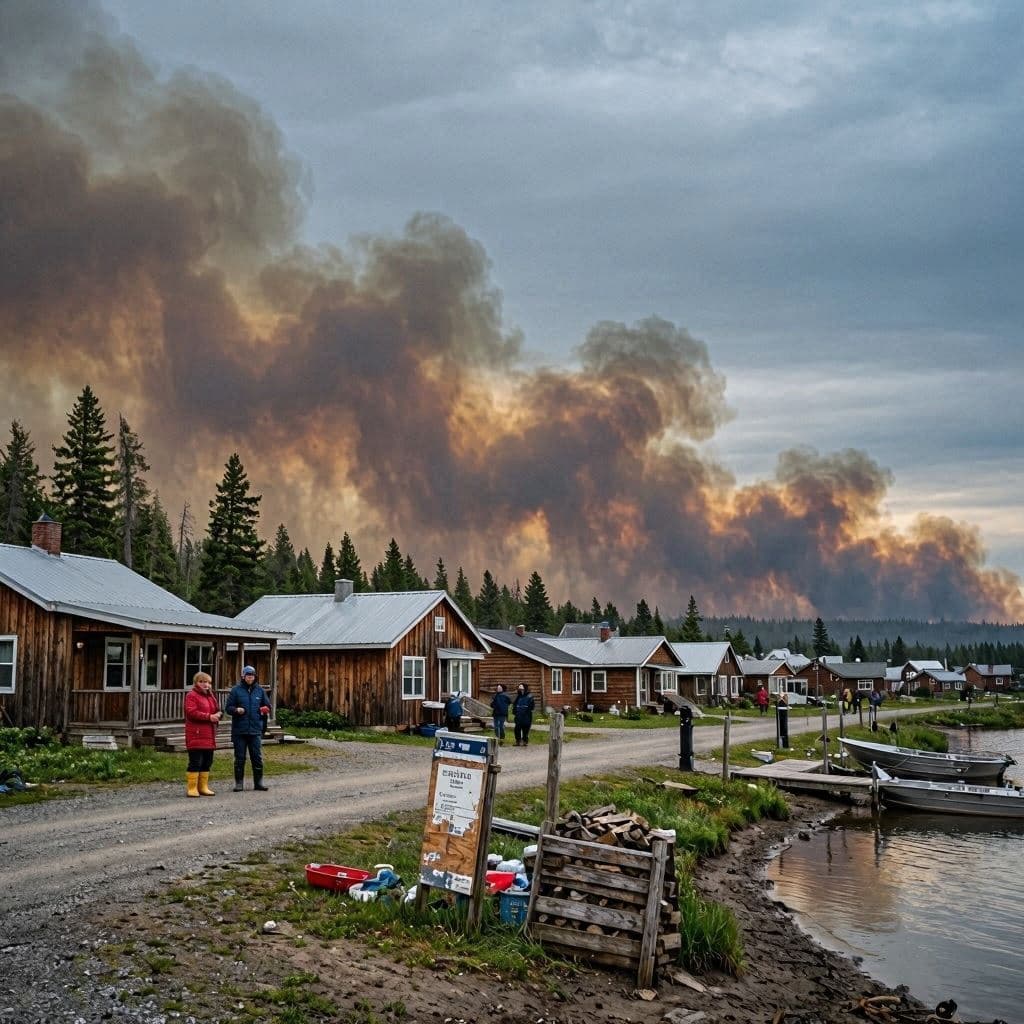
The northern forest often carries an image of endurance, where lakes mirror the sky and communities move with the rhythm of the land. Yet nature can change its language within moments, replacing familiar silence with a horizon that suddenly seems to move. For residents of a remote First Nations community in northwestern Ontario, that quiet transition became the beginning of an urgent evacuation.
At first, many residents believed there was no immediate danger. Thick smoke could be seen in the distance, but local accounts say they had been informed that the nearby wildfire was not expected to threaten the community right away. That sense of reassurance lasted only briefly before conditions shifted dramatically.
Residents of Namaygoosisagagun First Nation described watching an increasingly dense wall of smoke approach their homes. Visibility deteriorated quickly as changing weather and fire behavior accelerated the spread of smoke across the area. Community members began preparing to leave while emergency officials coordinated transportation to safer locations.
The evacuation reflected the growing challenges facing remote Indigenous communities during Canada's wildfire season. Limited road access and dependence on coordinated air or ground transportation can make rapid evacuations especially difficult when fire conditions change unexpectedly. Officials worked alongside community leaders to move residents while monitoring the evolving fire situation.
Across Canada, another active wildfire season has stretched emergency resources as numerous fires have burned across parts of northern Ontario and other provinces. Even communities located some distance from active flames have experienced hazardous smoke, reducing air quality and complicating daily life.
Health authorities have consistently warned that wildfire smoke may pose risks even when flames are not visible. Fine particulate matter can affect breathing, particularly for older adults, children, and people with existing respiratory or cardiovascular conditions. Public guidance generally recommends limiting outdoor exposure when air quality deteriorates significantly.
For many Indigenous communities, the wildfire season carries consequences beyond evacuation itself. Temporary displacement interrupts education, healthcare access, cultural activities, and local livelihoods, while uncertainty about returning home can weigh heavily on families waiting for updated assessments from emergency officials.
Emergency responders continue to monitor wildfire activity while supporting evacuated residents and assessing conditions for a safe return. The experience serves as another reminder that in wildfire-prone regions, conditions can evolve with remarkable speed, making timely communication and coordinated response essential for protecting communities.
AI Image Disclaimer: The accompanying illustration was created using artificial intelligence to visually represent the reported events and is not an actual photograph.
Sources (verified): CNN, The New York Times, Associated Press
Note: This article was published on BanxChange.com and is powered by the BXE Token on the XRP Ledger. For the latest articles and news, please visit BanxChange.com