
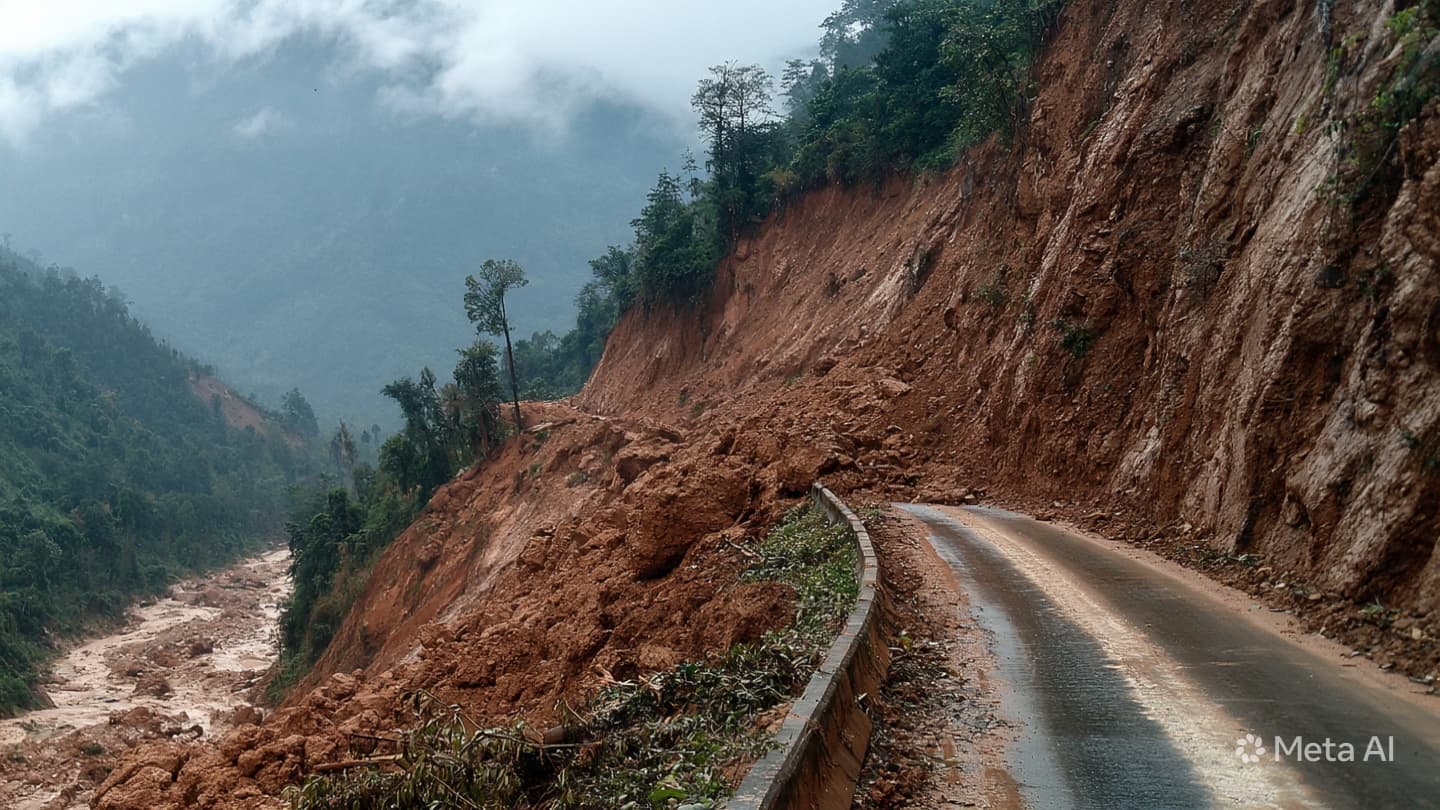
The highways of Oudomxay are arteries that cut through the ancient, forested fabric of the Laotian north. These roads represent a bold attempt to stitch together the disparate realities of the highlands, yet they exist in a landscape that remains fundamentally resistant to human geometry. When the monsoon rains descend, the mountain slopes, saturated and weary, eventually reach their limit. The result is the landslide—a sudden, violent rearrangement of the earth that turns the highway into a wall of mud and rock, a physical barrier that stops the flow of the nation in an instant.
To encounter a landslide while driving is to experience a jarring, cognitive shift. The landscape you were navigating—a route you understood as a predictable path—has been erased. In its place lies a chaotic, jumbled mass of debris that bears no resemblance to the road. For the vehicle caught in the path of such a slide, the transition is absolute. The sheer weight of the mountain, cascading with the force of a thousand tons, turns the steel chassis into a fragile, crushed object, a sobering monument to the power of the natural world against our modern, linear transit.
The loss of two lives under the weight of an Oudomxay landslide is a tragedy that speaks to the volatility of our intersection with this terrain. It is a reminder that the highway is not a static object; it is an environment in flux. As the recovery teams struggle to clear the debris, their work is constantly hampered by the threat of further movement, the earth still shifting, still settling, still reminding us that the mountain is the final authority on who may pass and when. The lives lost are the silent, solemn points of focus in a landscape that is otherwise defined by its sheer, indifferent scale.
Observing the aftermath, one is struck by the communal patience required to reopen these routes. The local authorities, the road construction crews, and the stranded travelers all coalesce into a temporary, expectant community, waiting for the path to be restored. It is a slow, methodical reclamation, as machines labor against the mass of the slide, one bucket at a time. The highway, for all its importance, is revealed to be a temporary convenience, a thin, vulnerable veneer draped over a geography that is perpetually in the process of reclaiming itself.
There is a reflective space in the contemplation of why we continue to build and traverse such unstable ground. The necessity of connection—of getting the harvest to market, of reaching the clinic, of visiting the family—is the driving force that keeps us on these roads. We are a species that refuses to be constrained by the topography, even when that topography warns us with every slide. The tragedy in Oudomxay is not a reason to stop, but a reason to reflect on the nature of our presence here, and the humility that must accompany our movement through the hills.
The resilience of the Laotian people in the face of these disruptions is a quiet, steady force. They accept the landslide as a part of the seasonal rhythm of the north, a tax paid to the mountains for the privilege of travel. They wait, they reroute, and they support one another in the long hours of the closure. This communal strength is the true foundation of their society, a spirit that remains intact even when the path is blocked and the way forward seems entirely buried under the weight of the mountain.
As the road is finally cleared and the traffic begins to pulse once more, the site of the slide remains a scarred, visible reminder of the event. Drivers pass by with a measured pace, their eyes scanning the slopes above for the next sign of movement. They know the geography of the risk, and they respect the power of the earth. We move on, but we do so with a deeper awareness of the precariousness of our passage, forever navigating the line between our desire for the road and the indifferent, overwhelming reality of the hills that surround us.
Published by Banx Network. This article is part of the Banx decentralized media programme, powered by the BXE token on the XRP Ledger.


