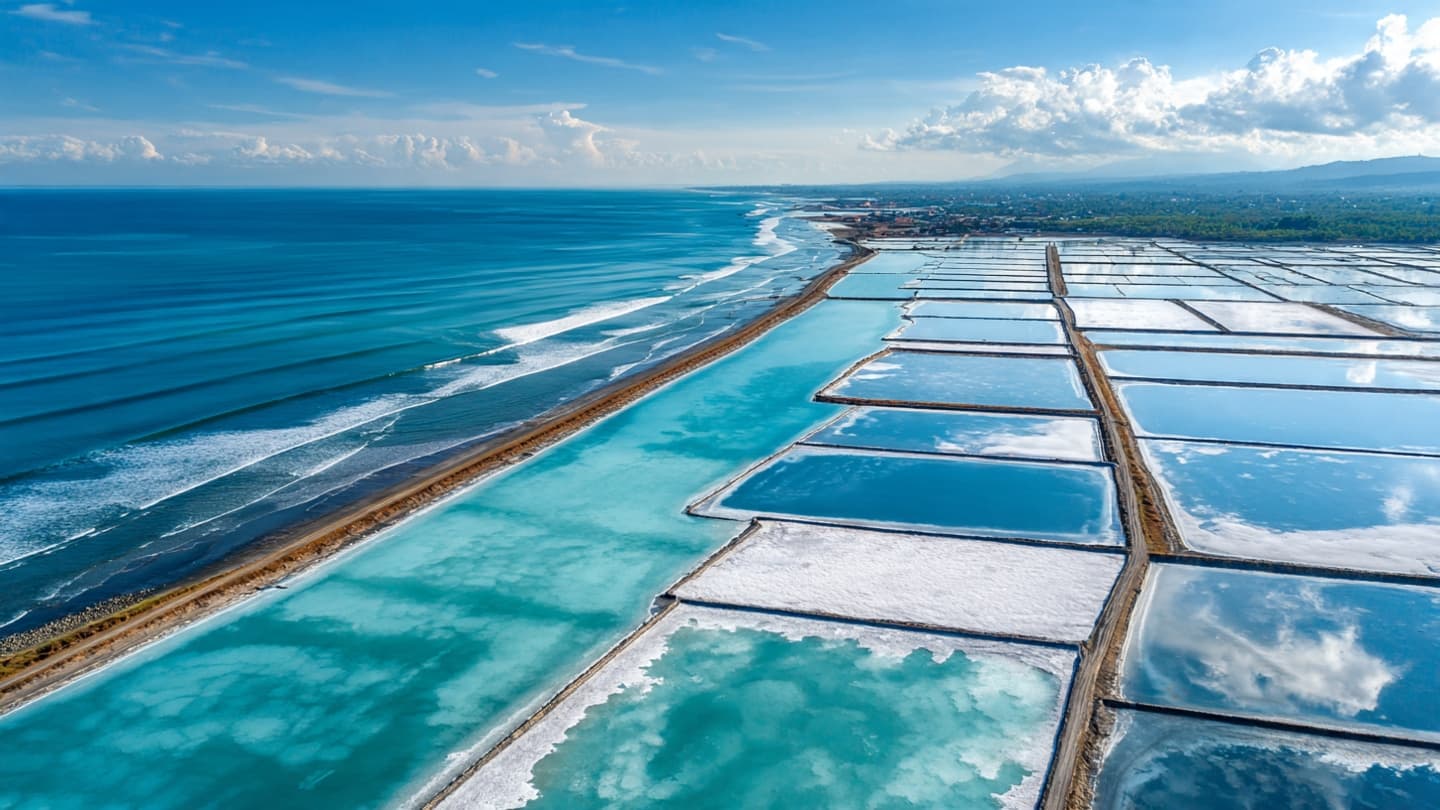
Along the northern coast of West Java, the landscape changes when the rain disappears. Pools of seawater sit beneath an open sky, slowly surrendering their moisture until crystals begin to form. In Cirebon, the dry season has brought conditions that salt farmers know well: bright sunlight, dry air, and long days with little interruption from rain.
Indonesia’s salt production in Cirebon has increased significantly during the current dry season, according to Reuters, as farmers take advantage of extended periods of sunshine. The report linked the conditions to a broader weather pattern influenced by El Niño, which has contributed to drier conditions in parts of Indonesia. (reuters.com)
For salt farmers, sunlight is more than scenery. It is part of the production process. Seawater is directed into shallow ponds where evaporation gradually removes the water and leaves behind salt crystals. The longer and more consistently the sun shines, the more favorable the conditions can become for harvesting.
This year's dry conditions have therefore created an unusual advantage for an industry that depends heavily on weather. Rain can interrupt evaporation, dilute saltwater ponds, and delay harvesting. A prolonged dry period, by contrast, can allow farmers to maintain production with fewer interruptions.
But the same weather that helps salt production can create difficulties elsewhere. Drought can place pressure on water supplies, agriculture, livestock, and ecosystems. For farmers, weather is rarely simply good or bad; its value depends on what is being grown, produced, or managed.
Cirebon’s salt fields offer a particularly visible example of that relationship. From a distance, the ponds can appear almost motionless, but beneath the still surface a slow physical process is taking place. Water is disappearing into the atmosphere while minerals gradually gather into the crystals that workers will eventually collect.
The work itself remains labor-intensive. Farmers must monitor ponds, move saltwater through different stages of evaporation, collect the finished crystals, and prepare them for transport. Technology can assist some stages, but weather remains one of the most influential forces in the process.
Indonesia has long sought to strengthen domestic salt production, particularly because the country has historically relied on imports to meet part of its industrial and consumption needs. Stronger local production can therefore contribute to a more stable domestic supply, although quality and consistency remain important considerations.
For now, Cirebon’s fields continue to brighten beneath the dry-season sun. The white crystals gathering across the coastal landscape are the visible result of seawater, labor, and weather working together. But as climate patterns become increasingly variable, farmers must continue adapting to a natural rhythm that can offer abundance one season and difficulty the next.
AI Image Disclaimer: The visuals are AI-generated representations created to illustrate the salt-production environment and are not actual photographs.
Sources:
Reuters Statistics Indonesia (BPS) Ministry of Marine Affairs and Fisheries of Indonesia Ministry of Agriculture of Indonesia BMKG
Note: This article was published on BanxChange.com and is powered by the BXE Token on the XRP Ledger. For the latest articles and news, please visit BanxChange.com