
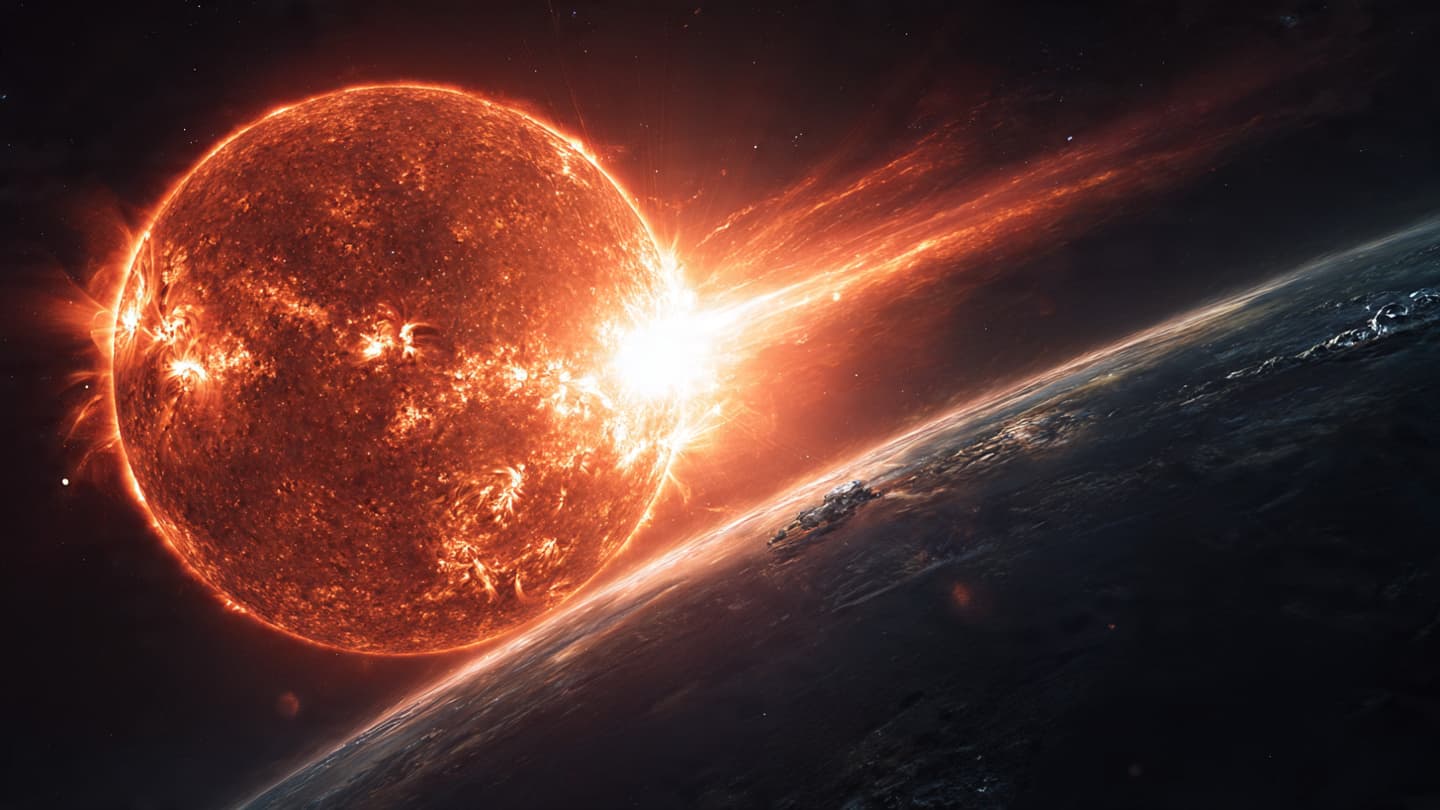
The Sun, though often perceived as constant and unchanging, is in fact a highly active star undergoing continuous magnetic activity. Among its most dramatic phenomena are coronal mass ejections, massive bursts of charged particles released into space.
Recent solar observations have recorded a significant coronal mass ejection traveling toward Earth. When these particles interact with Earth’s magnetic field, they create disturbances that can result in spectacular auroral displays.
Auroras occur when energetic solar particles collide with gases in the upper atmosphere. These collisions produce light emissions that appear as flowing curtains of green, red, and purple across the sky.
In strong solar events, these auroras can extend beyond their usual polar regions, becoming visible in areas where they are rarely seen. This makes them both a scientific and cultural phenomenon.
Space agencies such as NASA and NOAA monitor these events closely because they can also influence satellites, communication systems, and power infrastructure. While visually stunning, they are part of a complex space weather system.
The Sun follows an approximately 11-year solar cycle, during which periods of heightened activity increase the likelihood of such eruptions. Scientists study these cycles to better predict space weather impacts.
Beyond their technical significance, auroras also provide a reminder of Earth’s position within a larger cosmic system, where interactions between celestial bodies can become visible to the human eye.
In closing, this solar event highlights both the beauty and power of space weather, connecting scientific observation with one of nature’s most striking visual displays.
AI Image Disclaimer: Images are AI-generated for illustrative scientific visualization.
Sources: NASA, NOAA Space Weather Prediction Center, Space.com
Published by Banx Network. This article is part of the Banx decentralized media programme, powered by the BXE token on the XRP Ledger.



