
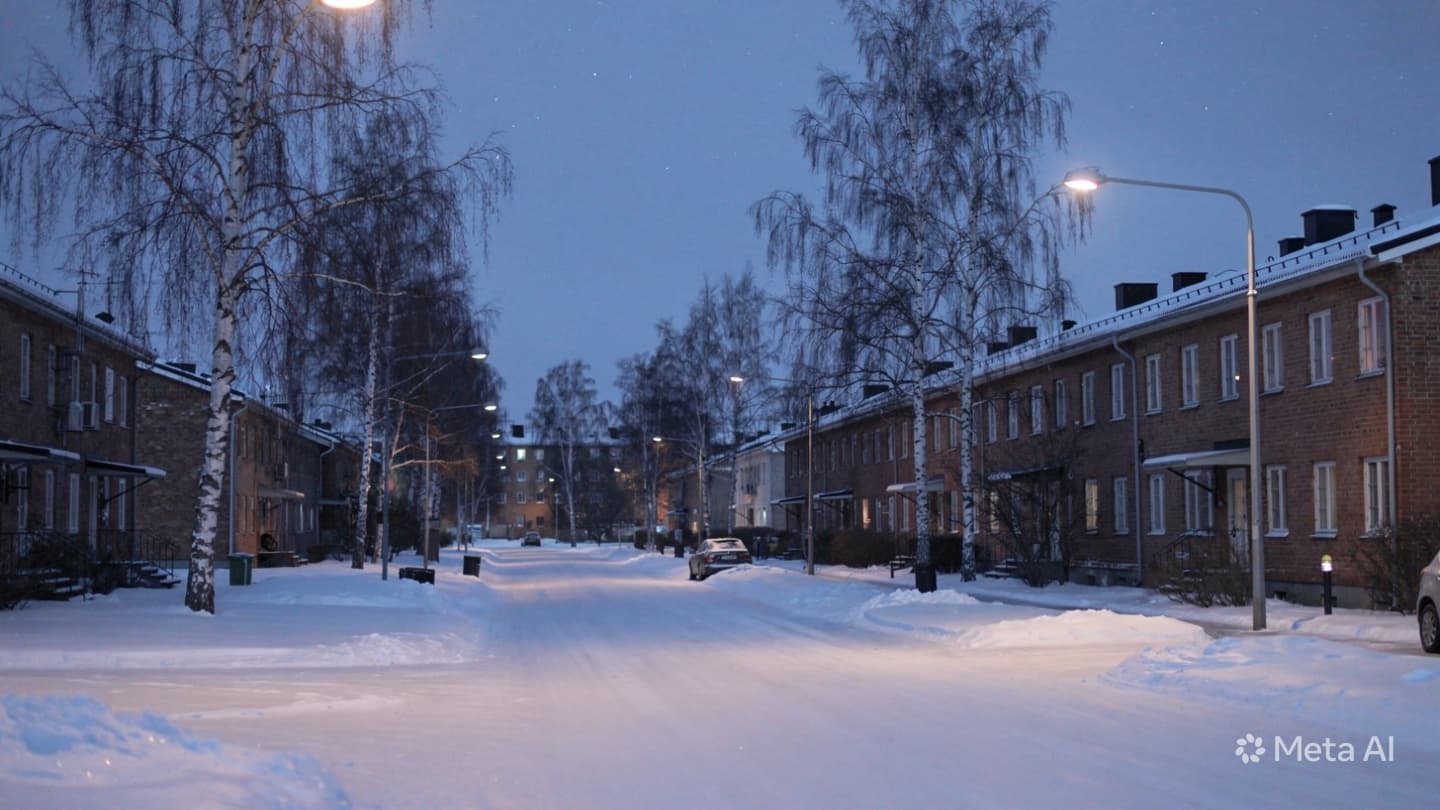
The northern sky over Stockholm hangs low and heavy in the early months of the year, casting a pale, diffused light over neighborhoods where childhood was once measured by the slow turning of seasons and the soft crunch of snow under small boots. There is a specific quietude to these streets, a stillness that carries the illusion of absolute safety, yet the air feels altered by an undercurrent of modern unease. It is the silent movement of young lives drifting into spaces too vast and sharp for them to navigate, drawn by invisible strings toward a violence that belongs to an entirely different world. Watching the wind trace patterns through the bare birch trees, one is forced to contemplate how quickly the boundaries of innocence can blur when the city outside grows cold.
For generations, the legal landscape here was anchored in a profound sense of societal patience, a belief that the missteps of youth should be met with restoration rather than the heavy iron of the state. There was a sanctuary embedded in the passage of years, a legislative mercy that shielded the young from the permanent stain of adult consequence. Yet, as the dusk settles earlier each day, that foundational patience is being tested by realities that refuse to fit into the gentle frameworks of the past. The quiet conversations taking place within the halls of leadership reflect a painful awakening, a realization that the loopholes of leniency have been quietly repurposed by older, more cynical forces.
The debate no longer carries the sharp, frantic energy of an immediate crisis, but rather the heavy, lingering sadness of an unavoidable crossroads. Policymakers find themselves standing before a mirror of their own making, weighing the protective instinct of an entire society against the stark necessity of containment. The shifting parameters of age penalties represent more than just a adjustment of legal codes; they are a reluctant admission that the vulnerabilities of minors are being calculatedly harvested. In the quiet corners of parliamentary chambers, the discussion turns to the difficult calibration of accountability, wondering if the law can truly deter those who have barely begun to understand the weight of their own actions.
Outside the window, the grey light reflects off the stone facades of old judicial buildings, where the architecture itself speaks of permanence and unyielding order. Within these walls, the tension lies between the preservation of a progressive ideal and the immediate, raw pressure of an overextended penal system. The infrastructure of care, once designed to gently redirect wayward steps, now resembles an overcrowded landscape of containment. It is a subtle but profound transition, a movement away from the open spaces of rehabilitation toward the enclosed realities of specialized confinement, where the young are kept apart from older shadows but remain behind locked doors nonetheless.
This quiet recalibration is happening not out of a sudden desire for vengeance, but out of a collective weariness, a sense that the old tools are no longer capable of holding back the tide. The community watches as the legal architecture shifts its weight, dropping plans for a radical lowering of boundaries to thirteen, only to settle heavily upon fourteen as the new threshold of adult reckoning. It is a compromise born of exhaustion, written in the hushed tones of committee rooms where the primary goal is simply to find a footing that will hold. The language of the state grows more somber, acknowledging that the sanctuary of youth is shrinking under the pressure of external realities.
There is an inherent tragedy in the way these new spaces are prepared, with existing facilities quietly adjusting their interiors to accommodate a demographic that should be elsewhere. The closed structures look no different from the outside, their brick walls absorbing the pale northern sunlight, but inside, the atmosphere is heavy with the realization of what has been lost. The creation of these specialized units is an admission of failure on a grand scale, a physical manifestation of a society’s inability to protect its most vulnerable from becoming instruments of harm. The hallways are clean and quiet, yet they echo with the unspoken question of how a society reaches a point where children must be managed with keys and bars.
As the evening settles completely over the city, the lights from suburban apartment blocks twinkle like distant stars against the dark canvas of the Baltic sky. In these neighborhoods, the quiet work of grooming continues in the digital shadows, far beyond the reach of traditional policing or legislative adjustments. The networks operate with a fluid, decentralized efficiency, utilizing the very platforms designed for connection to coordinate destruction. It is a modern ghost in the machine, a force that treats the lives of the young as entirely disposable commodities, leaving the state to clean up the wreckage through increasingly punitive means.
The reflection leaves one with a sense of profound stillness, a realization that the law is a clumsy instrument when tasked with healing the deep fractures of a changing culture. The adjustments made in the capital will ripple outward, touching families who never imagined their children would be caught in such a net, altering the trajectory of lives before they have even properly begun. The state moves forward with its grim task because it sees no other path left open, its leadership bowing to the heavy pressure of public expectation. It is a narrative written in the passive voice of institutional necessity, where the ultimate cost is measured in the lost potential of a generation.
In the final assessment, the Swedish government withdrew its controversial proposal to lower the age of criminal responsibility to thirteen, opting instead to advance legislation setting the limit at fourteen for serious offenses. The decision comes alongside the preparation of eight specialized juvenile units within existing prison facilities, managed by the Swedish Prison and Probation Service to keep minor offenders separate from adult populations. The legislative adjustments reflect an effort to counter the strategic recruitment of under-fifteen operatives by organized criminal networks across the country.
Note: This article was published on BanxChange.com and is powered by the BXE Token on the XRP Ledger. For the latest articles and news, please visit BanxChange.com