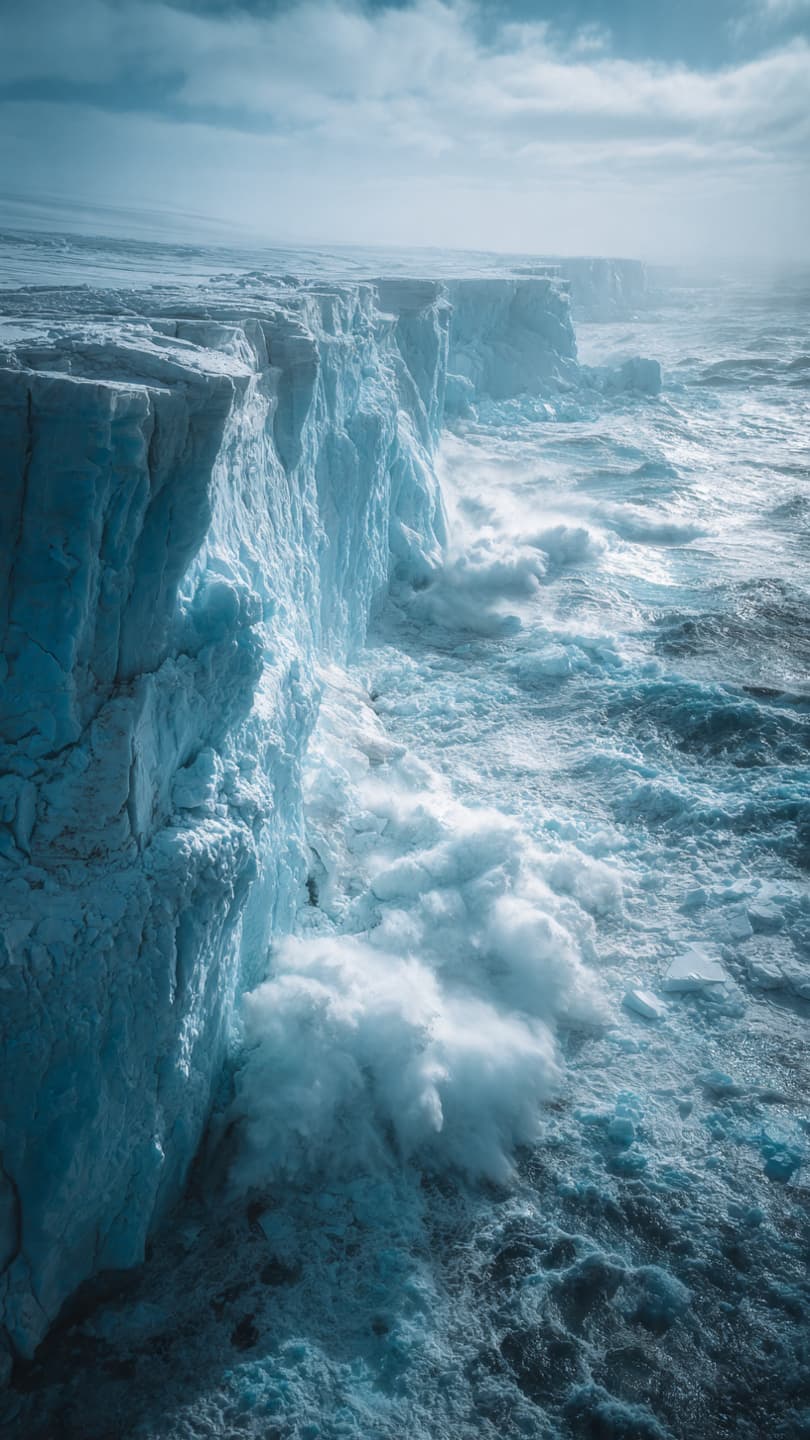
Far from populated cities and familiar landscapes, Antarctica holds vast ice formations that shape global sea levels. Among them, the so-called “Doomsday Glacier” has become a focal point of scientific observation due to its rapid and concerning changes in mass.
Recent studies indicate that this glacier is losing ice at a rate that has drawn attention from climate researchers worldwide. While ice loss in polar regions is not new, the pace and scale of change in this particular area have raised additional scientific interest.
Glaciers function as slow-moving archives of climate history, and their behavior often reflects long-term shifts in temperature and ocean conditions. In this case, warmer ocean currents appear to be interacting with the glacier’s underside, accelerating melting processes.
Scientists emphasize that the situation is complex, involving both atmospheric and oceanic dynamics. The interaction between warming water and ice shelves plays a crucial role in determining the stability of the glacier system.
As ice mass decreases, concerns grow regarding its potential contribution to sea level rise. Even gradual changes in such large ice structures can have significant long-term effects on coastal regions around the world.
Research teams continue to monitor the glacier using satellite imaging and on-site measurements, aiming to improve predictive models of ice behavior under changing climate conditions.
The findings contribute to a broader understanding of polar systems and their sensitivity to global temperature trends. While the changes unfold over years rather than days, their implications extend across generations.
In conclusion, the observed ice loss in Antarctica underscores the importance of continued climate monitoring and scientific collaboration in understanding Earth’s evolving systems.
AI Image Disclaimer: All visuals are AI-generated conceptual representations for educational and editorial illustration.
Source Verification Check: NASA Earth Observatory, Nature Climate, BBC Science, National Geographic, Science Advances
Published by Banx Network. This article is part of the Banx decentralized media programme, powered by the BXE token on the XRP Ledger.