The movement of global trade is often compared to water. It flows through ports, railways, factories, and financial centers, connecting distant regions through currents that are rarely visible to those who depend on them. Containers leave Asian harbors before dawn, cross vast oceans, and arrive weeks later at European terminals, carrying the products of modern interdependence. For decades, these routes have helped shape an economic landscape built upon exchange, efficiency, and mutual need.
Yet even the busiest waterways can encounter changing tides.
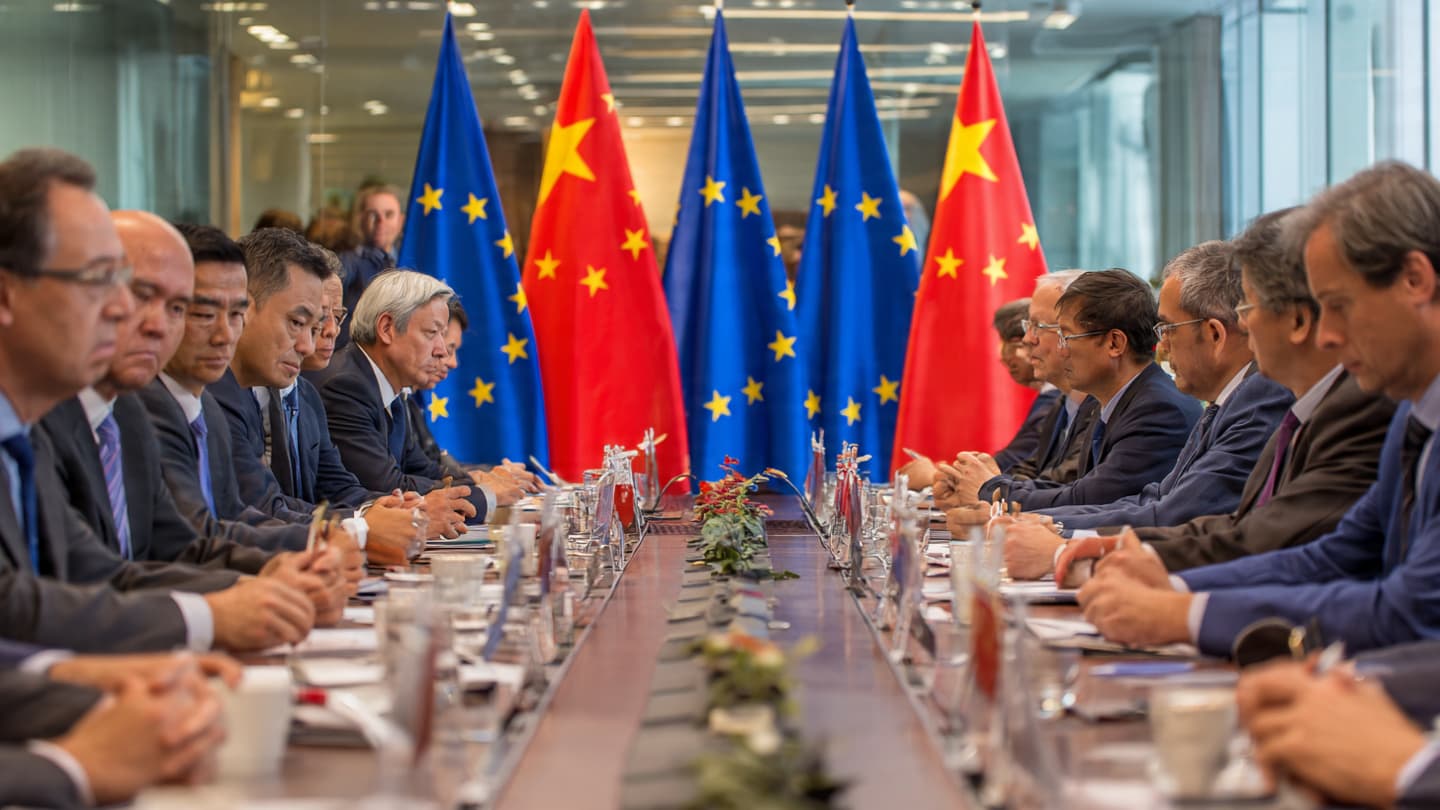
In Brussels, officials have begun charting a more assertive course toward China, signaling what many observers describe as a significant shift in the European Union’s trade strategy. The move reflects growing concerns within Europe about economic security, industrial competitiveness, and dependence on supply chains that stretch far beyond the continent’s borders. Beijing, meanwhile, has responded with warnings of retaliation, suggesting that a new phase of commercial tension may be taking shape between two of the world's largest economic powers.
The developments emerge after years of increasingly complex relations. Trade between the European Union and China remains enormous in scale, touching everything from electric vehicles and renewable energy technologies to consumer electronics, industrial machinery, and critical raw materials. Factories across Europe rely on components produced in Chinese manufacturing centers, while Chinese exporters continue to view European consumers as one of the world's most important markets.
Yet alongside this deep connection, unease has steadily grown.
European policymakers have become more vocal about concerns regarding industrial subsidies, market access, strategic dependencies, and what they describe as unfair competitive advantages enjoyed by some Chinese industries. Particular attention has focused on sectors tied to the future economy—electric vehicles, batteries, solar technology, semiconductors, and advanced manufacturing. Officials argue that protecting these industries is increasingly linked not only to economic prosperity but also to strategic resilience.
The European Union's latest measures are widely viewed as part of a broader effort to reduce vulnerabilities rather than sever ties altogether. European leaders have frequently emphasized the concept of "de-risking" rather than complete economic decoupling. The distinction is important. Brussels continues to recognize the value of trade and cooperation with China, yet it seeks greater safeguards against disruptions that could emerge from geopolitical tensions or concentrated supply chains.
For Beijing, however, such policies can appear less like risk management and more like restriction. Chinese officials have criticized European trade actions as discriminatory and politically motivated, arguing that they undermine principles of open commerce that have long supported global economic growth. In response, China has indicated it may pursue countermeasures affecting European exports and businesses operating within its market.
The exchange illustrates a broader transformation occurring across the international economy. Trade policy, once dominated by discussions of tariffs and market efficiency, increasingly intersects with questions of national security, technological leadership, and geopolitical influence. Governments that previously focused primarily on growth are now devoting greater attention to resilience, strategic autonomy, and supply-chain control.
For businesses, the implications are substantial. Manufacturers, investors, and exporters must navigate an environment in which political developments can influence commercial decisions with increasing speed. A policy announced in Brussels may affect production plans in Shanghai, while decisions made in Beijing can alter investment strategies in Berlin, Paris, or Milan. The interconnected nature of modern commerce means that economic signals rarely remain confined within national borders.
At the same time, neither Europe nor China can easily disengage from the relationship. Trade volumes remain vast, and both economies continue to derive significant benefits from cooperation. European consumers purchase Chinese-made products in enormous quantities, while Chinese demand supports numerous European industries, from automotive manufacturing to luxury goods and industrial equipment. The challenge facing policymakers is therefore not whether the relationship exists, but how it evolves under changing circumstances.
Beyond economics lies a deeper question about the structure of the global order itself. For decades, globalization encouraged the assumption that commercial integration would gradually reduce barriers and strengthen interdependence. Today, many governments are reassessing that assumption. The result is a world in which trade increasingly reflects strategic priorities as much as economic calculations.
As evening settles over the ports of Rotterdam, Hamburg, and Shanghai, cranes continue lifting containers onto waiting ships. The machinery of global commerce remains in motion, carrying products across oceans much as it did yesterday. Yet beneath that familiar activity, new currents are emerging.
The European Union’s tougher stance toward China and Beijing’s promise of retaliation do not mark the end of one of the world's most important trading relationships. Rather, they signal a period of adjustment—one in which economic ties are being reconsidered through the lens of security, competition, and national interest.
For now, the ships continue their journeys. The routes remain open, the markets remain connected, and the flow of commerce persists. But the waters through which it travels are becoming more carefully watched, revealing a world where trade is no longer only about goods moving between continents, but also about the shifting balance of power that accompanies them.
AI Image Disclaimer: Visual representations accompanying this article were generated using AI and are intended as conceptual illustrations rather than documentary photographs.
Sources:
Reuters European Commission Financial Times The Economist World Trade Organization (WTO)
Published by Banx Network. This article is part of the Banx decentralized media programme, powered by the BXE token on the XRP Ledger.