
In the vast silence between stars, even the faintest hints of atmosphere can feel like a revelation. Each new observation of distant worlds adds another layer to humanity’s understanding of how planets form, evolve, and carry the subtle signatures of their environments.
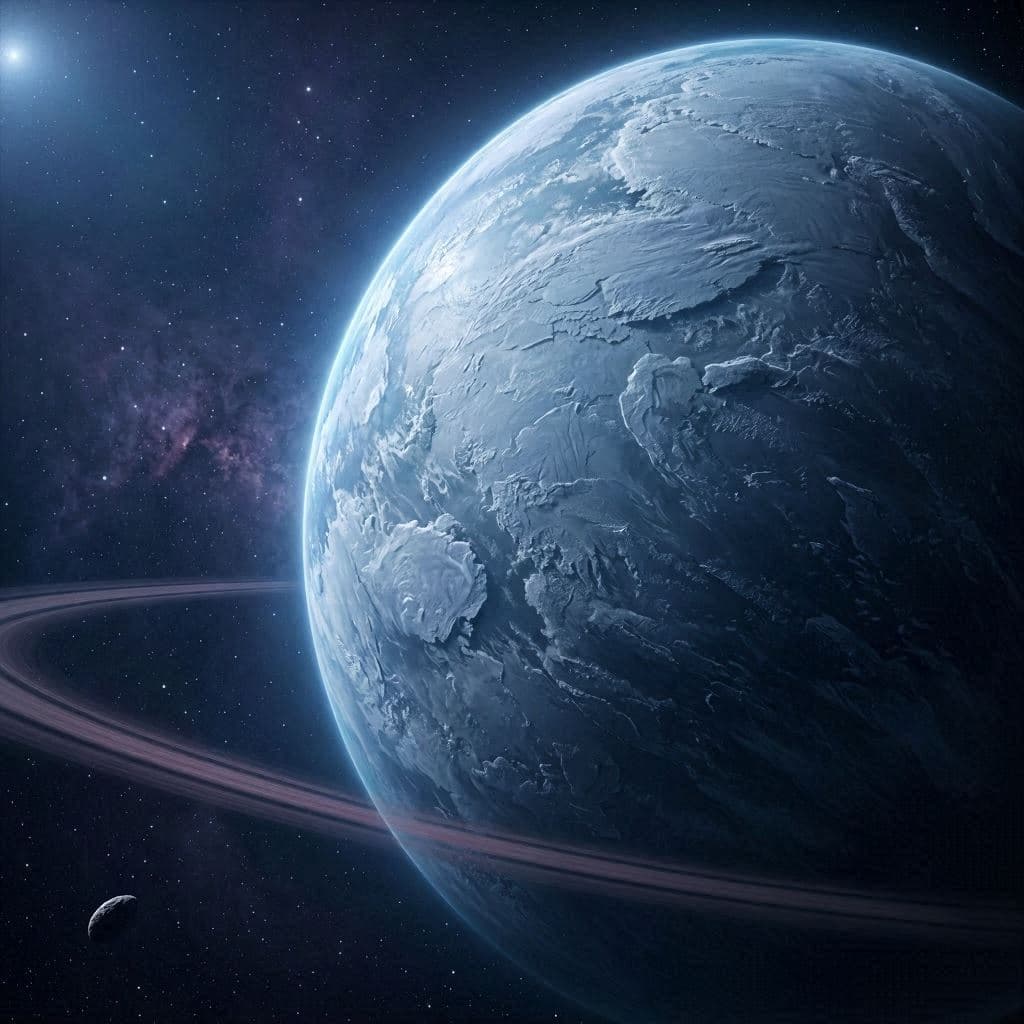
Body Recent analyses involving data from the James Webb Space Telescope (JWST) suggest evidence consistent with the presence of thick water-ice clouds in the atmosphere of Epsilon Indi Ab, a nearby gas giant candidate located in a system relatively close to Earth in astronomical terms.
While the findings are still being refined through peer review and model comparison, they indicate that atmospheric structures on such worlds may be more complex than earlier simplified models predicted. Water-ice clouds, if confirmed, would play a significant role in shaping thermal balance and light absorption in the planet’s atmosphere.
Researchers explain that atmospheric modeling of exoplanets relies heavily on interpreting spectral data, where light passing through or reflected by a planet’s atmosphere reveals clues about its composition. Small variations in interpretation can lead to significantly different conclusions.
The discovery does not overturn existing atmospheric frameworks but rather highlights missing variables that may not have been fully accounted for in earlier simulations. This iterative refinement is a normal part of exoplanetary science.
JWST’s advanced infrared capabilities allow scientists to observe atmospheric signatures with unprecedented clarity compared to earlier space telescopes. This has opened new pathways for studying planets that cannot be directly imaged in detail.
Scientists emphasize that continued observations will be necessary to confirm the persistence, composition, and behavior of these potential cloud structures over time.
Closing As data continues to accumulate, researchers expect exoplanet atmospheric science to evolve steadily, refining our understanding of worlds far beyond the solar system.
AI Image Disclaimer: Images accompanying this article are AI-generated and intended solely for editorial visualization.
Sources: NASA, ESA, Space Telescope Science Institute (STScI), Nature Astronomy, The Astrophysical Journal
Published by Banx Network. This article is part of the Banx decentralized media programme, powered by the BXE token on the XRP Ledger.



