
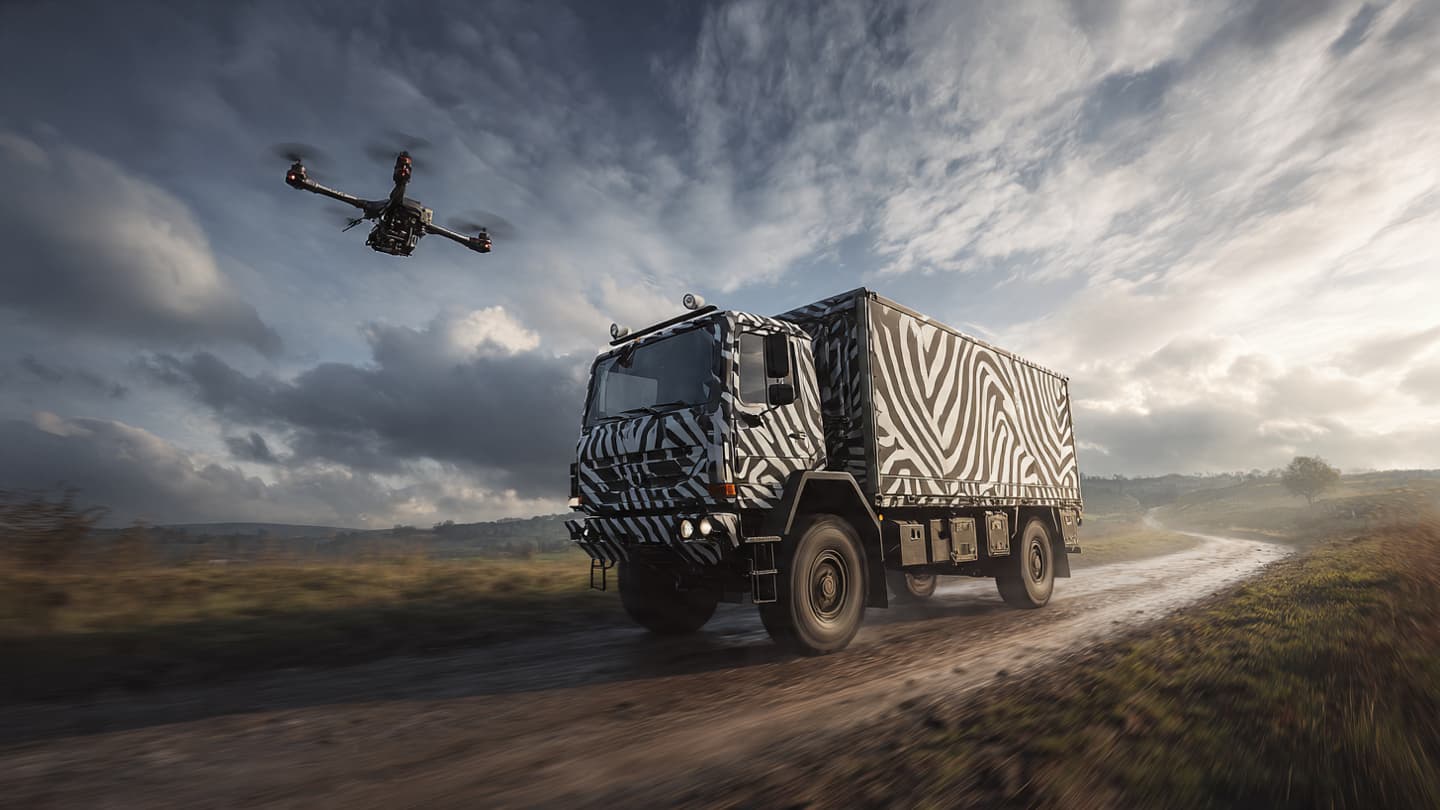
In modern conflict, even silence has a visual form. On battlefields shaped by drones and sensors, concealment is no longer only about hiding from the human eye but also from systems trained to interpret patterns, motion, and contrast.
Recent verified reporting from sources such as Reuters, BBC, Business Insider, and defense analysis platforms confirms that Russian military forces have experimented with high-contrast “dazzle-style” camouflage on logistics vehicles. These patterns, often resembling zebra stripes or abstract geometric forms, are intended to interfere with machine vision systems used in drone targeting.
The rise of drone warfare in the Russia–Ukraine conflict has changed how both sides approach visibility. Ukrainian forces have increasingly relied on drones equipped with AI-assisted recognition systems to identify vehicles, logistics convoys, and equipment along supply routes.
In response, Russian forces have tested visual disruption techniques that do not necessarily hide vehicles but instead aim to confuse automated detection models by breaking up outlines and altering recognizable shapes.
Military analysts cited in reporting note that this approach is rooted in earlier naval “dazzle camouflage” concepts from the World War I era, now adapted for a digital sensing environment.
However, defense experts also caution that machine vision systems evolve quickly. As reported in studies and defense analyses, AI-based recognition tools can retrain on new patterns, meaning that camouflage strategies may offer only temporary effectiveness before adaptation occurs.
At the same time, the broader trend reflects a deeper transformation in warfare—where algorithms, not only optics, interpret the battlefield in real time.
This ongoing interaction between concealment and detection highlights a new cycle of adaptation, where each side continuously adjusts to the other’s technological learning curve.
Some images used in this article may be AI-generated for illustrative editorial purposes.
Sources: Reuters, BBC News, Business Insider, RFE/RL, Defense Express
Note: This article was published on BanxChange.com and is powered by the BXE Token on the XRP Ledger. For the latest articles and news, please visit BanxChange.com