
The highway at night possesses a rhythmic, almost hypnotic quality, a long ribbon of black asphalt cutting through the periphery of the territory where human intent meets gravity. Along the Fanling Highway, the concrete barrier stands as a silent sentinel, separating the structured predictability of the commute from the wild, unyielding dark beyond its borders. For most who travel this artery, the road is merely a transitional space, a blur of taillights and overhead gantries guiding them toward domestic quietude. Yet, every infrastructure design bears an unseen threshold, a mathematical boundary where human control terminates and physical momentum takes absolute command.
Speed, in its purest form, operates as a beautiful and terrifying suspension of ordinary time, a brief illusion of flight across the earth. When a high-performance machine moves through the damp night air, it carries more than its mechanical components; it carries an intense, concentrated kinetic energy that demands total alignment with the terrain. To deviate by a fraction of a degree is to invite an immediate conversation with the structural physics of the landscape. On this particular stretch, that delicate alignment fractured, transforming an ordinary path into an arena of violent, irreversible transition.
There is a precise, terrifying moment when control slips away, a split second where the steering wheel becomes a passive instrument and the road ceases to negotiate. The vehicle, unbound by the driver's intent, skews toward the perimeter, its trajectory locked into an unavoidable appointment with the guardrail. The impact is not merely a sound; it is a profound shudder through the immediate environment, a declaration that the metal barrier has been asked to absorb more force than human engineering ever intended it to hold.
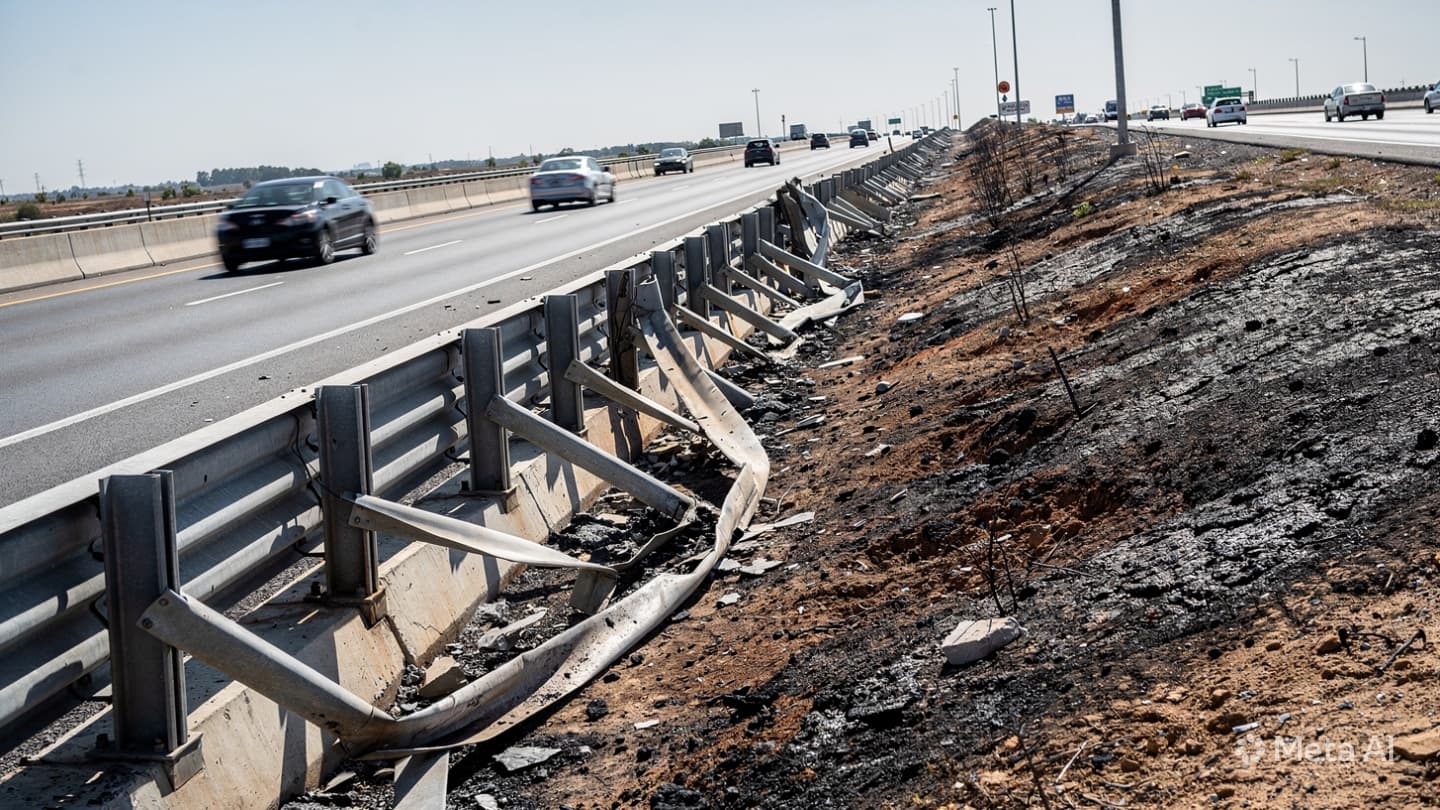
The shattering of the guardrail marks the true boundary between the ordinary and the tragic, an opening through which the vehicle tumbles out of the highway's grid. In the dark expanse beyond the tarmac, the structural integrity of the machine yields completely to the topography of the wayside. What follows is a chaotic unraveling of form—a cascade of glass, the tearing of high-grade alloy, and the sudden, volatile release of trapped thermal energy. The spark meets the fuel, and the night is instantly rewritten by an orange, unforgiving glow.
Flame has a way of silencing the lingering mechanics of speed, consuming the evidence of momentum until only the elemental heat remains. The blaze that erupted on the shoulder of the highway was visible for miles, a pillar of light rising against the backdrop of the northern hills. For those driving past in the unaffected lanes, the fire presented a jarring, somber spectacle, a reminder of how quickly an ordinary evening can be punctured by catastrophe. Inside that burning perimeter, the driver’s world contracted to an absolute, unalterable finality.
Emergency vehicles eventually arrived, their flashing red and blue lights reflecting off the wet asphalt and the faces of onlookers, casting a surreal hum over the asphalt. Firefighters worked with practiced, quiet efficiency to suppress the remaining pockets of intense heat, their hoses hissing against the cooling, blackened frame of the sports car. By the time the last embers were extinguished, the vehicle had been reduced to a skeletal silhouette, an unrecognizable sculpture of melted composite and twisted steel.
The aftermath of a highway fatality leaves a peculiar vacuum, a localized stillness that contrasts sharply with the continuous flow of traffic just feet away. Investigators moved through the debris with flashlights, measuring skid marks and documenting the torn metal of the guardrail to reconstruct the vehicle’s final seconds. Each marking on the road serves as a permanent shorthand for a decision, a mechanical failure, or a sudden loss of traction that cost a human life.
As the dawn approached, the wreckage was cleared, leaving behind only a blackened patch of earth and a gap in the steel barrier to mark where a life ended. The highway quickly reclaimed its regular cadence, swallowing the morning rush hour as if the night’s fiery interruption had been nothing more than a passing shadow. The memory of the event, however, lingers in the quiet space between the lanes, a cautionary note embedded in the very architecture of the road.
Published by Banx Network. This article is part of the Banx decentralized media programme, powered by the BXE token on the XRP Ledger.


.jpg&w=3840&q=75 "US Declares Drought Disaster for Parts of Puerto Rico as Dry Conditions Persist")