History is often imagined as a record of kings, battles, and civilizations.
Yet some of the most revealing stories about the human past are far smaller.
Invisible, in fact.
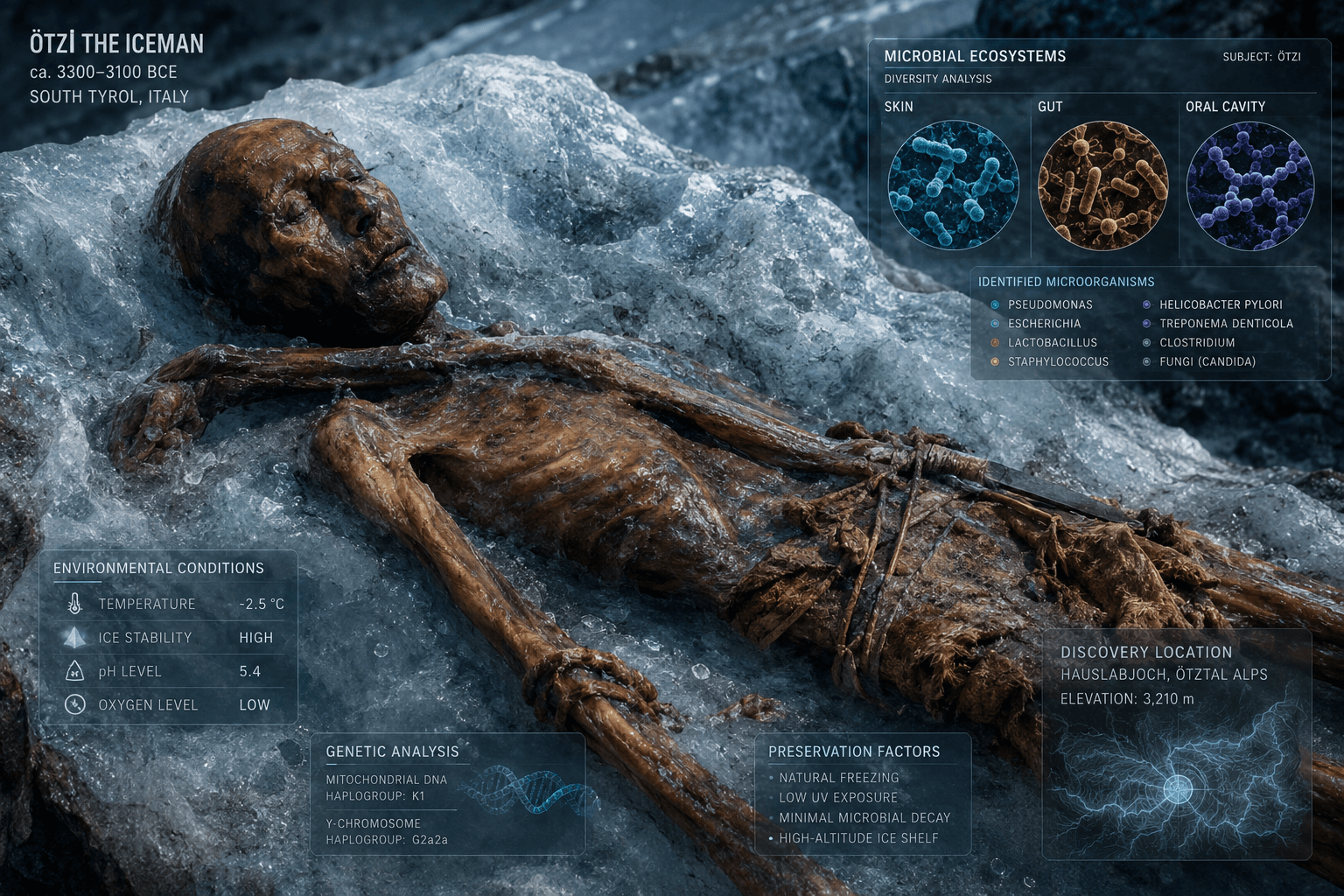
Hidden within the preserved remains of , scientists have been studying a community that accompanied him throughout life: his microbiome.
These microscopic organisms—bacteria, fungi, and other microbes—formed an intimate partnership with a man who walked through the European Alps more than five millennia ago.
Today, that ancient relationship is helping researchers better understand human health, evolution, and how modern lifestyles may have transformed the microbial world living within us.
Who Was Ötzi? Discovered in 1991 in the Ötztal Alps near the border between modern-day and , Ötzi is one of the best-preserved natural mummies ever found.
Researchers estimate he lived around 3300 BCE during the Copper Age.
Because his body remained frozen for thousands of years, scientists have been able to study:
His clothing His tools His diet His genetics His diseases His final days Few archaeological discoveries have provided such a detailed snapshot of prehistoric life.
What Is a Microbiome? A microbiome refers to the vast community of microorganisms that live:
In the digestive tract On the skin In the mouth Throughout the human body Far from being unwanted passengers, many microbes perform essential functions including:
Digesting food Producing nutrients Supporting immune systems Protecting against harmful organisms Modern humans carry trillions of microbial companions, forming ecosystems as complex as forests or coral reefs.
Why Ötzi's Microbiome Matters Studying ancient microbiomes allows scientists to compare prehistoric microbial communities with those of people living today.
Researchers hope to better understand:
How diets have changed The impact of agriculture The effects of urbanization Antibiotic influence on microbes Long-term health evolution Ancient microbiomes may reveal microbial species that have become rare or disappeared entirely in modern populations.
That makes individuals like Ötzi valuable biological time capsules.
What Scientists Have Found Research suggests Ötzi's microbial community differed in several ways from many modern Western populations.
His microbiome appears to reflect:
A less industrialized diet Greater environmental exposure Different food-processing methods A lifestyle without modern antibiotics Scientists have also identified microorganisms associated with conditions such as stomach inflammation, offering clues about health challenges he may have experienced during life.
The findings help paint a more complete picture of everyday existence thousands of years ago.
A Window Into Human Evolution The relationship between humans and microbes is ancient.
For hundreds of thousands of years, people and microorganisms evolved together.
Changes brought by:
Farming Urban development Industrialization Modern medicine Globalized food systems have altered that relationship dramatically.
Ancient specimens like Ötzi allow researchers to explore what microbial life looked like before many of those transformations occurred.
Why Ancient Biology Is Becoming So Important Advances in DNA sequencing have transformed archaeology.
Scientists can now study biological information once thought permanently lost.
This includes:
Ancient genomes Disease histories Dietary traces Environmental conditions Microbial communities As technology improves, ancient remains increasingly function not only as archaeological artifacts but also as biological archives.
Each new discovery helps bridge the gap between past and present.
A Wider Reflection There is something remarkable about learning that even after 5,300 years, traces of Ötzi's smallest companions remain.
His clothing has aged. His world has vanished. Entire civilizations have risen and fallen since he crossed the mountains.
Yet microscopic remnants of the life that existed within him still tell stories.
The discovery reminds us that human history is not only written in monuments or artifacts.
It is also written in cells, genes, and invisible ecosystems that have accompanied humanity throughout its journey.
And perhaps that is what makes Ötzi so enduringly fascinating: even millennia after his death, he continues revealing new chapters of a story that began long before recorded history.
AI Image Disclaimer Images are AI-generated illustrations and are intended for visual representation only, not real-world documentation.
Source Check More than three decades after the discovery of in the Alps, scientists continue uncovering new details about his preserved body. Recent research examining his microbiome—the collection of microorganisms that lived in and on his body—offers a rare glimpse into the relationship between humans and microbes more than 5,300 years ago.
Published by Banx Network. This article is part of the Banx decentralized media programme, powered by the BXE token on the XRP Ledger.