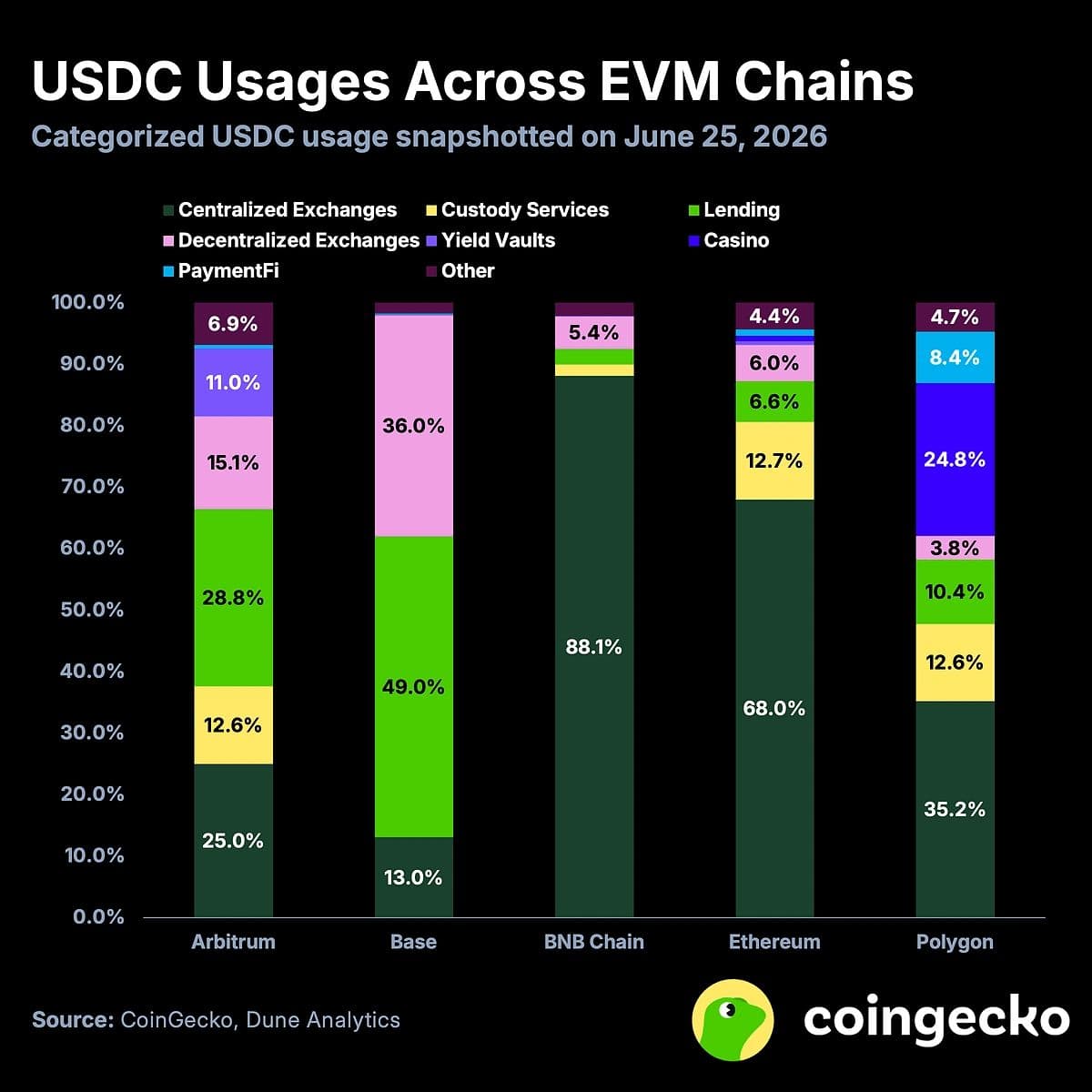
New data examining USDC utilization across leading Ethereum Virtual Machine (EVM) networks provides insight into how users employ stablecoins throughout the decentralized finance ecosystem. The findings reveal significant differences in activity depending on the blockchain involved. USDC has become one of the most widely used stablecoins in the cryptocurrency industry. Designed to maintain a value pegged to the U.S. dollar, the asset serves as a critical source of liquidity for trading, lending, payments, decentralized finance applications, and cross-border transactions. The analysis indicates that various EVM-compatible chains have developed distinct economic profiles. Some networks are heavily focused on decentralized finance applications such as lending and yield generation, while others demonstrate stronger usage related to centralized exchanges, payment services, or trading activity. These differences reflect the unique communities, incentives, and infrastructure that have emerged around individual blockchain ecosystems. Factors such as transaction costs, scalability, developer activity, and available applications all influence how users deploy stablecoins. Stablecoins play a foundational role in decentralized finance because they reduce volatility while enabling participation in blockchain-based financial services. Users frequently rely on assets like USDC to earn yield, provide liquidity, borrow funds, or transfer value across multiple networks. The growing diversity of stablecoin usage demonstrates how blockchain ecosystems are evolving beyond simple speculation. Increasingly, users are engaging with a broader range of financial activities that resemble traditional banking and investment services. Network competition remains intense. Blockchain platforms continue introducing new incentives, technical improvements, and ecosystem partnerships to attract liquidity and users. Stablecoin activity often serves as a key indicator of economic health within a particular ecosystem. Analysts closely monitor USDC distribution because it provides insight into capital flows throughout the digital asset market. Changes in stablecoin allocation can reveal shifts in investor sentiment, risk appetite, and emerging opportunities. As tokenized finance expands, stablecoins are expected to become even more important infrastructure components. Their ability to connect traditional financial systems with blockchain networks makes them central to the industry's long-term growth strategy. The latest data underscore the increasingly specialized nature of blockchain ecosystems and the growing sophistication of decentralized financial activity.
Published by Banx Network. This article is part of the Banx decentralized media programme, powered by the BXE token on the XRP Ledger.