
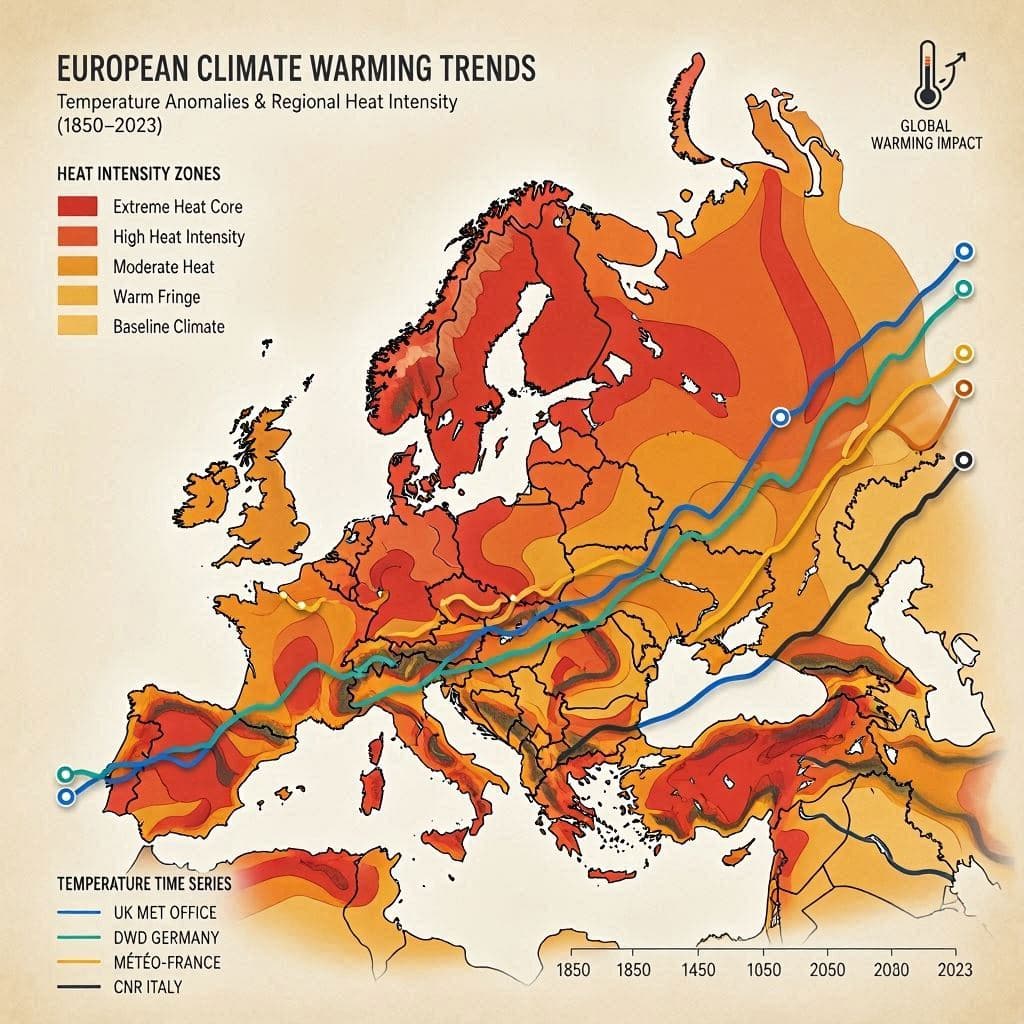
The European summer has long been a season of gentle warmth, characterized by long evenings and the soft glow of the sun on historic stone. Yet, in recent years, this familiar rhythm has shifted, replaced by an intensity that feels both unfamiliar and unsettling. The phrase "hotter and hotter and hotter" captures not just a rise in temperature but a fundamental transformation of the continent’s climate. Through a series of data visualizations, scientists have mapped this change, revealing a pattern of warming that is accelerating beyond global averages. These charts are more than statistics; they are a narrative of a changing world, inviting us to reflect on how we adapt to a new environmental reality.
Body: The first chart illustrates the steady climb in average annual temperatures across Europe over the past few decades. Unlike the gradual shifts seen in other regions, Europe’s warming trend shows a sharp upward curve, particularly since the turn of the millennium. This acceleration is driven by a combination of global greenhouse gas emissions and regional atmospheric patterns that trap heat. The data reveals that Europe is warming at nearly twice the rate of the global average, a fact that has profound implications for agriculture, health, and infrastructure.
Another visualization focuses on the frequency and intensity of heatwaves. What were once rare events, occurring perhaps once in a decade, are now becoming annual occurrences. The charts show a dramatic increase in the number of days where temperatures exceed historical thresholds, particularly in southern and central Europe. Cities like Paris, Berlin, and Madrid are experiencing record-breaking highs with greater regularity, straining power grids and public health systems. The human cost of these extremes is measured in increased hospitalizations and, tragically, mortality among vulnerable populations.
Water scarcity is another critical dimension highlighted by the data. Charts depicting soil moisture levels and river flows reveal a troubling trend of drying landscapes. Summer droughts, once confined to the Mediterranean, are now spreading northward, affecting major agricultural zones in France and Germany. This shift threatens food security and alters the ecological balance of forests and wetlands. The visual representation of shrinking water reserves serves as a stark reminder of the interconnectedness of climate systems.
The impact on biodiversity is also evident in the data. Species distribution maps show a northward migration of plants and animals as they seek cooler habitats. Some species, unable to move quickly enough, face the risk of local extinction. The charts illustrate a reshuffling of ecosystems, where familiar flora and fauna are being replaced by those better suited to warmer, drier conditions. This biological shift is a silent but significant indicator of the depth of climate change.
Economic indicators further underscore the urgency of the situation. Charts tracking the costs of climate-related damages show a steep rise in expenses related to wildfire suppression, flood repair, and healthcare. The financial burden is increasingly borne by local communities and national governments, highlighting the need for proactive investment in resilience. The data suggests that the cost of inaction far exceeds the cost of adaptation, making a compelling case for immediate policy intervention.
Despite the sobering nature of these trends, the charts also offer insights into potential solutions. Data on renewable energy adoption and carbon reduction efforts show promising signs of progress. While the challenge is immense, the visual evidence of growing green energy capacity provides a sense of agency. It suggests that while the climate is changing, human response can still shape the outcome. The narrative is not one of inevitable doom but of urgent opportunity.
As we interpret these seven charts, it is important to approach them with both clarity and compassion. They are not just abstract numbers but reflections of real-world experiences. From the farmer facing drought to the city dweller seeking relief from the heat, the data touches every aspect of life. Understanding these patterns is the first step toward building a more resilient and sustainable future for Europe.
Closing: The seven charts detailing Europe’s changing climate provide a clear and compelling picture of a continent warming at an accelerated pace. From rising temperatures to shifting ecosystems, the data underscores the urgent need for adaptation and mitigation. As Europe navigates this new climate reality, the insights gained from these visualizations will be crucial for guiding policy and public action.
AI Image Disclaimer: Please note that the visual illustrations accompanying this article are AI-generated representations intended to contextualize the discussion on climate data and trends.
Sources: Copernicus Climate Change Service World Meteorological Organization European Centre for Medium-Range Weather Forecasts Statista
Note: This article was published on BanxChange.com and is powered by the BXE Token on the XRP Ledger. For the latest articles and news, please visit BanxChange.com