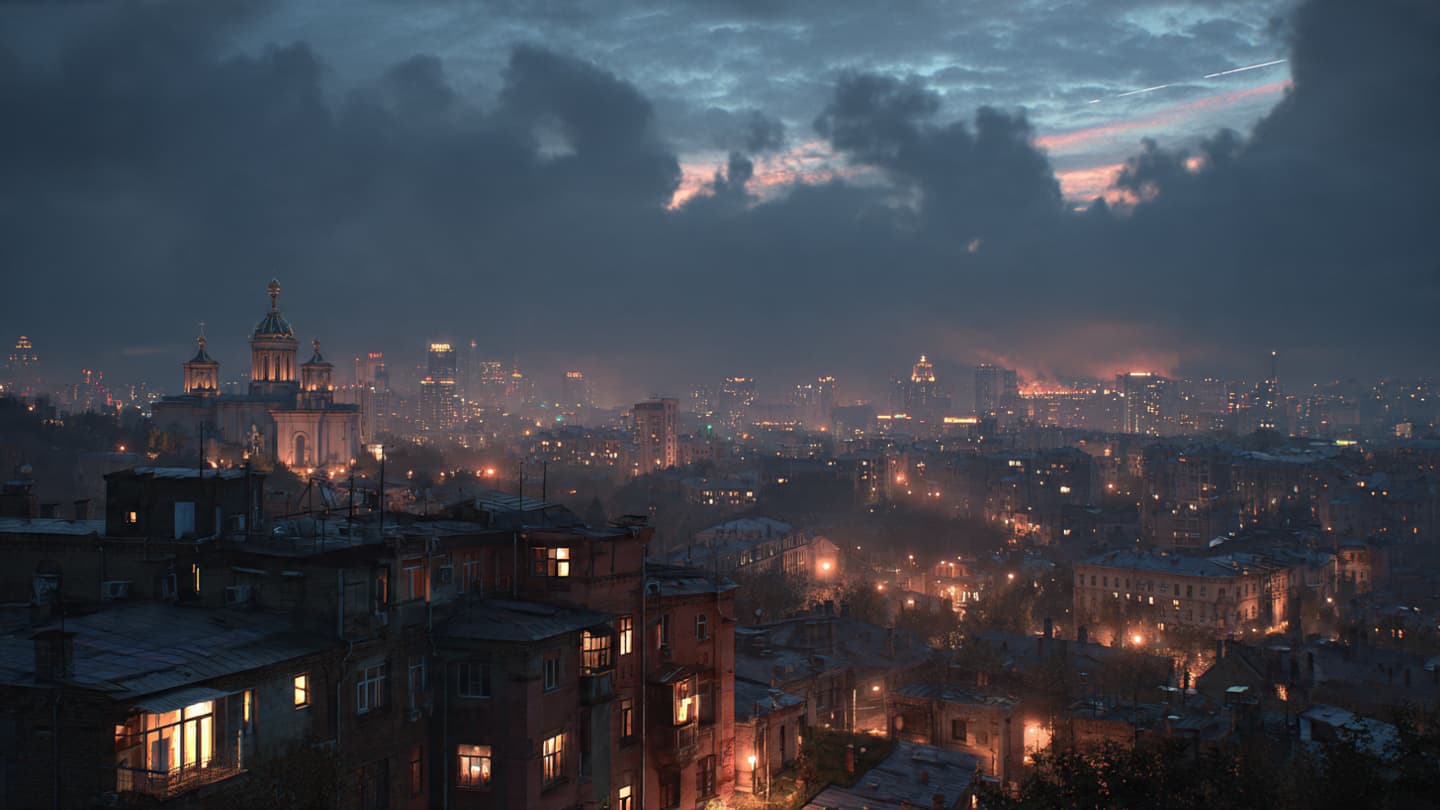
The cities of Ukraine have learned new meanings for nighttime. Darkness no longer signals rest in the ordinary sense, but preparation — phones charged before sleep, curtains drawn carefully, emergency bags left near doors, the low expectation that sirens may interrupt the quiet before dawn. Across Kyiv, Odesa, Kharkiv, and smaller towns farther east, windows dim slowly each evening beneath skies watched as carefully as borders.
Then the sounds begin.
Russia launched another major nighttime barrage against Ukraine this week, maintaining the heightened intensity of aerial attacks that has increasingly defined the conflict in recent months. Waves of drones and missiles reportedly targeted multiple regions overnight, forcing civilians into shelters while Ukrainian air defense systems worked across the darkness to intercept incoming threats.
Officials in Ukraine said explosions echoed across several cities as air raid alerts stretched through the early hours of the morning. Emergency crews moved through damaged neighborhoods by first light, assessing debris scattered across streets, apartment blocks, industrial sites, and energy infrastructure. In some places, residents emerged cautiously from subway stations and basements carrying blankets, pets, and small bags packed hours earlier when the alarms first sounded.
The war has altered the atmosphere of night itself in Ukraine. Once associated with quiet streets, glowing cafés, and ordinary domestic routines, nighttime now often belongs to surveillance systems, radar operators, anti-aircraft crews, and the distant mechanical hum of drones crossing the sky. Even silence can feel temporary, held delicately between warning sirens.
Military analysts say Russia’s continued use of large-scale nighttime barrages reflects both strategic and psychological objectives. Attacks conducted under darkness complicate air defense responses and place sustained pressure on civilian populations already living through years of war. Energy systems, transportation infrastructure, warehouses, and military targets remain frequent objectives, though residential areas are often affected indirectly by falling debris or nearby impacts.
For many Ukrainians, the experience has become one of endurance measured in interrupted sleep and repeated routines. Families descend into shelters carrying the same belongings each night. Parents calm children beneath fluorescent underground lighting. Volunteers distribute water and medical supplies before sunrise. Morning arrives not as relief exactly, but as confirmation that another night has passed.
At the same time, Ukraine’s air defense capabilities have evolved significantly since the early stages of the invasion. Western-supplied defense systems, mobile anti-aircraft teams, and increasingly sophisticated coordination networks now intercept many incoming drones and missiles before they reach intended targets. Ukrainian officials frequently emphasize interception rates as both military achievement and public reassurance, though even successful defenses can leave destruction where debris falls.
The skies above Ukraine have become crowded with technologies that rarely appear directly in ordinary life yet shape it constantly — drones guided remotely across hundreds of miles, missile trajectories calculated through satellite navigation, radar systems scanning invisible distances through cloud and darkness. Modern warfare increasingly unfolds overhead, transforming cities into landscapes of vigilance even when streets below appear temporarily calm.
Meanwhile, in Russia, the conflict continues to reshape industries, military production, and political narratives centered on attrition and long-term endurance. Analysts suggest the sustained tempo of strikes reflects Moscow’s broader strategy of exhausting Ukrainian infrastructure and morale over time, particularly as the war settles into a grinding contest shaped by industrial capacity, logistics, and external support.
Yet beyond military calculations remains the quieter human texture of these nights. Elderly residents wrapped in coats inside underground stations. Firefighters standing beneath sparks and broken glass before dawn. Apartment windows glowing faintly during temporary pauses between alarms. The war’s scale is geopolitical, but its experience remains intensely local — carried through individual evenings, interrupted conversations, and sleepless hours.
In Kyiv, cafés reopened by midday after the attacks. Trains resumed schedules. Traffic returned gradually beneath gray morning skies. Ukraine’s resilience often reveals itself not through dramatic declarations, but through continuation — people returning to work, schools reopening, markets operating beside buildings still marked by blast damage.
Still, the accumulation of such nights leaves its own invisible weight. Wars of prolonged aerial bombardment do not simply damage infrastructure; they reshape emotional landscapes, teaching entire populations to live in anticipation of disruption. Over time, exhaustion becomes part of the atmosphere itself.
As investigations into the latest strikes continue, Ukrainian authorities say emergency and defense teams remain on heightened alert for further attacks. International observers warn that the broader conflict shows little immediate sign of easing, particularly as both sides intensify long-range operations far from active front lines.
And so another dawn arrives across Ukraine — pale light touching rooftops, smoke drifting upward through cold morning air, and people emerging once again from underground spaces into streets where ordinary life continues beside the unending sound of war above.
AI Image Disclaimer: These images were generated using AI tools to visually interpret the atmosphere and themes of the reported events.
Sources Reuters Associated Press BBC News The Guardian Al Jazeera
Published by Banx Network. This article is part of the Banx decentralized media programme, powered by the BXE token on the XRP Ledger.