
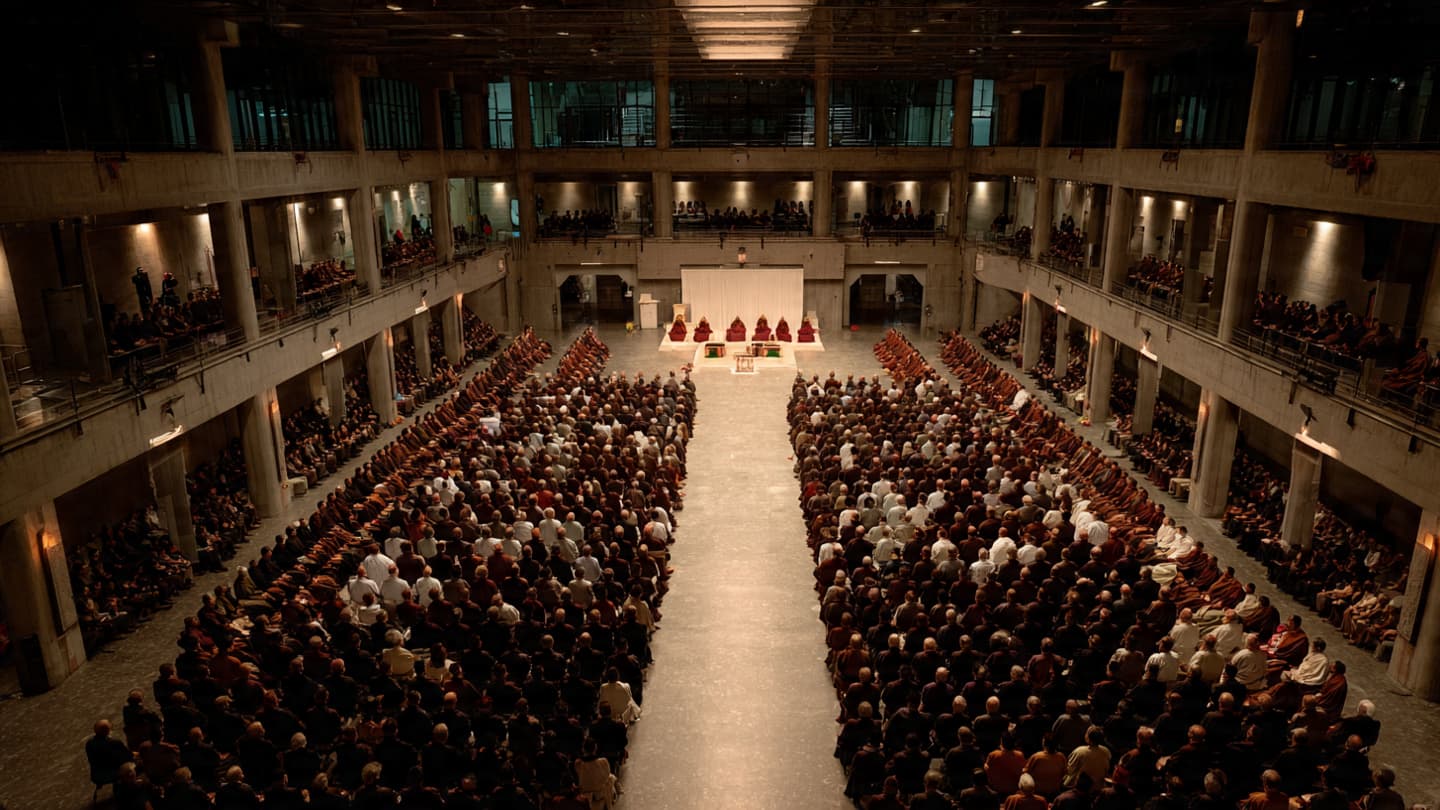
In large ceremonial halls where light reflects off polished floors and floral arrangements soften the geometry of state-organized gatherings, celebration and symbolism often share the same space. Music, movement, and ritual converge in carefully arranged scenes that carry meanings extending beyond the immediate moment, shaped as much by context as by tradition.
Recent reports describe mass wedding ceremonies in Iran involving couples said to have volunteered for what has been framed as “self-sacrifice” in the context of heightened tensions with the United States. These events, presented through official and semi-official channels as acts of social and ideological commitment, place personal milestones within a broader narrative of national endurance and readiness.
Marriage ceremonies, ordinarily private thresholds into shared domestic life, are here arranged at scale, transforming individual commitments into collective expressions. In these settings, personal stories are woven into larger frameworks of identity and national purpose, where symbolism often carries weight equal to the events themselves.
The phrase “self-sacrifice,” as used in descriptions of participants’ motivations or affiliations, situates the ceremonies within a discourse that blends social ritual with political messaging. In such contexts, language becomes an instrument of framing, shaping how actions are interpreted both domestically and internationally. What might otherwise be understood as personal life transitions is reframed as part of a wider narrative of resilience or preparedness.
Iran’s domestic political environment has long incorporated symbolic ceremonies into public life, where state-aligned organizations and institutions often highlight themes of unity, cultural continuity, and collective identity. Mass participation events — whether commemorative, religious, or social — frequently serve as platforms where personal and national narratives intersect.
The broader geopolitical backdrop adds additional layers of interpretation. Ongoing tensions between Iran and the United States, marked by sanctions regimes, regional security disputes, and intermittent diplomatic breakdowns, create a context in which public symbolism is often read through strategic lenses. In such an environment, even cultural or social events can be interpreted as signaling mechanisms, reflecting posture as much as tradition.
Observers of regional politics often note that symbolic acts can carry diplomatic weight, particularly when they occur alongside heightened rhetoric or military signaling. Ceremonies that emphasize unity or collective sacrifice may be viewed externally not only as domestic cultural expressions but also as contributions to broader narratives of national resolve.
At the same time, the lived reality of participants remains grounded in personal milestones — relationships formalized, families connected, and futures planned within the framework of marriage. These individual dimensions exist alongside the public interpretation of the events, creating a layered reality where private and political meanings coexist.
The use of large-scale ceremonial gatherings in politically charged contexts is not unique to any single state, but reflects a broader pattern in which governments and affiliated institutions use cultural rituals to reinforce social cohesion. In such settings, the boundaries between symbolism, messaging, and tradition can become fluid, shaped by both internal narratives and external perceptions.
As these mass weddings are presented and interpreted, they become part of a wider discourse about identity, commitment, and national narrative during periods of geopolitical tension. Whether viewed as cultural celebration, ideological expression, or strategic messaging, their meaning shifts depending on the lens through which they are seen.
In the quiet aftermath of music fading and ceremonies concluding, what remains are dual layers of interpretation — one rooted in personal beginnings, and another in the broader currents of international relations. The two do not cancel each other out; instead, they coexist, reflecting the complex ways in which private life and public narrative intersect in moments of heightened global attention.
AI Image Disclaimer These visuals are AI-generated and intended as conceptual interpretations of ceremonial and geopolitical symbolism.
Sources Reuters BBC News Al Jazeera Associated Press The Guardian
Note: This article was published on BanxChange.com and is powered by the BXE Token on the XRP Ledger. For the latest articles and news, please visit BanxChange.com