
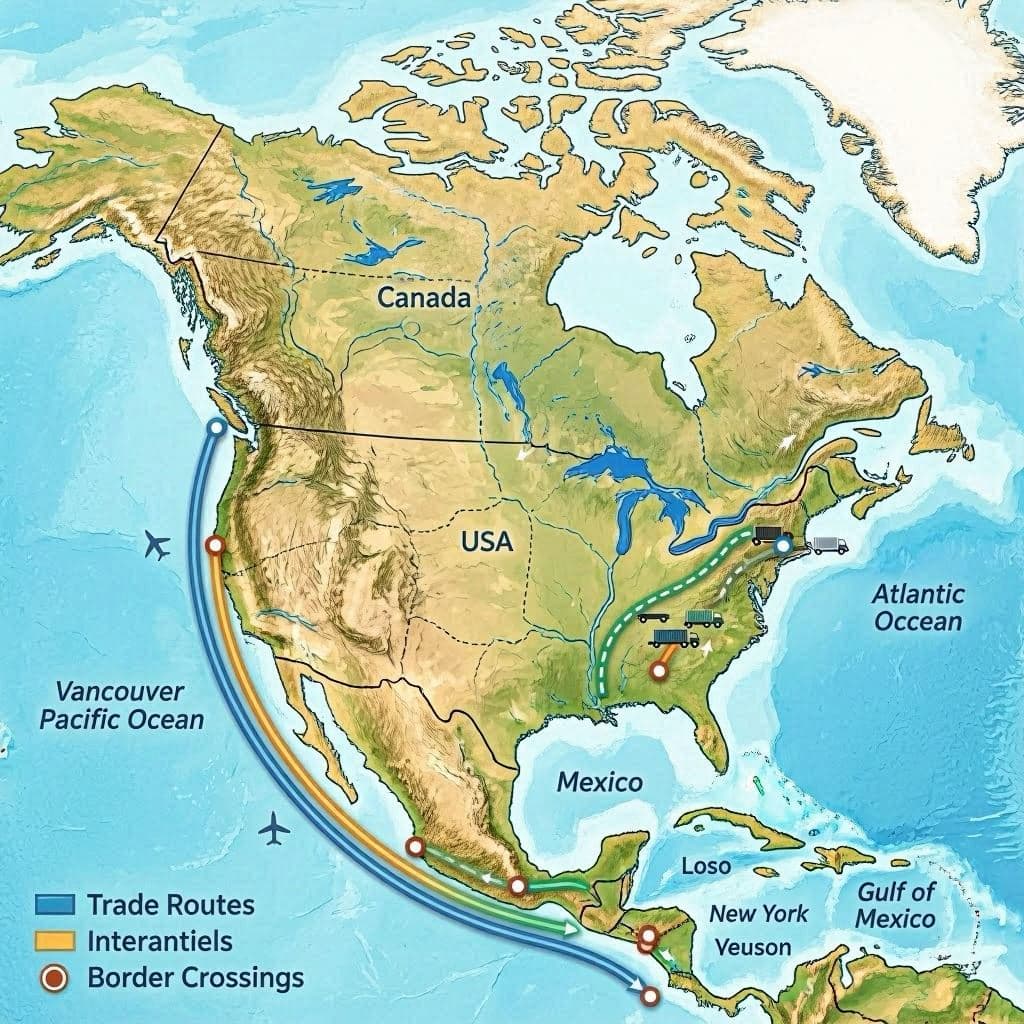
Like a clock whose hands begin moving toward a distant hour, the United States’ decision not to support renewal at the July 1, 2026 joint review sets in motion a steady, ten‑year countdown toward the North American trade agreement’s sunset in 2036. Under USMCA’s own rules, failure to agree on extension triggers annual reviews and a path toward final expiration unless consensus is reached before that date. The pact, which replaced NAFTA in 2020, carries a built‑in review cycle every six years and a hard end date 16 years from entry into force—July 1, 2036 . If no extension is confirmed this year, the parties shift to yearly consultations rather than locking in another 16‑year term; trade terms remain in force for now but operate under a lengthening shadow of uncertainty. Officials signal the U.S. stance reflects a desire to reopen certain chapters—especially automotive rules of origin, labor enforcement, and agricultural market access—rather than ending cooperation outright. Mexico and Canada have proposed renewals or incremental adjustments, warning that prolonged ambiguity discourages long‑horizon investments in cross‑border supply chains . Business groups note that industries built on just‑in‑time production and regional integration—automotive, electronics, and processed foods—are particularly sensitive to such uncertainty . Every delay or hesitation in clarifying the pact’s future adds friction to decisions about factories, parts distribution, and workforce training that take years to pay off. Trade economists explain that the decade‑long window is not a guarantee of stability, but a period of heightened caution. It allows time for negotiation, yet also creates a “wait‑and‑see” mindset that can slow efficiency gains and moderate growth in the $1.6‑trillion‑per‑year regional trade zone . Experienced trade negotiators observe that sunset clauses were meant to keep the deal modern and accountable, but without early agreement, they instead become a source of instability. The rhythm of annual reviews will now dominate policy discussions across Washington, Ottawa, and Mexico City until clarity emerges or the deadline draws near. Both supporters and critics of the agreement acknowledge that while the countdown begins now, the path remains open to change—renewal or revision could still occur at any point before 2036, though the longer the pause, the more costly and disruptive late‑stage fixes may be. For now, the message is clear: USMCA continues, but the clock is visibly ticking, prompting governments and firms alike to plan with both flexibility and care. AI Image Disclaimer: Visuals are AI‑created conceptual illustrations; not official trade‑document graphics or exact event photographs. Sources: U.S. Trade Representative, Congressional Research Service, MUFG Americas, TariffCenter.ai, Reuters
Note: This article was published on BanxChange.com and is powered by the BXE Token on the XRP Ledger. For the latest articles and news, please visit BanxChange.com