
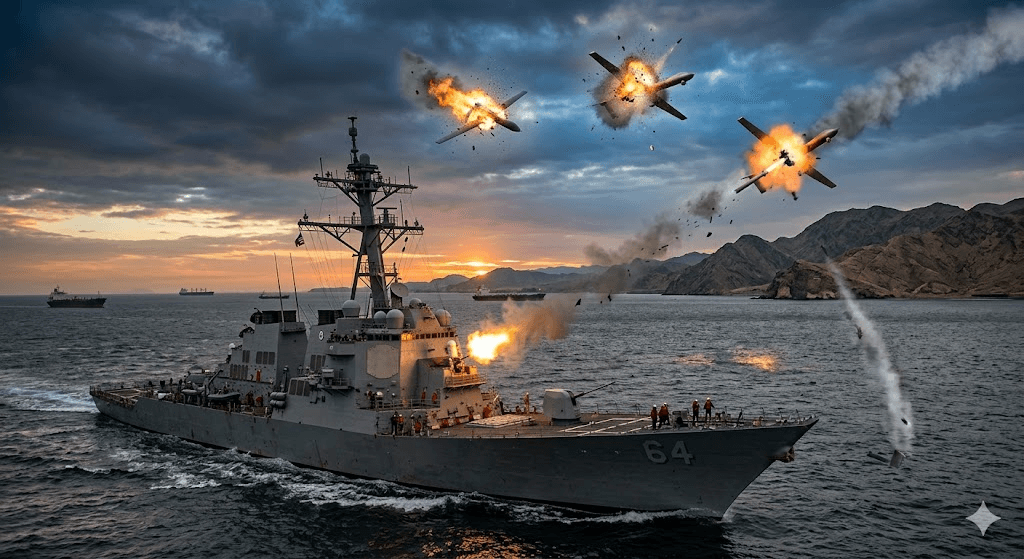
WASHINGTON — The fragile, seven-week-old ceasefire between the United States and Iran suffered a severe rupture overnight as American forces shot down four Iranian one-way attack drones near the strategically vital Strait of Hormuz. The high-stakes military engagement quickly escalated into a series of tit-for-tat strikes, threatening ongoing diplomatic efforts to end the three-month-old conflict.
According to U.S. Central Command (CENTCOM), the incident began when Iran deployed a cluster of "kamikaze" attack drones that posed an immediate threat to American military forces and commercial maritime shipping lanes in the Gulf.
U.S. forces successfully intercepted and destroyed four of the drones in mid-air. Acting on intelligence that the threat was not yet neutralized, the U.S. military immediately launched a retaliatory, surgical airstrike targeting a ground control station east of the southern Iranian port city of Bandar Abbas. U.S. officials confirmed the strike effectively prevented the launch of a fifth drone.
"These actions were measured, purely defensive, and intended to maintain the ceasefire," a U.S. official stated, speaking on the condition of anonymity.
Iranian state media reported that explosions were heard near the Bandar Abbas airport close to midnight, which prompted the brief activation of local air defense systems.
The skirmish did not stop at the Iranian coastline. Hours after the U.S. airstrike, Iran's Islamic Revolutionary Guard Corps (IRGC) retaliated by launching a ballistic missile toward a U.S. military airbase in Kuwait, where they claimed the American drone-hunting mission had originated.
Kuwaiti air defense forces successfully intercepted the incoming ballistic missile, preventing any casualties or infrastructure damage. CENTCOM sharply condemned the move, labeling the missile launch an "egregious ceasefire violation by the Iranian regime". The Kuwaiti Ministry of Foreign Affairs similarly denounced the "criminal Iranian attacks" for violating its national sovereignty.
The IRGC, meanwhile, accused the U.S. of firing first and warned of a much heavier response if American actions continued. "This response is a serious warning so that the enemy knows aggression will not go unanswered," the IRGC said in an official statement.
This latest clash marks the second major flare-up in the Strait of Hormuz this week, following a Monday engagement where U.S. forces sank two Iranian vessels allegedly attempting to lay naval mines.
The surge in violence comes at a highly delicate time for international diplomats. Peace talks in Doha are actively attempting to secure a permanent end to the war—which began on February 28—and completely reopen the Strait of Hormuz to stabilize skyrocketing global oil prices. Following the overnight strikes, Brent crude futures jumped more than 2 percent, nearing $97 per barrel.
Negotiations remain heavily stalled over secondary complications, beginning with a financial and nuclear standoff as Iran demands the upfront release of $12 billion in frozen assets while the U.S. insists on immediate nuclear concessions. Additionally, the U.S. Treasury Department recently placed fresh sanctions on Tehran’s newly formed Persian Gulf Strait Authority, which the Trump administration condemned for attempting to extort global trade by charging transit tolls up to $2 million.
Finally, diplomatic tensions have spiked following the White House's forceful rejection of a draft memorandum broadcasted by Iranian state media claiming a joint pact had been reached, with officials calling the report a "complete fabrication."
While both Washington and Tehran publicly maintain that they wish to preserve the technical ceasefire framework, the reality on the water points to an increasingly volatile war of attrition.
Note: This article was published on BanxChange.com and is powered by the BXE Token on the XRP Ledger. For the latest articles and news, please visit BanxChange.com