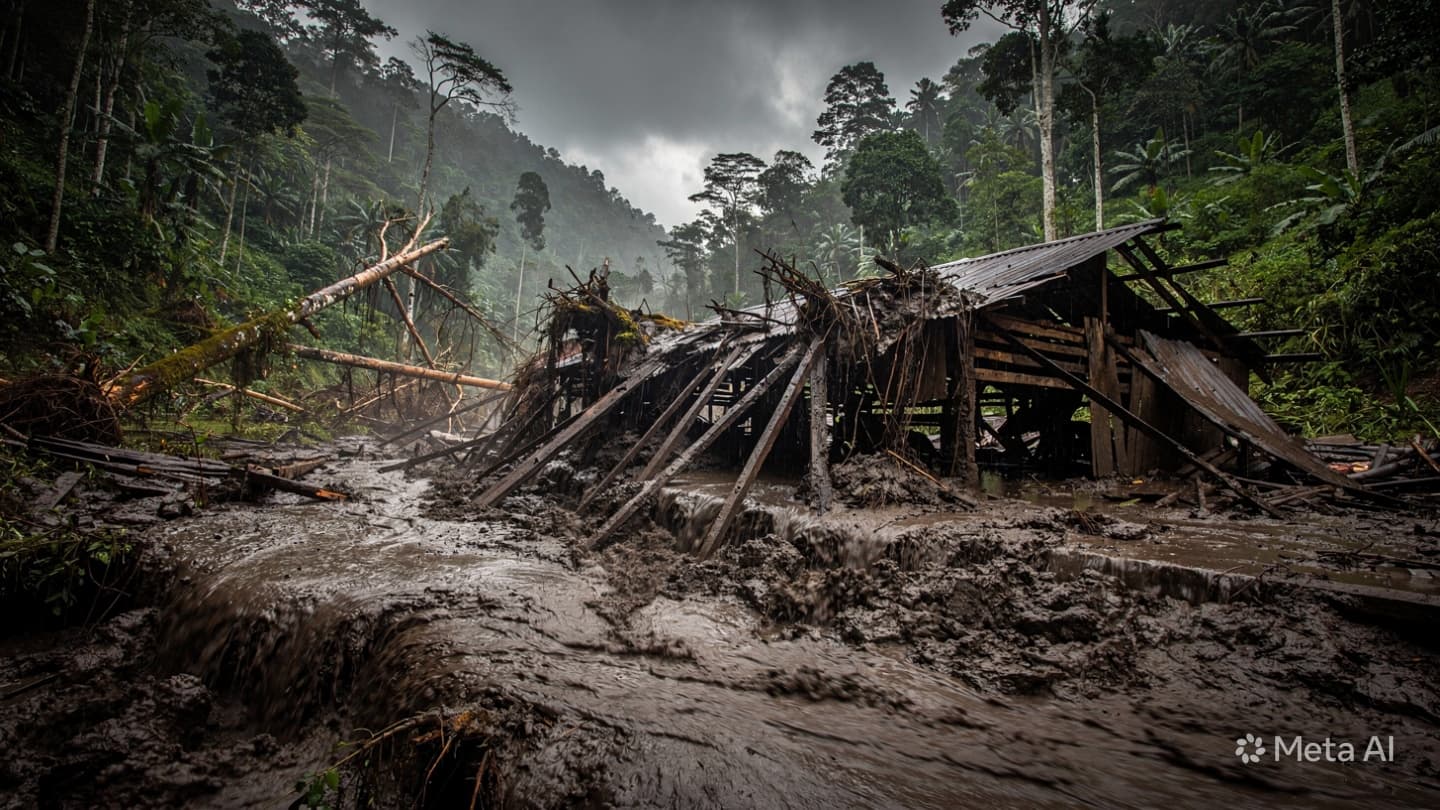
Miri, Malaysia—Torrential monsoon rains triggered a massive hillside collapse in a remote logging sector deep within the interior of Miri early Tuesday morning, burying a temporary dormitory structure and killing two timber workers. The landslide occurred around 2:00 a.m. while the camp personnel were asleep inside the plywood quarters. Millions of tons of saturated red earth and dislodged tree stumps sheared off the unstable slope, completely flattening the building within moments.
Other workers in the camp heard the loud roar of the sliding mountain and managed to escape their adjacent cabins before the mud reached them. They immediately began digging through the thick debris using shovels and bare hands in an attempt to reach their trapped colleagues. However, the density of the clay slurry and the continuous movement of the hillside made manual excavation extremely difficult in the dark.
The logging station is situated in a highly isolated valley accessible only by unpaved timber tracks, which were washed out by the same storm system that caused the slope failure. It took police and emergency medical teams from Miri over five hours to reach the site, as they had to clear multiple fallen trees and smaller mudslides along the route. By the time professional rescuers arrived, the two trapped workers had suffocated beneath the weight of the mud.
Recovery teams used chainsaws to cut through the splintered timbers of the crushed dormitory before they could safely extract the bodies of the deceased men. Authorities identified the victims as local citizens who had been employed as heavy machinery operators at the concession for the past three years. The remaining fifteen workers at the camp have been evacuated to a safer location down-river due to fears of secondary collapses.
The logging company operating the concession faced immediate questions from state safety inspectors regarding the placement of the staff quarters at the base of a heavily cleared slope. Environmental groups have long warned that aggressive timber extraction in northern Sarawak strips the hillsides of vital root networks, leaving the thin topsoil highly vulnerable to sudden failure during seasonal downpours. The company has declined to issue a formal statement while emergency operations conclude.
The Sarawak Fire and Rescue Department confirmed that the region has received over two hundred millimeters of rainfall within the last forty-eight hours alone, saturating the mountain terrain far beyond stable thresholds. Drone surveys conducted by the geological department indicate that several adjacent ridges are showing visible cracks, signaling an immediate threat of further mass movements if the rains persist.
Medical personnel at the scene examined the surviving camp workers for minor injuries and signs of shock before transporting them out of the forest zone. The remote camp has been officially cordoned off, and all logging operations within the sector have been ordered to halt indefinitely by the state resource ministry. The bodies of the deceased were transferred to the Miri General Hospital for formal autopsies.
Local community leaders expressed deep sadness over the incident, noting that industrial accidents in the deep interior often go unnoticed by urban centers until fatalities occur. They called for stricter enforcement of industrial housing codes for seasonal workers, arguing that temporary dormitories are routinely constructed in high-risk zones to minimize corporate operational costs.
The rain finally slowed to a light drizzle by Tuesday evening, allowing workers to secure the remaining heavy machinery and fuel tanks from being swept into the nearby river system. A small detachment of police officers remains at the logging site to secure the area and monitor the hillside for any sudden shifts overnight.
The local government has issued a general weather alert for all interior districts of Sarawak, warning residents near rivers and steep slopes to prepare for emergency evacuations as the monsoon front moves inland. The access track to the Miri logging sector remains highly unstable, with geologists declaring the valley unsafe for any permanent human habitation until the rainy season subsides.
Published by Banx Network. This article is part of the Banx decentralized media programme, powered by the BXE token on the XRP Ledger.