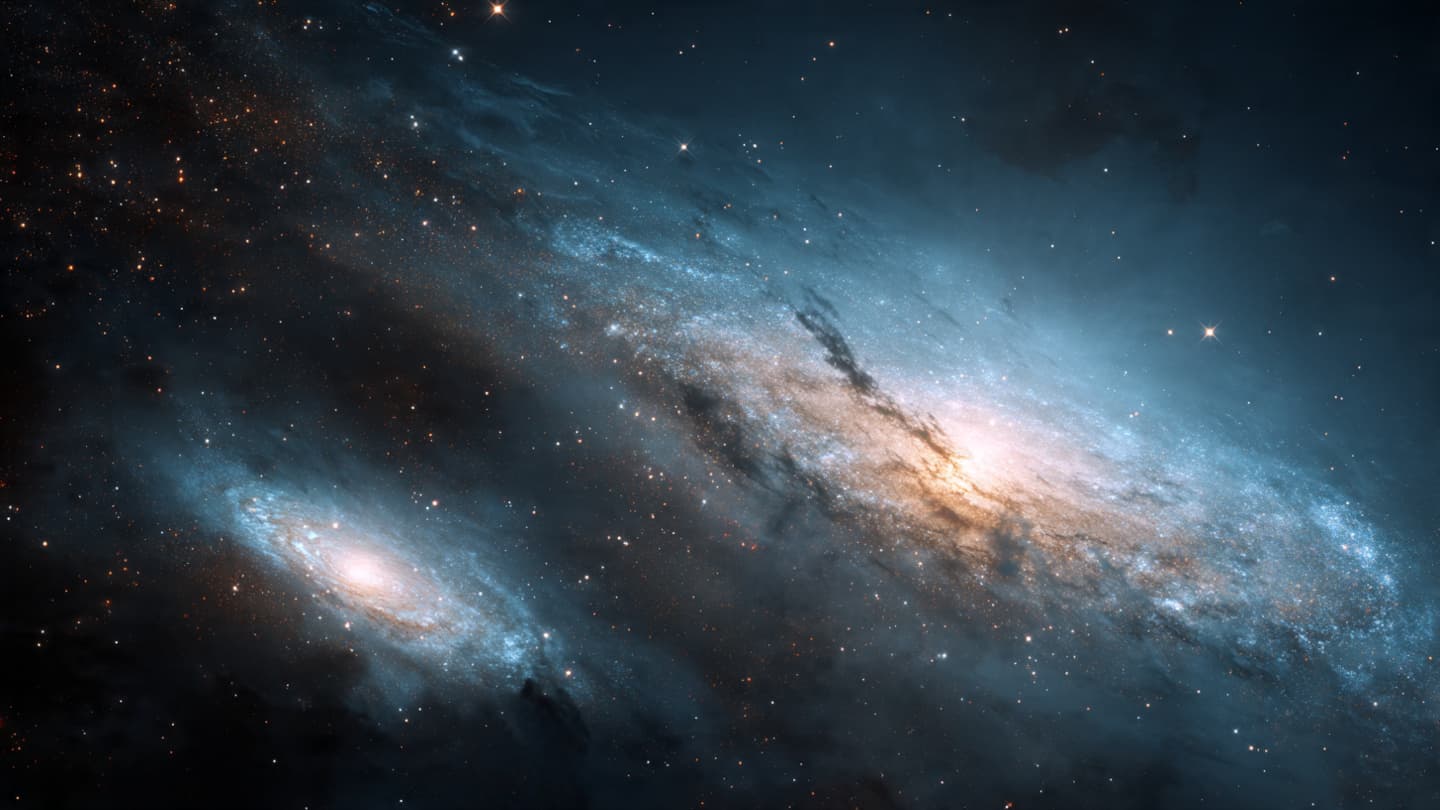
Galaxies often appear peaceful when viewed from Earth. Against the dark canvas of the night sky, they seem like distant islands of light, unchanged across human lifetimes. Yet beneath that calm appearance, gravity continuously reshapes the universe, guiding encounters that unfold over millions and billions of years.
New research suggests that the Large Magellanic Cloud, one of the Milky Way’s closest galactic neighbors, is gradually pulling apart its smaller companion, the Small Magellanic Cloud. The findings reveal a dramatic example of gravitational interaction occurring relatively close to our own galaxy.
The Large and Small Magellanic Clouds are dwarf galaxies that orbit near the Milky Way. Visible from the Southern Hemisphere, they have long served as important laboratories for astronomers studying galaxy formation and evolution.
Using more than a decade of observations from the VISTA Survey of the Magellanic Clouds, researchers tracked the motions of millions of stars inside the Small Magellanic Cloud. Their analysis revealed that many stars are moving outward rather than following the orderly rotation once assumed.
Scientists found that these stellar motions align closely with the direction of the Large Magellanic Cloud. The pattern strongly suggests that tidal forces generated by the larger galaxy are stretching and disrupting its smaller neighbor.
The findings challenge earlier interpretations that treated the Small Magellanic Cloud as a rotating system. Instead, gravitational disturbances appear to dominate its internal dynamics. Researchers describe evidence of large-scale tidal expansion occurring throughout the galaxy.
Such interactions are not unusual in the universe. Galaxies frequently influence one another through gravity, exchanging material, triggering star formation, and altering their structures over time. The Magellanic Clouds offer a nearby example of these broader cosmic processes.
The observations may also help scientists better understand conditions that were common in the early universe, when smaller galaxies interacted and merged more frequently than they do today. By studying nearby systems, astronomers gain clues about the evolution of galaxies across cosmic history.
The study concludes that the Small Magellanic Cloud is undergoing significant gravitational disruption from its larger companion. While the process unfolds over immense timescales, it provides researchers with a rare opportunity to observe galactic transformation in progress.
AI Image Disclaimer: This visual is AI-generated and designed to illustrate the astronomical concepts discussed in the article rather than depict a direct observation.
Sources Verified Space.com EarthSky Astronomy & Astrophysics
Published by Banx Network. This article is part of the Banx decentralized media programme, powered by the BXE token on the XRP Ledger.