The outer reaches of the solar system have long resembled a library filled with unopened books. Each new observation turns another page, revealing unfamiliar chemistry and unexpected connections between distant worlds. Recent findings from the James Webb Space Telescope have added yet another intriguing chapter.
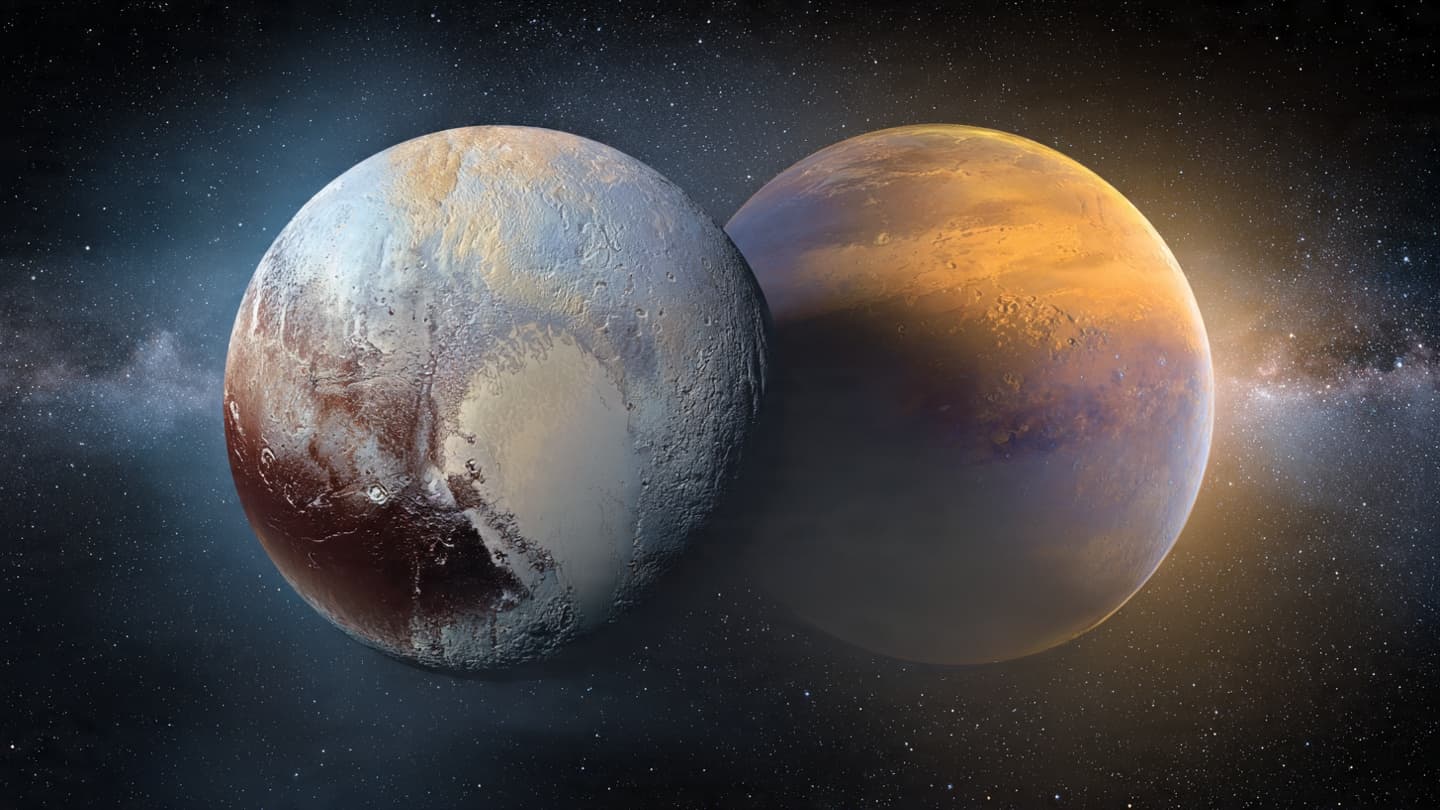
Scientists analyzing observations from NASA's James Webb Space Telescope have identified an unexplained spectral signature on both Pluto and Saturn's moon Titan. The mysterious absorption feature, detected at a wavelength near 5.11 micrometers, may originate from material present on the surfaces of these icy worlds.
Researchers were surprised to find remarkably similar chemical fingerprints on two bodies separated by vast distances and possessing very different environments. Titan is enveloped by a thick nitrogen-rich atmosphere, while Pluto possesses a far thinner atmosphere and resides in the distant Kuiper Belt.
The feature was detected using Webb's highly sensitive spectroscopic instruments. By comparing observed spectra with existing laboratory measurements of known compounds, researchers determined that none of the currently cataloged substances provided a satisfactory match.
Because the compound remains unidentified, scientists have suggested several possible explanations, including unusual forms of organic material or previously unrecognized combinations of frozen chemicals. Further laboratory studies will be necessary before a definitive identification can be made.
The discovery highlights the growing capabilities of the James Webb Space Telescope, which has allowed astronomers to examine distant planetary surfaces with unprecedented precision. Such observations are expanding knowledge about the chemistry and evolution of icy bodies throughout the solar system.
Researchers caution that the finding does not yet confirm the existence of an entirely new compound. Instead, it identifies a spectral feature that has not been successfully matched to known laboratory data, leaving room for future investigation.
As scientists continue to study Pluto and Titan, the mysterious signature serves as a reminder that even familiar members of our cosmic neighborhood can still surprise us.
AI Image Disclaimer: Visuals used with this article are AI-generated and are intended for illustrative purposes only.
Sources (verification check): arXiv, Astrobiology Magazine, NASA, James Webb Space Telescope research teams
Published by Banx Network. This article is part of the Banx decentralized media programme, powered by the BXE token on the XRP Ledger.