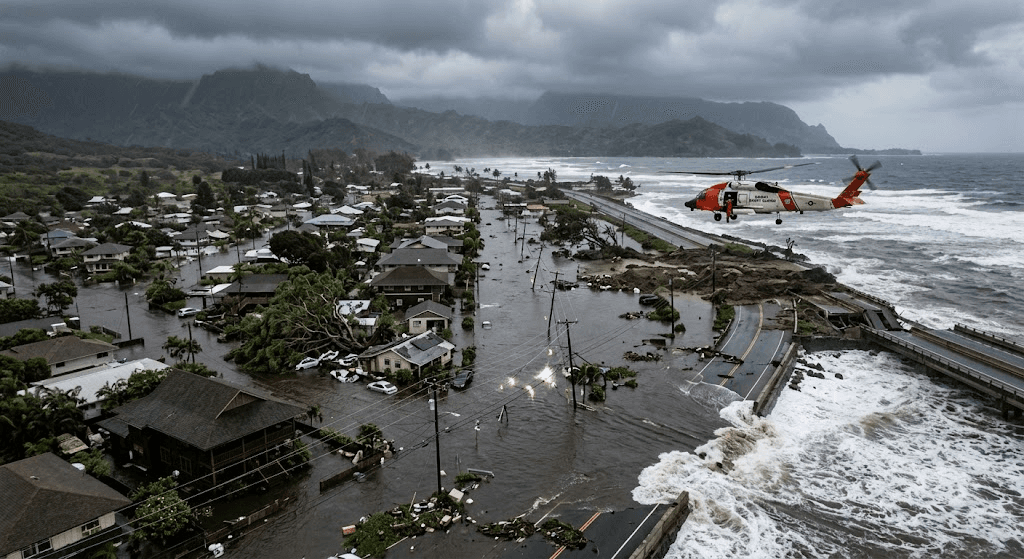
HONOLULU — Tropical Storm Lala unleashed severe weather across the Hawaiian archipelago, leaving over 180,000 customers without electricity, causing widespread flash flooding, and damaging at least 100 homes. Although the system weakened after brushing past the Big Island as a Category 1 hurricane, its relentless rain bands and gale-force winds caused massive infrastructure damage across multiple islands.
The storm brought torrential downpours exceeding 30 inches in certain high-altitude regions. Fast-moving floodwaters swept away residences in coastal communities like Naalehu, prompting dramatic emergency rescues by local responders and the National Guard. Rushing water, fallen trees, and mudslides tore through major roadways, collapsing bridge sections and briefly isolating thousands of residents.
The state’s infrastructure suffered its most immediate blow through severe damage to the power grid, as heavy wind gusts topping 100 mph at Mauna Kea downed main transmission lines and utility poles across the region. Oahu bore the heavy burden of these blackouts, with over 130,000 homes and businesses losing electricity while emergency responders in Honolulu fielded more than 600 calls regarding fallen trees and structural damage.
Meanwhile, the Big Island saw nearly 70% of its customers lose power, forcing critical infrastructure—including three regional hospitals—to run on backup generators, while Maui and Kauai faced significant power disruptions, widespread road closures, and localized flash flooding.
Hawaii Governor Josh Green confirmed that while damage to housing and infrastructure is extensive, emergency teams have been deployed statewide to clear roadways and restore basic utilities. Hawaiian Electric crews continue working through hazardous conditions to repair destroyed lines, though officials warned that remote rural areas should prepare for extended multi-day blackouts.
State emergency management agencies continue urging residents to remain off damaged roads while repair crews work, citing persistent hazards from exposed power lines, unstable terrain, and residual floodwaters.
Community leaders and local relief organizations have already begun setting up temporary shelters and distributing emergency food supplies to families displaced by the storm. As weather conditions slowly stabilize, state officials emphasize that community cooperation will be vital to ensuring a swift and safe recovery process.
Note: This article was published on BanxChange.com and is powered by the BXE Token on the XRP Ledger. For the latest articles and news, please visit BanxChange.com