
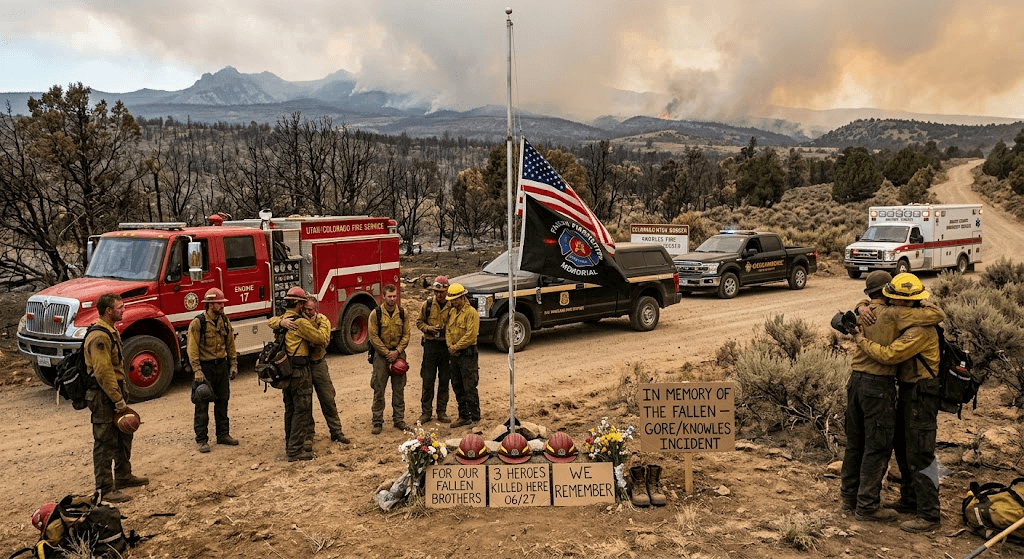
BEAVER, UTAH — Extreme wildfire conditions across the American West have turned catastrophic. The newly formed U.S. Wildland Fire Service confirmed Sunday, June 28, 2026 that three firefighters were killed and two others injured on Saturday while battling out-of-control blazes along the Colorado-Utah border.
The fallen and injured crews were part of an intensive, multi-agency emergency response deployed While details regarding the identities of the victims and the exact circumstances of the incident are being withheld pending family notifications, the loss has devastated the wildland firefighting community.
The U.S. Wildland Fire Service—established earlier this year to streamline public land firefighting efforts—expressed profound sorrow in a joint statement with the USDA Forest Service: "The U.S. Wildland Fire Service stands united with the USDA Forest Service in grief and in our unwavering support for the loved ones left behind. Their bravery, dedication, and sacrifice will never be forgotten."
The tragic fatalities come as consecutive days of record-shattering heat, single-digit humidity, and erratic, gusty winds fuel an explosive start to the Western wildfire season.
The Cottonwood Fire, currently the region's largest active blaze located in southwest Utah, ballooned on Saturday to more than 144 square miles (373 square kilometers). The fire violently marched through steep canyons, destroying several summer cabins and damaging parts of a local ski resort.
Fire officials noted that tactical nightmares like sheer cliffs and mountainous terrain are severely hampering containment operations. Spokesperson Alyssa Mason highlighted that the rugged landscape makes it incredibly difficult to deploy heavy machinery like bulldozers or fire engines, forcing crews to rely heavily on grueling, manual ground efforts.
To minimize the risk of new infrastructure-ignited blazes under red flag conditions, utility companies like Rocky Mountain Power implemented precautionary blackouts, launching rolling safety power shut-offs across Beaver County and parts of northern Arizona.
The escalating situation has stretched national wildland firefighting capabilities to their absolute limits. Nationwide, nearly 3 million acres have already burned this year—surpassing the 10-year historical average.
In response to the unprecedented fire behavior and a record-low winter snowpack, Utah Governor Spencer Cox declared a statewide state of emergency and enacted a strict fireworks ban ahead of the July Fourth holiday, describing the immediate outlook as "bleak". Neighboring Colorado Governor Jared Polis followed suit on Saturday, declaring an emergency and officially activating the National Guard to assist overwhelmed local ground crews.
Published by Banx Network. This article is part of the Banx decentralized media programme, powered by the BXE token on the XRP Ledger.


