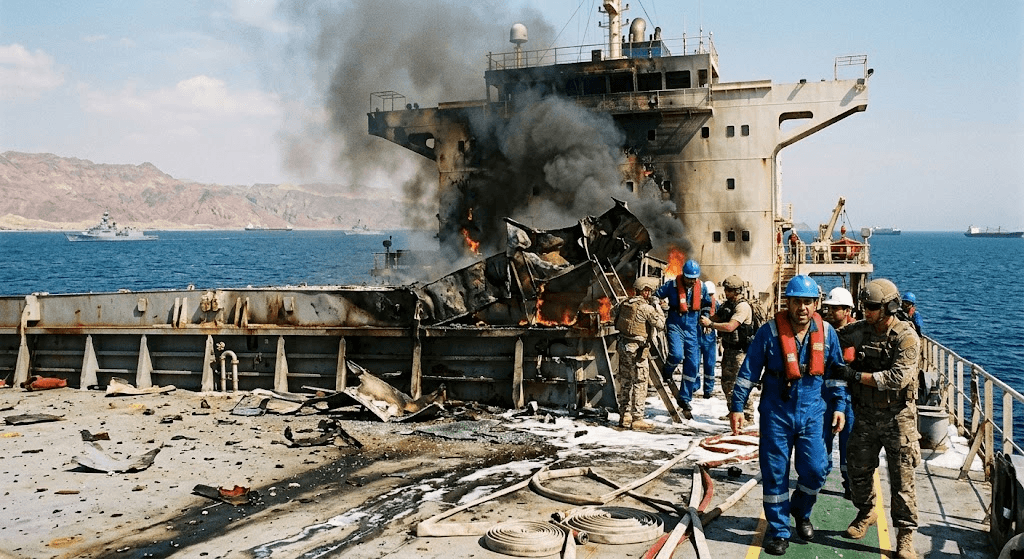
BAB EL-MANDEB STRAIT — Three crew members—two Pakistani nationals and one Indonesian—were killed on Tuesday, August 11, 2026 after a Houthi missile struck a commercial vessel in the Bab el-Mandeb Strait, according to a report by news outlet Al Hadath.
The fatal strike marks a sharp escalation in attacks targeting international maritime traffic passing through the critical sea lane connecting the Red Sea to the Gulf of Aden.
The missile struck the vessel's superstructure during transit through the narrow bottleneck, causing immediate structural damage and igniting a localized fire on board.
Emergency distress signals were transmitted shortly after the impact. Nearby naval assets deployed to assist the vessel confirmed that three crew members suffered fatal injuries during the blast.
The Bab el-Mandeb Strait remains one of the world's most critical choke points for global energy and containerized cargo traffic. Repeated missile and drone attacks in the corridor have forced multiple global shipping conglomerates to divert vessels around the Cape of Good Hope, adding thousands of miles and significant transport costs.
Diplomatic representatives from Pakistan and Indonesia are working with international maritime agencies to coordinate the recovery and repatriation of the deceased crew members' remains.
In response to the fatal strike, naval task forces operating in the region have heightened their patrol readiness and issued fresh security advisories to commercial vessels navigating the Red Sea transit corridor. International maritime security coalitions have urged shipping operators to exercise extreme caution, maintain continuous communication with regional monitoring centers, and implement enhanced onboard security measures when passing through high-risk zones.
The incident has also sparked sharp international condemnation, with several governments calling for immediate action to protect civilian mariners and safeguard freedom of navigation. Diplomatic officials emphasized that unprovoked attacks on neutral merchant vessels violate international maritime law and pose a direct threat to the stability of global supply chains already strain under elevated operational risks.
Meanwhile, industry analysts warn that the loss of life could drive up insurance premiums for vessels operating in the region, further compounding costs for global trade. As war-risk surcharges rise, more shipping lines may decide to avoid the Suez Canal route entirely, choosing instead the longer but safer path around the southern tip of Africa until stability in the Bab el-Mandeb can be assured.
Published by Banx Network. This article is part of the Banx decentralized media programme, powered by the BXE token on the XRP Ledger.