
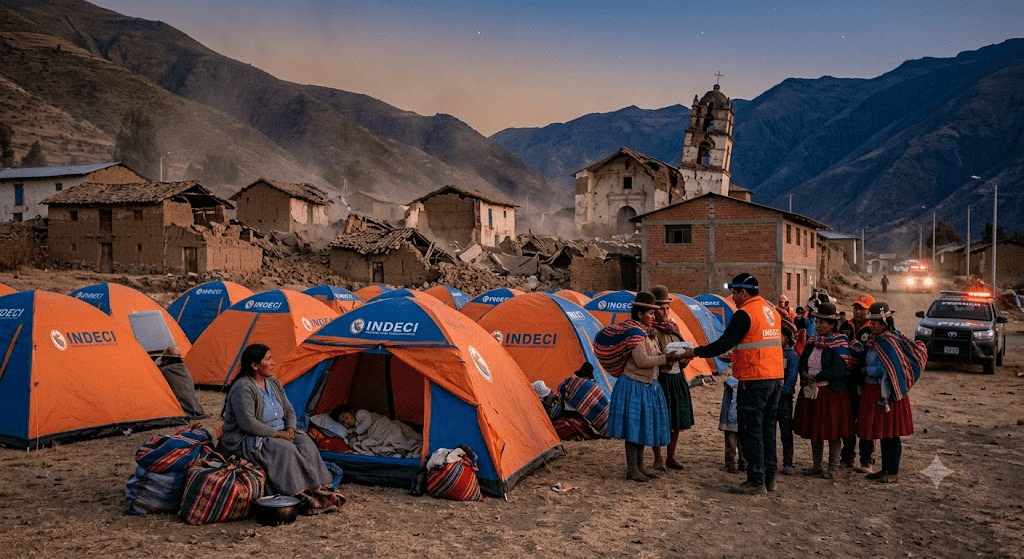
LIMA, Peru — A powerful 5.5 magnitude earthquake struck central Peru's Andes region late Saturday night, July 18, 2026 killing at least five people, injuring more than 20 others, and leaving around 300 residents displaced as homes crumbled across the mountainous terrain.
The disaster has triggered an urgent deployment of emergency teams as local authorities scramble to carry out search, rescue, and damage assessment operations.
According to the U.S. Geological Survey (USGS), the seismic event occurred at 9:24 PM local time on Saturday. The epicenter was traced to a location roughly 2 kilometers (1.24 miles) west-southwest of the city of Sicaya in the Huancayo province, part of the Junín region.
The 5.5 magnitude earthquake struck at a shallow depth of 10 kilometers (6.2 miles), causing intense surface shaking. The tremor was felt heavily across Huancayo, Concepción, Jauja, and numerous other settlements nestled throughout the Mantaro Valley.
Because the earthquake struck at such a shallow depth, the surface shaking was intense, amplifying the destruction of local structures and triggering immediate power outages across several districts. The hardest-hit area was identified as the agricultural district of Chongos Bajo, particularly within the Pumpunya area, where the fatalities were concentrated.
Luis Vásquez, head of the local civil defense office, explained to journalists that the predominant use of rustic adobe building materials in the Andean region contributed significantly to the high level of structural failure. Dozens of residential brick and mud homes collapsed completely, trapping people and livestock beneath the rubble.
Beyond residential properties, the tremor caused severe structural damage to several historic monuments and heritage sites. Among them was the historic "Santiago de León" church and former convent in Chongos Bajo, an architectural gem originally constructed in 1565.
Images from local media captured the immediate panic and grief as families huddled under blankets on the streets next to their severely damaged homes.
"My home has been destroyed," Hermenegilda Guamalato told a local radio station as she desperately sought temporary shelter for herself and her three children in a neighboring province.
Peru's National Civil Defense Institute confirmed that while relief operations have begun—providing emergency assistance and temporary shelters—the total number of missing individuals remains unknown as search and rescue teams continue sifting through the debris.
Earthquakes are a frequent hazard in Peru, which sits directly on the boundary of shifting tectonic plates within the volatile Pacific "Ring of Fire". The country is no stranger to seismic tragedy, with its worst recent disaster occurring in 2007 when a massive 7.9 magnitude earthquake devastated the Pisco province, killing nearly 600 people.
Engineers and emergency services remain on the ground checking roads, bridges, and compromised buildings before allowing displaced residents to return to the area.
Note: This article was published on BanxChange.com and is powered by the BXE Token on the XRP Ledger. For the latest articles and news, please visit BanxChange.com