
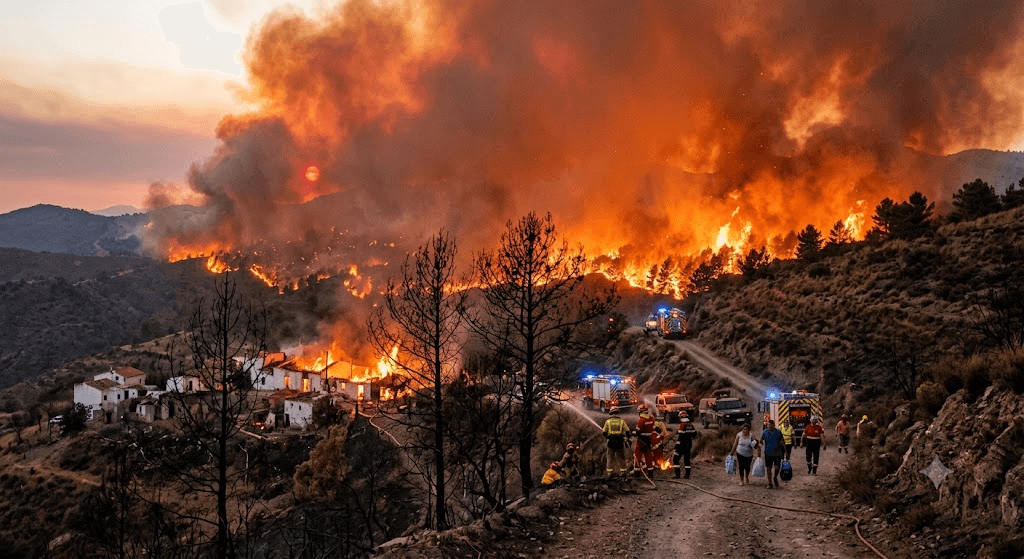
ALMERÍA, Spain — A fast-moving, ferocious wildfire fueled by an intense European heatwave has devastated a remote expat and tourist community in southern Spain, claiming the lives of at least 12 people. The inferno, labeled by local broadcasters as one of the deadliest Spanish wildfires of the 21st century, swept through the parched, rugged terrain of Andalusia, trapping victims as they tried to flee in panic.
The blaze erupted in a semi-arid area scarred by steep ravines near the Sierra de Los Filabres mountains in Almería province. Fanned by strong winds and fed by an abundance of dry undergrowth, the fire rapidly expanded to scorch over 3,800 hectares (9,390 acres), completely overwhelming local defenses.
Emergency responders faced horrific scenes as they pushed into the burnt-out disaster zones. Authorities confirmed that six of the victims were found in the hamlet of Bédar—four of whom perished inside a single vehicle—while six additional bodies were recovered in the neighboring Los Gallardos area.
According to Antonio Sanz, the regional minister for emergencies in Andalusia, a significant portion of the tragedy occurred because fleeing residents ignored official shelter-in-place instructions. In their rush to escape the advancing flames, several groups abandoned their cars to flee on foot or chose alternative routes.
"Some tried to escape via a dry riverbed," Sanz stated during a harrowing morning press briefing. "It turned out to be a real death trap."
Regional President Juanma Moreno noted that the victims were "badly burnt and unrecognizable," adding that the vast majority, if not all, of the deceased are believed to be foreign nationals. Among the dead are at least four suspected British citizens, identified because they were trapped inside a right-hand-drive vehicle.
Fires have broken out across southern Europe, but the disaster in Almería represents what scientists are calling a perfect storm of environmental dangers. Investigators believe the inferno may have been sparked initially by a fallen electric power pole. Once ignited, the flames encountered an environment primed for catastrophe.
Fire scientists note that a wet winter and spring caused a surge in vegetation, which a prolonged, multi-week summer heatwave then baked into highly flammable fuel. With local temperatures soaring past $42^\circ\text{C}$ ($107.6^\circ\text{F}$), the fire possessed extreme kinetic energy, moving too quickly for standard community alerts to protect the population.
As hundreds of firefighters and the Military Emergencies Unit (UME) battle to fully contain the remaining active flanks, the focus has shifted heavily toward search and rescue. At least 23 people remain officially unaccounted for, leaving families across Europe waiting in agony for news. More than 120 displaced residents have been relocated to emergency shelters in local theatres and cultural centers.
The tragedy has resonated at the highest levels of the state. The Spanish Royal Family publicly canceled ceremonial events out of respect, issuing a statement expressing their profound sadness and condolences to the families of the deceased. Meanwhile, forensic teams in Madrid are working urgently on DNA matching to formally identify the victims, as emergency services warn that the death toll could still rise as teams push deeper into the charred ravines.
Note: This article was published on BanxChange.com and is powered by the BXE Token on the XRP Ledger. For the latest articles and news, please visit BanxChange.com