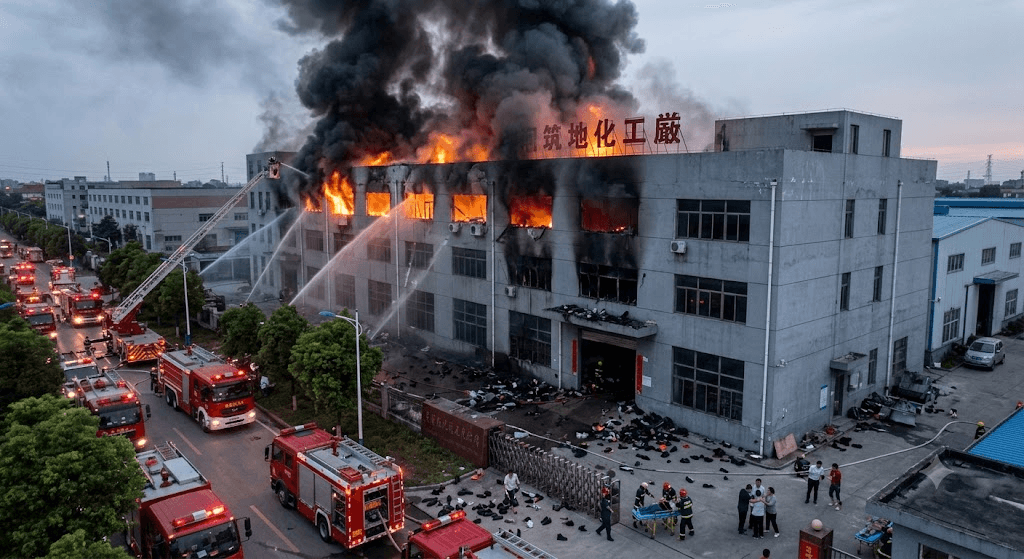
JINJIANG, China — A devastating fire tore through a shoe manufacturing plant in southeastern China’s Fujian province on Thursday, July 9, 2026 leaving 28 people dead and launching a massive emergency response. The incident highlights ongoing challenges with industrial safety standards in the region's dense manufacturing hubs.
The blaze broke out around 12:04 p.m. local time at a multi-story concrete factory operated by Huiteng Shoes Co., Ltd., located in Jiangtou Village within Chendai Township—a district widely recognized as the heart of Jinjiang, China's "shoe capital."
At the time the fire ignited, there were 237 factory workers and two external delivery personnel inside the facility. Preliminary investigations indicate that the fire originated on the ground floor, which housed both a workshop and a storage warehouse.
The ground floor was heavily stocked with highly flammable shoe-making components, including synthetic soles and industrial adhesives. These materials acted as an immediate accelerant, sending pungent, toxic black smoke billowing upward and engulfing the upper levels within minutes.
As the flames rapidly cut off primary exit routes, dramatic footage broadcast by state media showed several desperate workers trapped on the rooftop, surrounded by thick plumes of smoke, waving for assistance.
Local authorities deployed a massive rescue force, eventually totaling more than 500 emergency personnel. The initial response included 183 firefighters and 35 specialized vehicles dispatched from the nearby city of Quanzhou.
Firefighters faced significant structural obstacles upon arrival. According to a local fire department official interviewed by state broadcaster CCTV, a massive buildup of shoe sole materials had been piled directly into the building's stairwells. This blockage severely hindered rescue teams from advancing up the stairs to reach trapped individuals and fight the upper-level flames.
It took emergency crews approximately four hours to completely extinguish the open flames. While 213 people were successfully evacuated from the building, two succumbed to their injuries after emergency treatment failed at a local hospital. Following a grueling search through the charred remains, the remaining 26 missing persons were confirmed dead.
The disaster immediately caught the attention of China's top leadership. Chinese President Xi Jinping issued urgent directives demanding an all-out effort to support the victims' families and ordered a swift, thorough investigation. Pointing out a string of recent workplace safety incidents across the country, Xi emphasized that authorities must "strictly hold those responsible accountable."
Following the tragedy, local police and provincial authorities took swift punitive action. The owner and several corporate managers of Huiteng Shoes Co., Ltd. were immediately detained in police custody, and the company's corporate banking accounts were frozen. Additionally, the Fujian provincial government established five dedicated working groups to oversee the ongoing accident investigation, handle on-site recovery, and manage the aftermath.
The tragedy has renewed intense scrutiny over industrial safety enforcement in Jinjiang. The city produces roughly one billion pairs of athletic shoes annually—accounting for nearly 20% of global sports footwear output.
While official data from China’s Ministry of Emergency Management notes that workplace fatalities have technically decreased nationwide over the last year, enforcement gaps remain a critical hazard. The practice of using exit stairwells as overflow storage for highly toxic, combustible production materials—as seen in the Huiteng disaster—remains a widespread structural violation that safety campaigns have struggled to eradicate.
Published by Banx Network. This article is part of the Banx decentralized media programme, powered by the BXE token on the XRP Ledger.